
Reviewed · MULTI-DAY TOURS
Magically Smart Angkor Explorer _ 2-Day Private Tour
Angkor rewards a well-planned route. This two-day private tour brings together Cambodia’s essential temples, from delicate Banteay Srei to the giant galleries of Angkor Wat, while giving you an air-conditioned car and flexible pickup. I especially like the small private format for up to three people and the included bottled water and cool towels, useful comforts in Siem Reap’s heat. The main drawback is simple: there is no tour guide included, so historical explanations depend on your driver and your own preparation.
The route also reaches beyond the headline monuments. Banteay Samré, Pre Rup, and Preah Khan give you a better sense of Angkor’s size and variety, while village views add a little local context between temple visits. At $119 per group, the transport value is strong, but you must add the temple pass, meals, and any guide you arrange separately.
In This Review
- Key points to know before booking
- What the $119 private rate really buys you
- Day one begins with Banteay Srei’s pink sandstone
- Banteay Samré offers Angkor Wat style without the same scale
- Pre Rup brings warm brick and a temple mountain
- Preah Khan shows the scale of a royal religious center
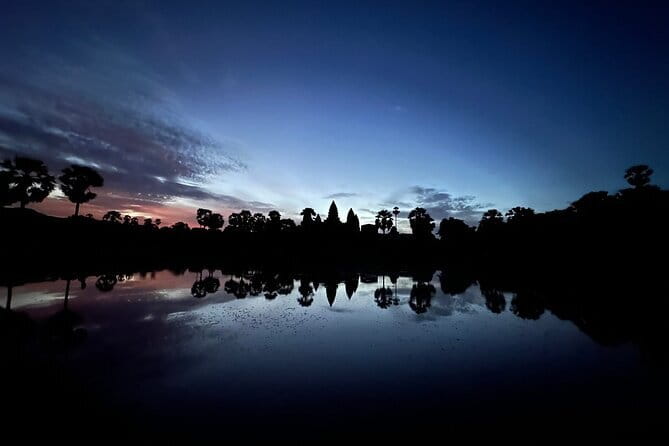
- Sunrise at Angkor Wat is the centerpiece of day two
- Ta Prohm keeps the jungle atmosphere
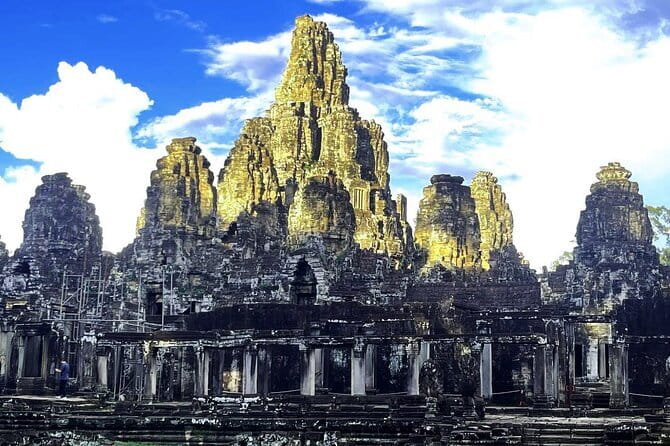
- Bayon’s stone faces give Angkor Thom its character
- Phnom Bakheng closes the trip with a sunset view
- Comfort matters more than it sounds in Siem Reap
- Who should book this Angkor route?
- Final booking advice
- FAQ
- How much does the private tour cost?
- Is the temple pass included?
- Is a tour guide included?
- What transportation is provided?
- Are water and towels provided?
- Which temples are visited?
- Can I cancel for a full refund?
Key points to know before booking
- Up to three people share one private tour price: The $119 rate covers the group, not each person, which can make the transport a good deal for a small party.
- The itinerary mixes famous and quieter temples: Angkor Wat, Ta Prohm, and Bayon provide the big moments, while Banteay Samré and Preah Khan add useful variety.
- Banteay Srei requires extra driving: It is about 40 kilometers from town, but its pink sandstone and fine carvings make the journey worthwhile for many temple fans.
- No temple guide is included: You receive an English-speaking driver, not a dedicated guide, so bring reading material or hire a guide separately if detailed interpretation matters to you.
- Sunrise and sunset shape the two days: Angkor Wat is scheduled for sunrise, and Phnom Bakheng for sunset, giving the tour two memorable light-filled bookends.
- The temple pass costs extra: Admission is listed at $37 per person per day, separate from the tour price.
What the $119 private rate really buys you
The price covers private transportation, hotel pickup and drop-off, an air-conditioned vehicle, bottled water, cool hand towels, and an experienced English-speaking driver. For a group of three, the transport portion works out to about $39.67 per person before temple admission. For one person, the same rate is less economical, but the private setup still offers comfort and a personal vehicle.
The value comes from covering a lot of ground without sharing a bus with a large group. Angkor Archaeological Park is spread across a wide area, and the first day includes a trip to Banteay Srei, about 40 kilometers from Siem Reap. An air-conditioned car matters here. You can cool down between the stone sites instead of spending every minute in the open heat.
The driver speaks English and handles the driving, pickup, and drop-off. That is useful, but you should understand the limits of the arrangement. A driver can help you move smoothly from place to place, yet the tour does not include a trained temple guide. If you want detailed help with religious symbolism, architectural terms, and Khmer history, arrange a guide separately or prepare before you go.
You also pay for meals yourself. No meal plan is included, which leaves you free to choose what suits your budget and appetite, but you will need to plan those breaks with your driver.
More multi-day routes in Siem Reap:
- Siem Reap: Angkor Wat 2-Day Tour with Sunrise and Sunset
★ 4.9 · 4,429 reviews - Angkor 2-Day Sunset & Sunrise Small-Group Tour
★ 5.0 · 2,567 reviews - Siem Reap: Angkor Sunrise 1- or 2-Day Guided Temples Tour
★ 4.9 · 1,132 reviews
Day one begins with Banteay Srei’s pink sandstone
Banteay Srei is the most distant stop and one of the most visually delicate. Built in the 10th century and consecrated in 967, this Hindu temple was dedicated to Shiva. Its name is often translated as Citadel of Women or Citadel of Beauty, and its smaller scale gives it a different feel from the huge royal monuments closer to Siem Reap.
The stone is pink sandstone, and the carvings are unusually fine. Look closely at the decoration around the doorways and towers. The detail is the reason this temple deserves the long drive. Banteay Srei was commissioned by two courtiers, Yajnavaraha and Vishnukumara, rather than by a king. That detail gives you a glimpse of how influential officials could be in ancient Khmer society.
The scheduled visit lasts about one hour. That is enough for a focused look, though you may want more time if you enjoy photography or architectural detail. Admission is not included, and the temple pass is paid separately.
The practical catch is the distance. You spend more time in the car than you would on a route made only of central Angkor temples. I think the trade is worthwhile for anyone who cares about carvings, but visitors focused only on the most famous monuments may prefer a shorter route.
Banteay Samré offers Angkor Wat style without the same scale
Banteay Samré sits about 400 meters east of the East Baray and dates mainly to the early 12th century. It is a Hindu temple built in the Angkor Wat style, with a single tower connected to other sections of the complex.
The design has similarities to Thommanon and Chau Say Tevoda, but Banteay Samré feels like a separate stop rather than a quick copy. Its name refers to the Samré, an ancient people of Indochina. The temple was restored by Maurice Glaize between 1936 and 1944, an important detail to keep in mind when you look at its repaired stonework.
You have about one hour here. That makes the stop easy to fit into the first day, especially after the longer drive to Banteay Srei. I like the pairing because Banteay Srei gives you intricate pink sandstone, while Banteay Samré gives you a more compact example of the Angkor Wat architectural approach.
Again, admission is extra. The itinerary does not specify a separate guide at either temple, so your experience will be stronger if you know a little about the layout before arriving.
Pre Rup brings warm brick and a temple mountain
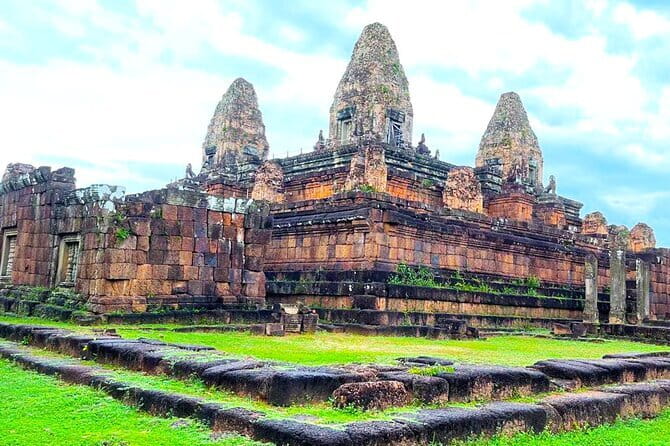
Pre Rup was built in 961 or early 962 as the state temple of King Rajendravarman. It is a temple mountain made from brick, laterite, and sandstone. The brick and laterite give the monument a reddish tone, especially in early or late sunlight.
The name Pre Rup means turn the body. Local belief connects the temple with funerary rituals in which a body’s ashes were rotated in different directions. That association adds a solemn layer to the site, though the temple is also valued for its strong geometry and broad upper levels.
Your visit lasts about 45 minutes. This is the shortest scheduled stop on day one, so expect a brisk look rather than a slow exploration. The placement is sensible: after the more detailed carving at Banteay Srei and the enclosed form of Banteay Samré, Pre Rup gives you a bold, upward-looking structure.
The site can be physically demanding because temple mountains involve steps and raised levels, but the supplied information does not give specific accessibility details. If stairs are a concern, ask the operator before booking.
A few more options around Siem Reap worth reading up on
- Angkor Wat Sunrise or Sunset Tour with Guide from Siem Reap
★ 5.0 · 12,109 reviews - Siem Reap: Angkor Wat: Small-Group Sunrise or Sunset Tour
★ 5.0 · 9,444 reviews - From Siem Reap: Kampong Phluk Floating Village Tour by Boat
★ 4.9 · 6,979 reviews - Sunset tour of Kampong Phluk stilts home village on the Tonle Sap
★ 5.0 · 4,865 reviews
Preah Khan shows the scale of a royal religious center
Preah Khan, meaning Royal Sword or Holy Sword, was built in the 12th century by King Jayavarman VII to honor his father. It was constructed on the site connected with the king’s victory over the invading Chams in 1191.
The temple has a flatter design than Pre Rup, with rectangular galleries arranged around a Buddhist sanctuary. It was not simply a place for short ceremonies. Preah Khan functioned as a large organization with almost 100,000 officials and staff connected to it, according to the historical description provided for the site.
That fact changes the way you read the corridors. You are not just looking at carved stone. You are seeing part of a religious and administrative center that once supported a large community.
The planned visit is one hour. Preah Khan is a good final stop for day one because its galleries offer a different experience from the open temple mountain at Pre Rup. You can compare the two architectural forms without needing another distant drive.
Sunrise at Angkor Wat is the centerpiece of day two
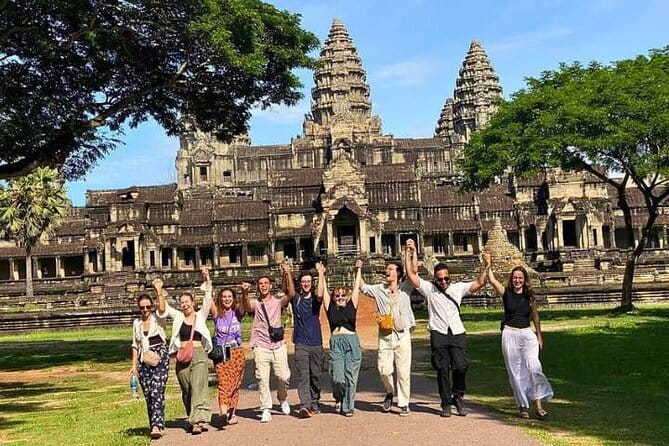
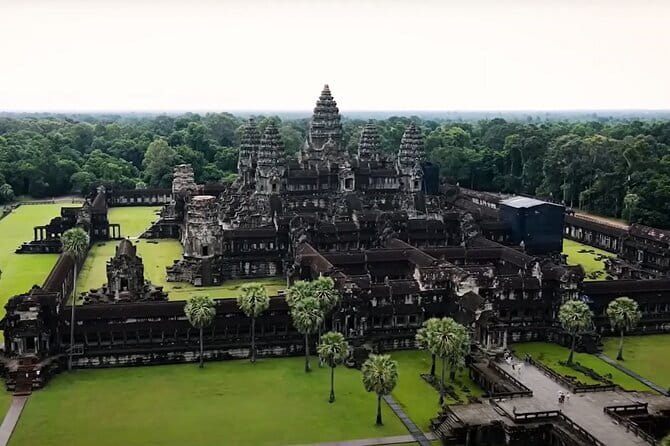
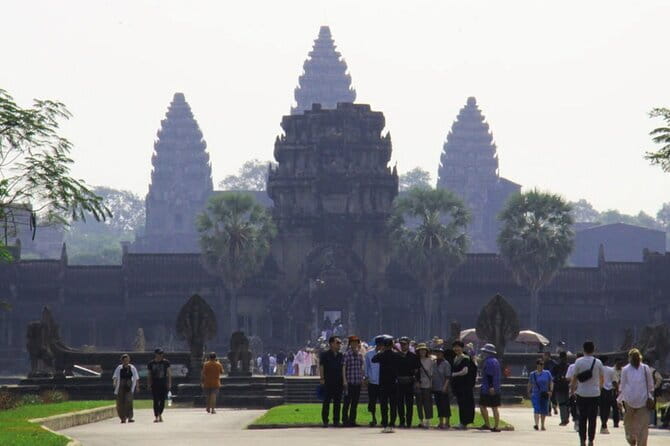
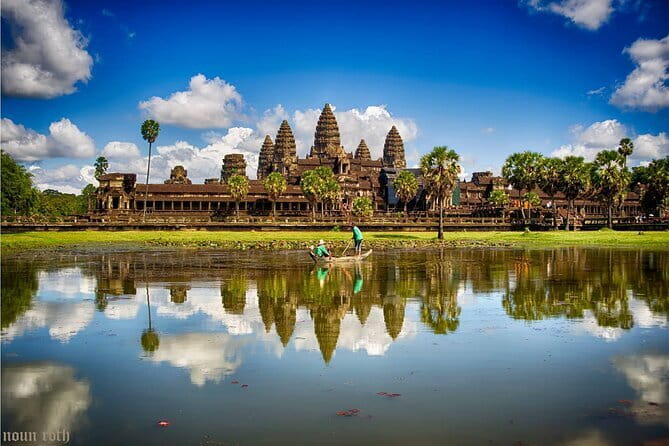
Day two begins with Angkor Wat and a scheduled visit of about three hours. Built by King Suryavarman II in the early 12th century, the complex was dedicated to Vishnu and later became a Buddhist temple. It served as both a state temple and a royal mausoleum.
Angkor Wat covers about 162.6 hectares, or roughly 402 acres. That size explains why three hours is useful. You are not making a quick photo stop. The complex combines the temple-mountain form with long galleries, creating a progression from broad outer spaces to more concentrated sacred areas.
The design represents Mount Meru, the mythical home of the gods. Even without a guide, you can appreciate the careful alignment, towers, galleries, and carved surfaces. With a guide, you would receive more help understanding the religious changes from Hindu worship to Buddhism and the meaning of the temple’s plan.
The sunrise timing is one of the tour’s biggest draws, but the description does not state the exact pickup hour or how long you wait before sunrise. Confirm those details with the operator. You should also confirm how the two-day temple admission will be handled, since the listed $37 daily pass is not part of the package.
Three hours can pass quickly. If you prefer a slow photographic visit, you may find the schedule tight, especially when you account for the early start and the size of the complex. Still, the tour gives Angkor Wat the longest visit of the trip, and that is the right priority.
Ta Prohm keeps the jungle atmosphere
Ta Prohm was built in the 12th century during the reign of Jayavarman VII. Its original name was Rajavihara, meaning Royal Monastery, and it served as a Mahayana Buddhist monastery and learning center dedicated to the king’s mother.
The temple is known for its partly unrestored appearance, with jungle growth intertwined with the stone structures. That setting gives Ta Prohm a more dramatic mood than the orderly galleries of Angkor Wat. You see a monument where vegetation and masonry share the same space, rather than a site that feels fully cleared and formal.
The scheduled visit lasts one hour. That is enough to see the main character of the temple, but not necessarily every corner. Ta Prohm is a strong choice for you if atmosphere matters as much as architectural scale. It is also one of the places where having historical context helps, since the temple was part of a large royal foundation rather than an isolated ruin.
Bayon’s stone faces give Angkor Thom its character
Bayon sits at the center of Angkor Thom and served as the state temple of Jayavarman VII. Built in the late 12th or early 13th century, it was originally called Jayagiri, meaning Victory Mountain.
The famous feature is the collection of serene stone faces associated with the Buddha and possibly modeled on the king himself. These faces give Bayon an expression that differs sharply from the more formal, balanced presentation of Angkor Wat.
You have about one hour to see it. Use that time to look both upward at the towers and sideways at the carved bas-reliefs. The temple’s decoration records scenes connected with Khmer life, warfare, and royal power. The supplied information notes that Bayon represents a more baroque Khmer style, in contrast with Angkor Wat’s classical style.
The route places Ta Prohm before Bayon, which gives you a useful change of mood. Ta Prohm is known for trees and broken enclosure walls. Bayon is more concentrated and visually crowded, with its faces pressing into your view from every direction.
Phnom Bakheng closes the trip with a sunset view
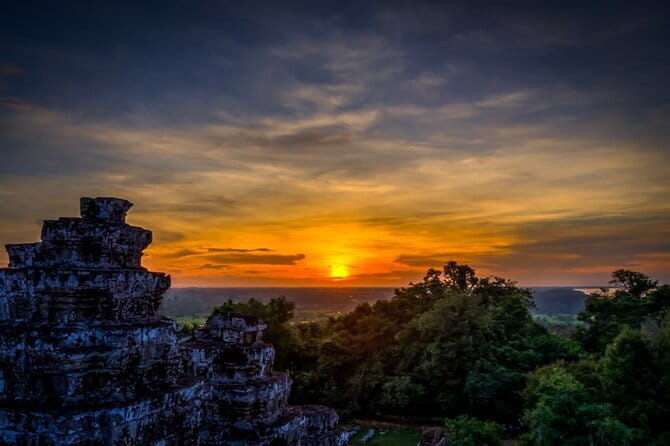
Phnom Bakheng was built at the end of the 9th century by King Yasovarman. It represents Mount Meru and sits on a hill about 65 meters above the surrounding plain.
The one-hour visit is scheduled for sunset. The height gives you broad views over the area, and the temple’s position is part of its meaning, not just a convenient lookout. The hilltop setting links the monument to Hindu ideas about the home of the gods.
This is a fitting end to two busy days. You have seen temples in several forms, and Phnom Bakheng gives you a final chance to look outward rather than at another enclosed gallery. The description presents the sunset as a major highlight, but exact sunset conditions naturally depend on the day and weather.
Ask about the practical timing in advance. The information provided confirms a one-hour stop, but it does not explain the exact walking arrangement or any access limits. The tour does not promise a private viewing area, so the main value here is the hilltop setting and the closing light.
Comfort matters more than it sounds in Siem Reap
The air-conditioned private vehicle is one of the most useful inclusions. Temple days involve repeated movement between hot outdoor sites, and the car gives you a place to cool down between stops. Hotel pickup and drop-off also remove the need to arrange separate transport each morning.
Bottled water and cool hand towels are small additions, but they suit this itinerary well. You will be outside for long stretches, especially at Angkor Wat, Ta Prohm, and Phnom Bakheng. The tour also promises convenient waiting for pickup and drop-off at your hotel.
The group limit is up to three people. That is a good fit for a couple, a family with one child, or a small group of friends who want to share a car without joining a larger party. Since the tour is private, only your group participates, which keeps the arrangement personal.
The itinerary is fairly full. You should not expect long unscheduled breaks, and meals are not included. If you like to move steadily through major sites, the pace makes sense. If you prefer sitting for long lunches or spending half a day at one temple, discuss changes with the operator before booking.
Who should book this Angkor route?
I would choose this tour if you want the main Angkor highlights in two days, prefer private transport, and value hotel pickup. It suits first-time visitors who want a clear route with sunrise and sunset built in.
It is also a good match for small groups. At $119 for up to three people, the transport cost is easier to justify when shared. The included water, towels, and air conditioning add practical value in a hot setting.
I would be more cautious if you need a dedicated historian or archaeologist. The package includes an English-speaking driver, but not a tour guide. It may also be less suitable if you want a slow, flexible temple schedule, since the days include several stops and a distant excursion to Banteay Srei.
The experience has a 5 out of 5 rating based on one submitted review, with the accompanying response from Khmer Temples & Nature thanking the customer for visiting Angkor Wat. That is positive, but one review is not enough to prove every part of the service will suit you. Treat the rating as an encouraging sign, then focus on the clear practical details: private transport, no included guide, separate admission, and a full two-day route.
Final booking advice
Book this tour if you want efficient private transportation and a well-chosen introduction to Angkor’s major temples. The combination of Banteay Srei, Preah Khan, Angkor Wat, Ta Prohm, Bayon, and Phnom Bakheng gives you variety instead of repeating one temple style.
Before paying, confirm the pickup time, the plan for sunrise at Angkor Wat, the sunset timing at Phnom Bakheng, and whether you want to arrange a separate guide. Remember that the temple pass costs $37 per person per day, and meals are not included.
Free cancellation is available with at least 24 hours’ notice. Changes or cancellations made within 24 hours are not accepted for a refund. That gives you some flexibility, but the local cutoff time applies.
FAQ
How much does the private tour cost?
The tour costs $119 per group of up to three people. Temple admission and meals are not included.
Is the temple pass included?
No. The temple pass is listed separately at $37 per person per day.
Is a tour guide included?
No. The package includes a friendly, experienced English-speaking driver, but it does not include a dedicated tour guide.
What transportation is provided?
You travel in a private air-conditioned vehicle. Hotel pickup and drop-off are included.
Are water and towels provided?
Yes. The tour includes bottled water and cool hand towels.
Which temples are visited?
Day one includes Banteay Srei, Banteay Samré, Pre Rup, and Preah Khan. Day two includes Angkor Wat, Ta Prohm, Bayon, and Phnom Bakheng.
Can I cancel for a full refund?
Yes, if you cancel at least 24 hours before the experience starts. Cancellations within 24 hours are not refunded, and changes within that period are not accepted.
Newest reviews from Siem Reap
- War Museum, Killing Field, and APOPO Hero RATs Tour★ 5.0 · 7 reviews
- Angkor Wat at Sunrise★ 4.0 · 7 reviews
- Siem Reap Angkor Airport Taxis (from Airport to Hotel)★ 5.0 · 44 reviews
- Short Cycling at Countryside★ 5.0 · 29 reviews
- Cambodian Cooking Class and Oxcart Ride with Local Village Tour★ 5.0 · 4 reviews
- Secret Temples of Angkor – Guided Tour in Siem Reap★ 5.0 · 6 reviews
- SIEM REAP E-BIKE HALF-DAY COUNTRYSIDE (25-30 km)★ 4.0 · 1 review
- Unveiling the Mystical Beauty of Phnom Kulen National Park★ 5.0 · 6 reviews
Multi-Day Tours, compared.
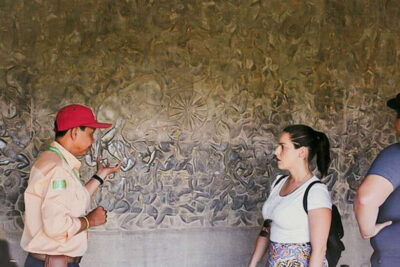
Angkor Wat 2-Day Tour with Sunrise and Sunset
Read our review →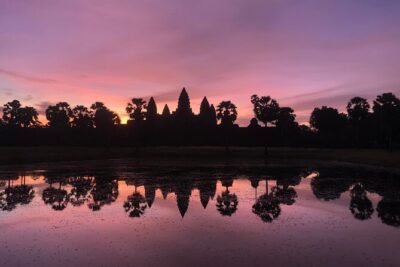
Angkor 2-Day Sunset & Sunrise Small-Group Tour
Read our review →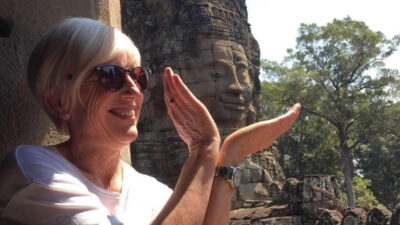
Angkor Sunrise 1- or 2-Day Guided Temples Tour
Read our review →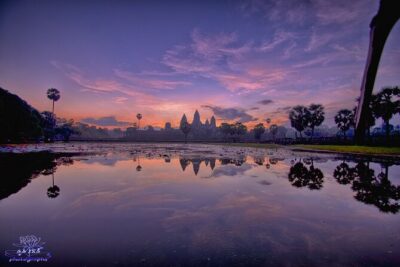
2-Day Angkor Wat With Small, Big Circuit and Banteay Srei Tour
Read our review →
2-Day Temple Highlights Sunrise and Sunset Option
Read our review →
Angkor Wat 2-Day complex Sun rise & Sun set with Guided Tour
Read our review →
2-Day Angkor Wat Tour with Banteay Srei and Floating Village
Read our review →
Browse the lists this tour appears in