
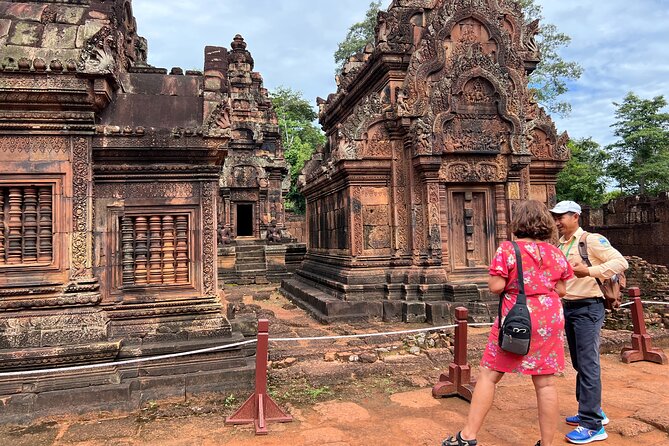
Reviewed · ANGKOR WAT TOURS
2-Day Angkor Wat and Banteay Srei with Countryside Exploration
Sunrise starts this temple adventure early. This two-day private tour pairs Angkor Wat at dawn with smaller temples, countryside stops, local meals, and a visit to the Landmine Museum. I like the mix of famous sights and quieter ruins, and I like that guides such as Sam, Sinan, Mony, Sareik, and Makara have been praised for clear explanations and friendly care. The main drawback is the pace: Day 1 begins around 4:30 or 5:00 am and can run until early afternoon, so you need stamina.
The $160 price is reasonable for two full days of air-conditioned transport, an English-speaking guide, breakfast, lunch, cold water, and towels. But you must add the $62 two-day Angkor pass, plus the $5 Landmine Museum ticket, making the basic cost $227 per person before extra drinks or other food.
In This Review
- Key things to know before you book
- Why two days work better than one long temple day
- Angkor Wat before sunrise, then breakfast at Srah Srang
- Pre Rup and Ta Prohm show Angkor’s changing moods
- Angkor Thom and Bayon put royal power on a giant scale
- Preah Khan begins a quieter second morning
- Eastern Mebon adds a brick-built change of pace
- Banteay Srei is the day’s finest carving stop
- The Landmine Museum adds essential modern context
- What the $160 price really covers
- Practical advice for a smoother two days
- Who will get the most from this temple tour?
- Should you book the two-day Angkor experience?
- FAQ
- Is hotel pickup included?
- Is the Angkor temple pass included?
- How much does the tour cost?
- Is this a private tour?
- What meals are included?
- Are vegetarian meals available?
- What should I wear?
- Does the tour provide transportation and refreshments?
- What is the cancellation policy?
Key things to know before you book
- Angkor Wat sunrise requires an early hotel pickup: Be ready in the lobby 15 minutes before a pickup between 4:30 and 5:00 am on Day 1.
- The two days cover very different temple styles: You see major monuments such as Angkor Wat and Bayon, then smaller sites including Ta Som, Neak Pean, and Banteay Srei.
- Breakfast is a local stop at Srah Srang: The meal supports a family-run restaurant and includes local food, with vegetarian choices available if requested ahead of time.
- The Angkor pass is a major extra cost: The required two-day pass costs $62 per person and is not included in the tour price.
- Banteay Srei is the artistic high point: Its small scale and fine sandstone carvings make it a welcome change from Angkor’s huge temple complexes.
- This is best for active sightseers: You will spend long hours walking, climbing temple steps, and moving between several sites in hot conditions.
Why two days work better than one long temple day
Angkor is too large for a quick checklist. A one-day visit can cover the biggest names, but you may spend much of that day rushing from one monument to the next. This tour spreads the major stops across two mornings and adds several outlying temples that are easy to miss if you stay near the central circuit.
The split also gives each day a different feel. Day 1 is the classic Angkor introduction: sunrise, Angkor Wat, Ta Prohm, Angkor Thom, and Bayon. Day 2 moves through the northern and eastern parts of the park before heading farther out to Banteay Srei and the Landmine Museum.
That said, this is not a slow, meditative retreat. The schedule is full. Day 1 starts before sunrise and may end around 1:00 pm, according to the experience of one party. You get a break afterward, but the morning demands an early night and sensible expectations.
The tour is described as private, meaning only your own group participates. It can also work for a very small party, and one booking had a day with only one participant. That is useful if you want to ask questions or adjust the rhythm within the planned route, although the listed stops still create a fairly fixed day.
More ways to see Angkor Wat:
- Angkor Wat Sunrise or Sunset Tour with Guide from Siem Reap
★ 5.0 · 12,109 reviews - Siem Reap: Angkor Wat: Small-Group Sunrise or Sunset Tour
★ 5.0 · 9,444 reviews - Siem Reap: Angkor Wat 2-Day Tour with Sunrise and Sunset
★ 4.9 · 4,429 reviews
Angkor Wat before sunrise, then breakfast at Srah Srang
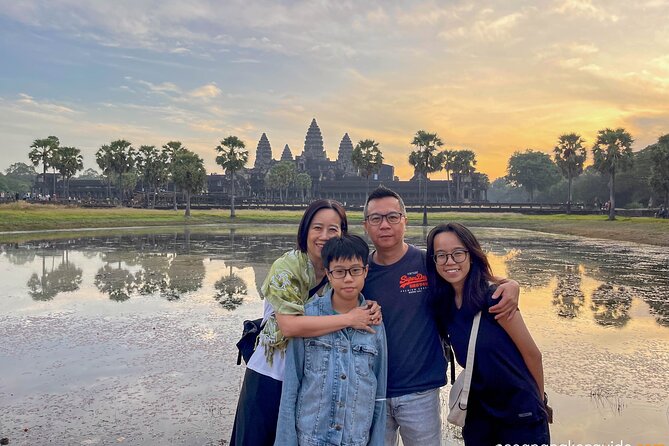
The first pickup is the hardest part of the schedule. You wait in your hotel lobby 15 minutes before the assigned time, between 4:30 and 5:00 am. Have your temple pass ready before the morning begins. The operator requires every participant to hold the pass before the tour starts, specifically so the sunrise visit is not delayed.
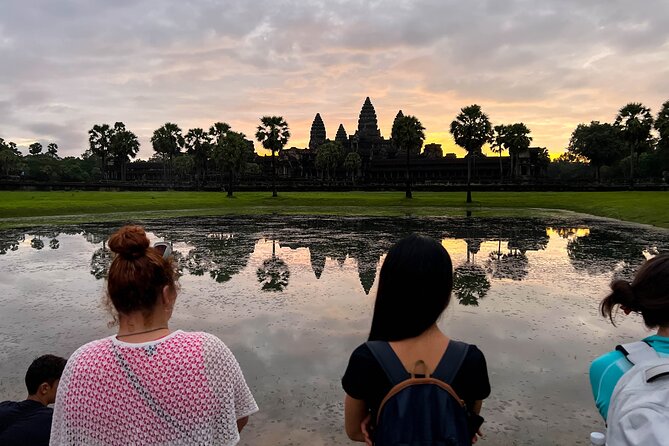
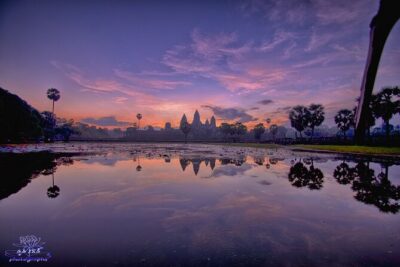
Angkor Wat is the natural opening act. It is the largest temple in the world and one of Cambodia’s most important cultural sites. In the half-light, the towers and reflection pool provide the familiar view many people come to Siem Reap hoping to see.
Your allotted time at Angkor Wat is about two hours. That gives you more than a quick photograph, though the early start and crowds around the most popular viewing areas can make the first part feel busy. Wear shoes you can walk in and carry only what you need.
After the temple, the group heads to Srah Srang for breakfast. This is one of the tour’s more appealing human touches. Rather than treating breakfast as a quick packaged stop, the experience uses a local family restaurant and includes local food. You also support a small business in Siem Reap.
Vegetarian food is available if you tell the operator in advance. Food and soft drinks beyond the stated meals are not included, so ask what is covered before ordering anything extra.
Pre Rup and Ta Prohm show Angkor’s changing moods
After breakfast, the route continues to a village and local market before reaching Pre Rup. This tenth-century brick Hindu temple has a more severe, reddish appearance than the pale sandstone of Angkor Wat. Its stepped form gives you a useful sense of how Angkor’s temple designs changed over time.
The planned visit lasts about 40 minutes. That is enough to see the main structure and listen to an explanation, but not enough for an unhurried exploration of every corner. If you enjoy architectural detail, pay close attention to the brickwork and the temple’s high central platform.
Ta Prohm brings a sharp change in mood. Known as the jungle temple, it has been left partly in its original overgrown state. Large roots press around sections of the structure, creating the image that made this temple famous.
You have about an hour at Ta Prohm. The appeal is not only the trees. The broken galleries, narrow passages, and collision between stone and roots make the site feel different from the more ordered monuments. Your guide can help explain what you are seeing, which matters here because it is easy to focus only on the most photogenic tree.
The drawback is that Ta Prohm is one of the best-known stops in the park. You should expect popular photo areas to take time. Stay aware of the group meeting point, since the ruins can feel confusing once you move inside.
Angkor Thom and Bayon put royal power on a giant scale
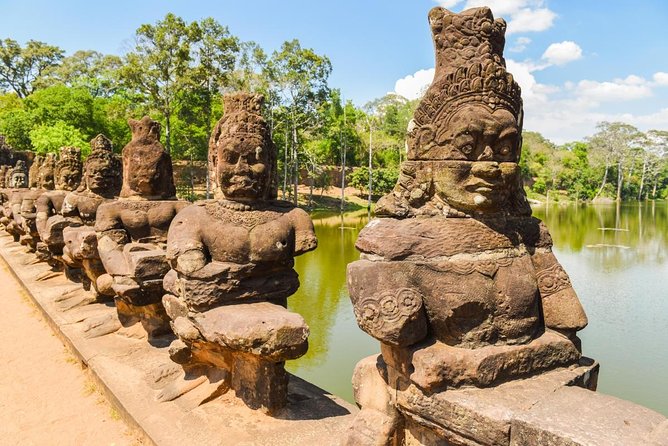
The route then pauses at the South Gate of Angkor Thom. The stop is only about 15 minutes, but it gives you a chance to see the gate’s long rows of statues representing gods and demons.
The gate is sometimes described in the schedule as a victory gate, but the listed stop is the South Gate. Either way, the important point is scale. The approach makes the old city feel less like a single temple and more like a vast royal complex.
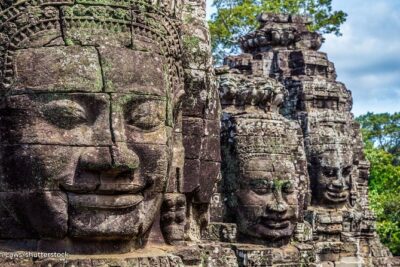
Bayon is the main stop inside Angkor Thom. Its towers carry the famous smiling faces associated with the monument, with more than 200 faces carved across the temple. The one-hour visit gives you time to look at the faces from several angles and move through the tight interior spaces.
I find Bayon most rewarding when you stop treating it as a single postcard view. Look up at the towers, then down at the bas-reliefs and passageways. The temple can be visually confusing, so a good guide adds real value by pointing out how the structure fits together.
Guide quality is one of the strongest reasons to choose this tour. Sam has been praised for keeping the mood lively despite the 4:30 am start. Sinan was described as serious and respectful in his explanations, while Sareik has been praised for his patience, personal stories from his time as a monk, and family experiences during Cambodia’s war years. Mony was also praised for temple explanations and photography.
You are not guaranteed a particular guide, but these examples give you a useful sense of what the operator’s better guides contribute. Their role is not just to identify each ruin. They can help connect the carvings, religious symbols, royal buildings, and modern Cambodian life.
After Bayon, the minivan returns you to your Siem Reap hotel. Bring water, even though the tour supplies free cool water and towels. The towels are a small but welcome comfort after a hot morning of walking.
More trips out to Banteay Srei:
- Full-Day Banteay Srei & 4 Temples – Grand Tours Join-in Tour
★ 5.0 · 1,155 reviews - Siem Reap Tour: Angkor Wat Sunrise, Bayon, Ta Prohm, Banteay Srei
★ 5.0 · 931 reviews - 2-Day Angkor Wat With Small, Big Circuit and Banteay Srei Tour
★ 5.0 · 545 reviews - From Siem Reap: Banteay Srei Temple & Grand 5 Temple Tour
★ 4.8 · 262 reviews
Preah Khan begins a quieter second morning
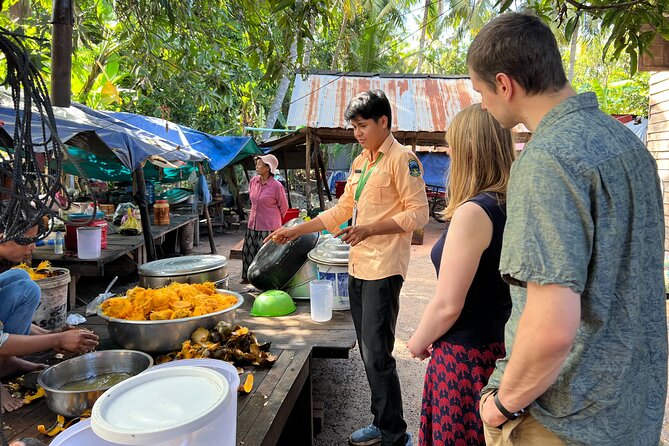
Day 2 starts at 8:00 am, after breakfast at your hotel. This later departure makes the second day easier on your body, though you still have a full route ahead.
Preah Khan is the first stop. It was built during the reign of Jayavarman VII and served as a major Buddhist temple complex. Compared with Angkor Wat, its corridors and courtyards can feel more enclosed and less immediately legible.
You have about an hour here. Use it to notice the mixture of religious imagery and the way vegetation has worked into the structure. The temple is large enough to reward an unhurried pace, but the tour must keep moving to reach Banteay Srei later in the day.
The next stop is Neak Pean, an artificial island temple set on a circular island in the Jayatataka Baray reservoir. The water setting gives it a different character from the land-based temples. Your visit lasts about 30 minutes, so this is primarily a focused look and photo stop rather than a long walk.
Ta Som is another small temple built for Jayavarman VII at the end of the twelfth century. Its compact size makes it a useful contrast with Preah Khan. You have 30 minutes, enough to see its principal features without spending another hour navigating a huge complex.
Eastern Mebon adds a brick-built change of pace
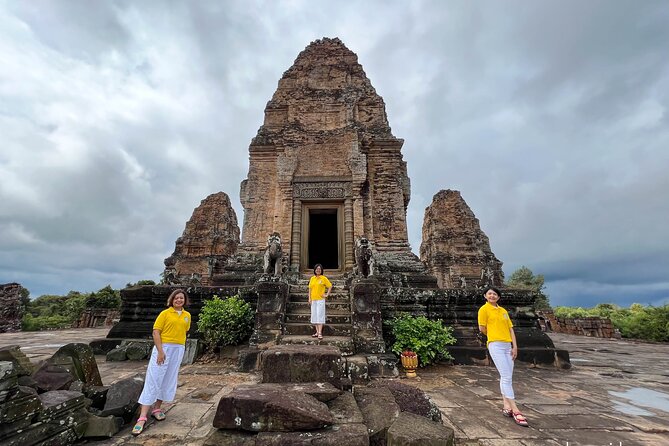
Eastern Mebon dates from the tenth century and was built during the reign of King Rajendravarman. It once stood on an artificial island at the center of the East Baray reservoir, which is now dry.
The historical setting is part of the point. You are looking at a temple that was designed in relation to water, even though the surrounding reservoir no longer appears as it once did. The stop lasts about 30 minutes and gives you another look at earlier brick construction before the route turns toward lunch.
Lunch is at a local restaurant in the Angkor Archaeological Park. The included meal is based on ordering an individual dish from a menu. Soft drinks are not included, so keep a little cash available if you want something beyond the supplied water.
Banteay Srei is the day’s finest carving stop
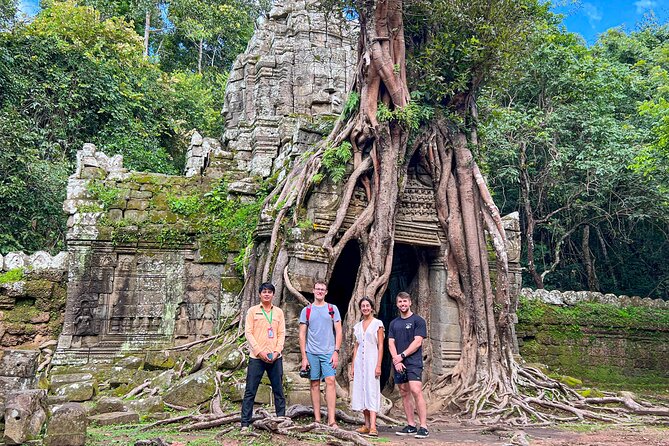
The drive to Banteay Srei takes you farther from Siem Reap’s central temple zone and into the countryside. That change is valuable. You are not seeing only the most famous monuments, but also getting a sense of the rural setting around the archaeological park.
Banteay Srei is smaller than Angkor Wat, but its sandstone carvings are among the most finely executed in the area. The details are the reason to come. Close views of the relief work reveal a level of care that can be harder to appreciate on a huge temple facade.
The planned visit lasts two hours, the longest stop on Day 2. That is a good allocation. Banteay Srei rewards patience, and the smaller scale makes it easier to focus on individual carvings rather than simply taking in the whole building.
The distance is also the tradeoff. You spend time in the vehicle to reach it, and the full day can feel long by the afternoon. Still, I would keep this stop even if you were tempted to shorten the itinerary. It adds an artistic side of Angkor that the larger temples cannot provide.
The Landmine Museum adds essential modern context
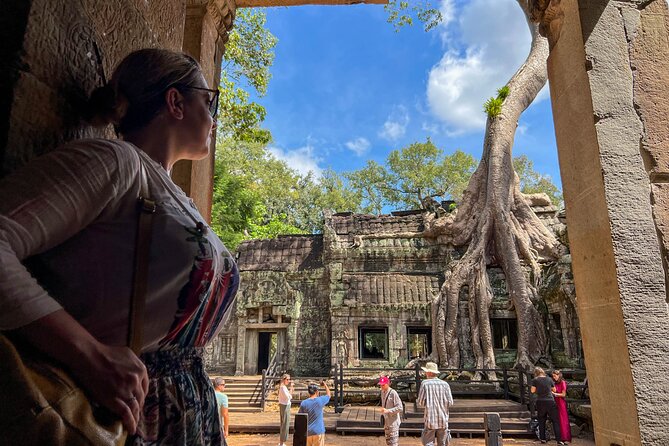
On the return to Siem Reap, the tour visits the Cambodian Landmine Museum for about 20 minutes. The $5 admission fee is not included.
The museum displays different types of mines used during Cambodia’s civil war. It is a brief stop, but it changes the tone of the day. After seeing royal temples built centuries ago, you confront the much more recent damage that continues to shape Cambodian communities.
Twenty minutes is not a long visit, so you should view this as an introduction rather than a full museum program. Even so, it gives the countryside and the country’s recent past a context that a temple-only itinerary would miss.
The final transfer takes you back to your hotel. Transportation is by air-conditioned minivan or minibus, an important comfort when the route includes several hours on the road.
What the $160 price really covers
At $160 per person, the tour offers solid value if you want a guide and transport rather than arranging each temple independently. You receive two days of hotel pickup, an English-speaking guide, an air-conditioned vehicle, breakfast on Day 1, lunch on Day 2, cold water, and cool towels.
The required extras change the calculation:
- Tour price: $160 per person
- Two-day Angkor pass: $62 per person
- Landmine Museum admission: $5 per person
- Basic total before extra drinks or food: $227 per person
The meals are useful but limited to what is stated. Day 1 includes breakfast with local food. Day 2 includes lunch, with an individual dish ordered from a menu. Other food and soft drinks are not included.
For a private group, the price can make more sense because you are paying for a dedicated vehicle and guide rather than simply buying admission. If you are a solo visitor, the total is harder to call cheap. The operator offers group discounts, but the exact savings are not provided, so ask before booking if you have several people in your party.
The experience is booked about 59 days ahead on average. That suggests planning early is sensible, especially if your dates in Siem Reap are fixed.
Practical advice for a smoother two days
Buy the Angkor pass online before Day 1. The operator requires it in advance, and arriving without it could interfere with the sunrise schedule.
Cover your knees and shoulders at the temples. Shorts and tops that leave the shoulders bare are not acceptable for this experience. Choose light clothing that meets the rule, and remember that you will be walking outdoors for long periods.
Tell the operator about vegetarian needs ahead of time. Vegetarian breakfast and lunch options can be arranged, but this is not something to leave until the morning pickup.
Pack only the basics: water, a phone or camera, sun protection, and comfortable footwear. The supplied water and towels reduce what you need to carry, but they do not replace sensible clothing for heat and walking.
I would also treat Day 1 as an early-morning workday. Do not schedule a late evening before it, and avoid planning another demanding activity after returning to your hotel. Day 2 starts later, but the distant Banteay Srei visit still makes it a full outing.
Free cancellation is available up to 24 hours before the start time. Changes or cancellations inside that window are not accepted for a refund, and the experience requires a minimum number of participants. If the operator cancels because that minimum is not met, you are offered another date or experience, or a full refund.
Who will get the most from this temple tour?
I would choose this tour if you want the major Angkor sights explained in context, but also want smaller and less famous temples in the same trip. It suits first-time visitors who would rather let a guide handle the route, transport, temple sequence, and local meal stops.
It is also a good fit if you value human context. The local breakfast, countryside drive, guide stories, and Landmine Museum keep the experience from becoming a simple parade of old stones.
I would think twice if you dislike early mornings, long vehicle rides, or fixed schedules. The first day is especially demanding, and the number of stops leaves limited room for lingering. If your priority is photographing one or two temples at your own pace, a shorter private plan may suit you better.
Should you book the two-day Angkor experience?
Book it if you have two days in Siem Reap and want broad coverage with a guide, reliable transport, and meals arranged. Banteay Srei, Ta Prohm, Bayon, and the local breakfast make the route more varied than a basic Angkor Wat day trip.
Skip it if you want a slow temple visit or cannot manage a 4:30 am pickup. Before paying, budget for the $62 Angkor pass and $5 museum ticket, ask about vegetarian meals if needed, and confirm the pickup details with your hotel.
For most first visits, the extra day is worth the effort. You see the iconic sunrise, but you also get the quieter temples and the modern history that make Cambodia more than a single famous monument.
FAQ
Is hotel pickup included?
Yes. Pickup from your hotel lobby in Siem Reap is included. On Day 1, you should wait in the lobby 15 minutes before the scheduled pickup between 4:30 and 5:00 am. Day 2 pickup is at 8:00 am.
Is the Angkor temple pass included?
No. The required two-day Angkor pass costs $62 per person and must be purchased before the tour begins. The operator recommends buying it online so you do not miss the sunrise visit.
How much does the tour cost?
The tour costs $160 per person. You must also budget $62 for the two-day Angkor pass and $5 for the Cambodian Landmine Museum ticket.
Is this a private tour?
Yes. Only your own group participates in the activity. Group discounts are offered, although the exact discount depends on the group size and is not specified.
What meals are included?
Day 1 includes breakfast with local food at a family restaurant near Srah Srang. Day 2 includes lunch at a local restaurant, with an individual dish ordered from a menu.
Are vegetarian meals available?
Yes. Vegetarian breakfast and lunch options can be provided, but you need to notify the operator in advance.
What should I wear?
Your knees and shoulders must be covered while visiting the temples. Clothing that leaves the shoulders bare or does not cover the knees is not permitted.
Does the tour provide transportation and refreshments?
Yes. Transportation is provided in an air-conditioned minivan or minibus. Cool water and towels are supplied during the tour.
What is the cancellation policy?
You can cancel up to 24 hours before the experience starts for a full refund. Cancellations or changes made less than 24 hours before the start time are not accepted for a refund.
More Multi-day Routes in Siem Reap
- Angkor 2-Day Sunset & Sunrise Small-Group Tour
★ 5.0 · 2,567 reviews - Siem Reap: Angkor Sunrise 1- or 2-Day Guided Temples Tour
★ 4.9 · 1,132 reviews - Siem Reap: 2-Day Temple Highlights Sunrise and Sunset Option
★ 4.9 · 445 reviews - Angkor Wat 2-Day complex Sun rise & Sun set with Guided Tour
★ 4.9 · 439 reviews
Newest reviews from Siem Reap
- War Museum, Killing Field, and APOPO Hero RATs Tour★ 5.0 · 7 reviews
- Angkor Wat at Sunrise★ 4.0 · 7 reviews
- Siem Reap Angkor Airport Taxis (from Airport to Hotel)★ 5.0 · 44 reviews
- Secret Temples of Angkor – Guided Tour in Siem Reap★ 5.0 · 6 reviews
- Short Cycling at Countryside★ 5.0 · 29 reviews
- Cambodian Cooking Class and Oxcart Ride with Local Village Tour★ 5.0 · 4 reviews
- SIEM REAP E-BIKE HALF-DAY COUNTRYSIDE (25-30 km)★ 4.0 · 1 review
- Unveiling the Mystical Beauty of Phnom Kulen National Park★ 5.0 · 6 reviews
Angkor Wat Tours, compared.
Angkor Wat Sunrise or Sunset Tour with Guide from Siem Reap
Read our review →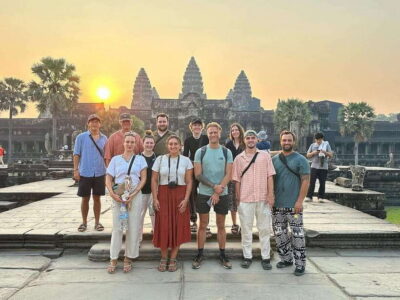
Angkor Wat: Small-Group Sunrise or Sunset Tour
Read our review →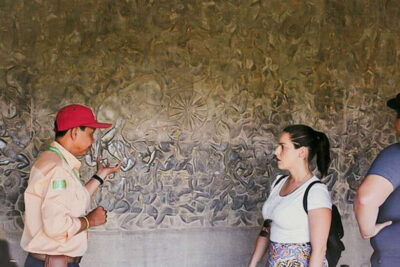
Angkor Wat 2-Day Tour with Sunrise and Sunset
Read our review →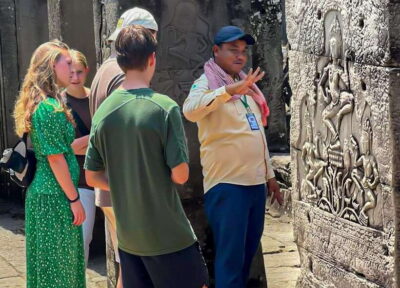
Angkor Wat Sunrise tour with Small – Group and Guide tours
Read our review →
Angkor Wat Highlights and Sunrise Guided Tour from Siem Reap
Read our review →
Angkor Wat Sunset Small Group Tour with Lunch Included
Read our review →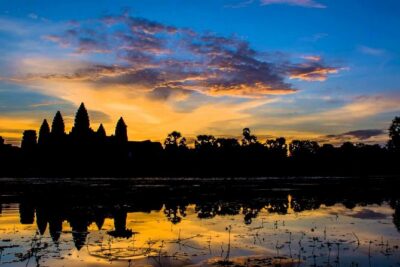
Full-Day Angkor Wat Sunrise Private Tour with Guide from Siem Reap
Read our review →Browse the lists this tour appears in