
Reviewed · BANTEAY SREI TOURS
Grand Circuit with Banteay Srei and Banteay Samre Tour
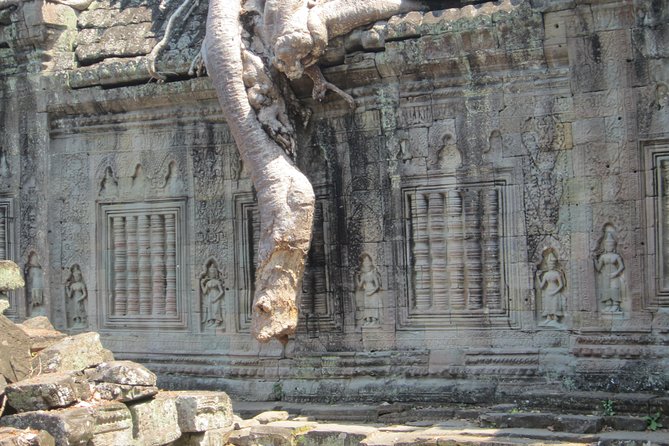
The quieter side of Angkor is worth your time. This private 8 to 9-hour tour takes you beyond the headline temples to Preah Khan, Neak Pean, Ta Som, East Mebon, Pre Rup, Banteay Samre, and the finely carved Banteay Srei. I especially like the wide mix of temple styles and the chance to see small villages along the road to Banteay Srei.
I also like that transportation, an English-speaking guide, and drinking water are included. Guides such as Pheng, Bunpheng, Chen, and drivers such as Mai have received warm praise for clear explanations and kind service. The main catch is cost: the $59 tour price does not include the $37 one-day Angkor Pass, lunch, or drinks, so your actual day will cost more than the headline price.
In This Review
- Key points to know before you book
- Why this Grand Circuit route works
- Banteay Srei and its pink sandstone carvings
- Banteay Samre, a quieter stop on the return
- Preah Khan, the day’s big exploration
- Neak Pean and its man-made island
- Ta Som and its half-hour visit
- East Mebon and its elephant sculptures
- Pre Rup, a Hindu temple dedicated to Shiva
- What the $59 price really gets you
- Guides, drivers, and the feel of a private day
- Who should book this tour?
- Should you book the Grand Circuit tour?
- FAQ
- Is the Angkor Pass included in the tour price?
- How long does the tour last?
- Is this a private tour?
- What transportation is provided?
- Is lunch included?
- What clothing is required at the temples?
Key points to know before you book
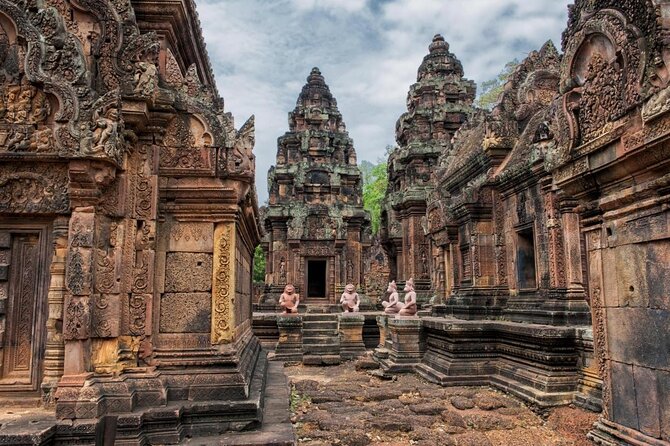
- Banteay Srei has Cambodia’s finest small-scale carvings: The pink sandstone temple is detailed enough to reward a slow look.
- The route covers seven temple stops: You get a broad view of Angkor-era architecture rather than one famous monument.
- Preah Khan receives the most time: Two hours gives you room to explore its long corridors and carved spaces.
- This is a private tour: Only your own group participates, which makes the long day easier to manage.
- The Angkor Pass is extra: Budget $37 per person in addition to the $59 tour price.
- Dress for temple rules: Your thighs and shoulders must be covered, or you may be refused entry.
Why this Grand Circuit route works
Many visitors spend their limited temple time at Angkor Wat and Angkor Thom. Those sites deserve their fame, but this route gives you a different look at the Khmer Empire. You move from large royal foundations to compact shrines, from Buddhist sites to Hindu temples, and from crowded highlights to quieter corners of the Angkor area.
The route is also useful if you have already seen the main temples. One of the strongest comments about this experience came from someone returning to explore less familiar Angkor temples. That is exactly where this tour makes sense. It is not designed as a first and only introduction to every major Angkor sight. It is better for adding variety or seeing the wider circuit in one organized day.
You spend about eight or nine hours on the road and at the temples. That is a full day, but the schedule has a sensible rhythm. Preah Khan receives two hours, Banteay Srei two hours, and smaller sites receive shorter visits. You will not give every temple the same attention, but that is a practical way to cover a lot of ground.
The tour uses an air-conditioned car, minivan, or minibus. Pickup is offered, and confirmation is provided when you book. Since the activity is private, you do not share the day with an unrelated group. That matters here because temple visits work better when you can pause for a carving or move on when a site has given you all it can.
More trips out to Banteay Srei:
- Full-Day Banteay Srei & 4 Temples – Grand Tours Join-in Tour
★ 5.0 · 1,155 reviews - Siem Reap Tour: Angkor Wat Sunrise, Bayon, Ta Prohm, Banteay Srei
★ 5.0 · 931 reviews - 2-Day Angkor Wat With Small, Big Circuit and Banteay Srei Tour
★ 5.0 · 545 reviews
Banteay Srei and its pink sandstone carvings
Banteay Srei is the afternoon star of the route, even though the listed stop order places it first. The name is commonly translated as Citadel of the Women, and the temple is known for its pink sandstone and unusually fine carving.
I would give this site its full two hours. The scale is smaller than the monumental Angkor temples, but the decoration is more intimate. Look closely at the carved figures and the Hindu imagery. The detail is the reason this stop is included, so rushing through it would defeat the point.
The road out to Banteay Srei adds something beyond the temple itself. You may pass villages and have a chance to stop for photographs. The information does not promise a fixed village activity, so treat this as a possible roadside pause rather than a guaranteed cultural program. Still, it gives the day a more local feel than a straight temple-to-temple transfer.
There is one practical matter to handle before you leave your hotel: clothing. Shoulders and thighs must be covered at the temple complexes. Light trousers or a long skirt and a shirt with sleeves are the safe choice. Do not rely on getting a pass for unsuitable clothing at the gate.
Banteay Samre, a quieter stop on the return
Banteay Samre is visited on the way back from Banteay Srei, with about an hour set aside for the temple. That makes it a good companion to Banteay Srei: one site is prized for small, precise carvings, while the other gives you a more substantial temple setting without taking another half-day.
The stop is short enough that you should keep your expectations realistic. You will have time to see the main structure and absorb the design, but not the leisurely pace offered at Preah Khan or Banteay Srei. If you like photographing stonework and comparing temple layouts, this hour is well used.
The route also includes Pre Rup later in the day. The supplied schedule describes Banteay Samre and Pre Rup as afternoon visits, while the detailed stop list gives Pre Rup about 40 minutes. Exact timing can depend on the guide and the day’s pace, so the private format is useful here. Your group can discuss the rhythm with the guide rather than follow a large bus on a fixed march.
Preah Khan, the day’s big exploration
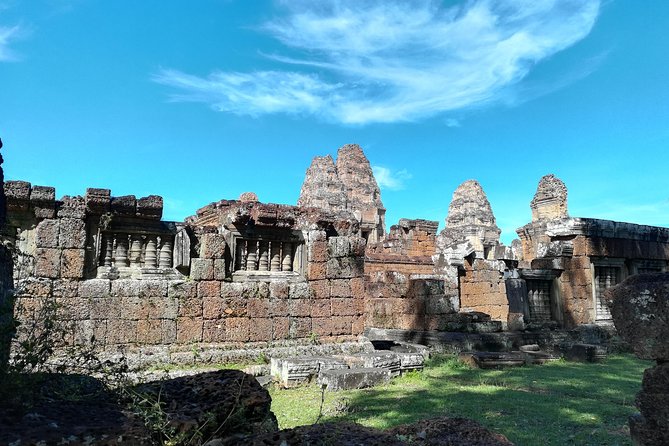
Preah Khan translates as Royal Sword. King Jayavarman VII built this 12th-century temple and dedicated it to his late father. It lies north of Angkor Thom and is one of the route’s most substantial stops, with two hours planned.
This is where the tour feels most expansive. You have time to walk through the temple rather than simply step out, take a quick look, and return to the vehicle. The long visit also gives an English-speaking guide room to explain the setting, the king who built it, and the religious ideas behind the carvings.
Preah Khan is a strong reason to choose this tour over a basic highlights transfer. Two hours is still not unlimited, especially if you stop often for photographs, but it is enough to make the temple more than a blur of sandstone corridors.
The main drawback is physical pace. Seven temples in one day means plenty of walking and repeated trips in and out of the vehicle. The information says most people can participate, but it does not give a detailed accessibility plan. If stairs, uneven ground, or long walks are a concern, ask the provider about the route before booking.
A few more options around Siem Reap worth reading up on
- Angkor Wat Sunrise or Sunset Tour with Guide from Siem Reap
★ 5.0 · 12,109 reviews - Siem Reap: Angkor Wat: Small-Group Sunrise or Sunset Tour
★ 5.0 · 9,444 reviews - From Siem Reap: Kampong Phluk Floating Village Tour by Boat
★ 4.9 · 6,979 reviews - Sunset tour of Kampong Phluk stilts home village on the Tonle Sap
★ 5.0 · 4,865 reviews
Neak Pean and its man-made island
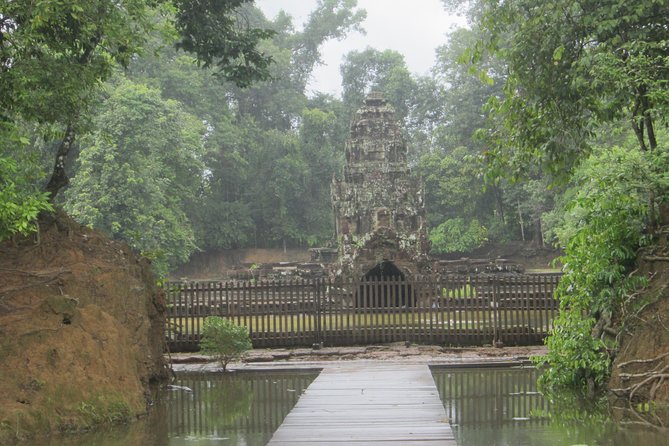
Neak Pean receives about 45 minutes. Its name means Entwined Serpents, and it is a 12th-century Buddhist temple built on a man-made island.
This stop changes the visual rhythm of the day. Instead of another large temple enclosure, you see a compact Buddhist site surrounded by water. The island setting is the point, so allow time to look beyond the central structure and understand how the temple is arranged.
Forty-five minutes is a reasonable visit for a small site, but it can feel brief if you want a long explanation or many photographs. That is one of the tradeoffs of this itinerary. You see more places, but the smaller temples receive a quick, focused visit.
Ta Som and its half-hour visit
Ta Som is another 12th-century temple built by King Jayavarman VII. The planned visit lasts about 30 minutes.
This is a compact stop, and I would treat it as a chance to see another expression of the same king’s building program rather than as a major standalone visit. The short time makes sense if you want a broad circuit, but it leaves little room for lingering.
A good guide can make a difference here. The praise for Pheng and Chen centers on their ability to explain Khmer kings, religion, and local life in clear English. That kind of context is especially helpful at a smaller site, where the stones may not explain themselves at a glance.
East Mebon and its elephant sculptures
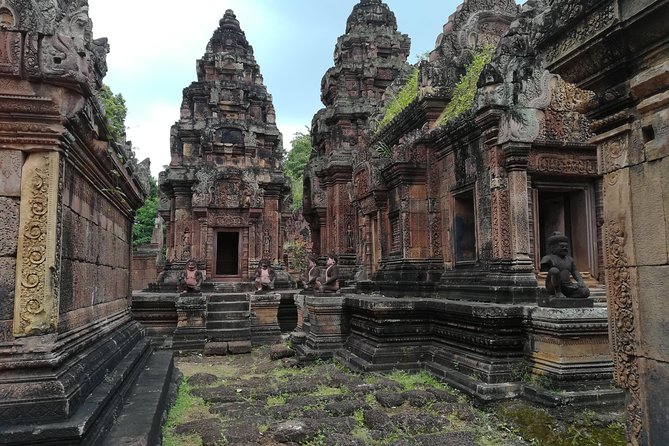
East Mebon is one of the early Khmer architectural examples on this route, dating to the 10th century. The visit lasts about 30 minutes, and the temple is noted for its elephants.
The elephants give you an easy visual detail to look for, especially after several sites with similar sandstone corridors and towers. East Mebon also helps you see the development of Khmer architecture across time. The itinerary moves between 10th-century Hindu temples and 12th-century Buddhist and royal foundations, so the day is not just a collection of ruins.
Half an hour is enough to see the main features, but not enough for a slow study of every carving. I would listen closely to the guide here, then use the remaining time for photographs and a quick walk around the site.
Pre Rup, a Hindu temple dedicated to Shiva
Pre Rup is a late 10th-century Hindu temple dedicated to Lord Shiva. About 40 minutes are planned for the visit.
This stop adds a clear Hindu element to a day that also includes Buddhist temples. That contrast is one of the tour’s best features. You are not seeing a single religious style repeated seven times. You are tracing how royal power and faith shaped different temple designs over several centuries.
The stop may feel short if you want a detailed visit, but it is long enough to understand the temple’s role in the circuit. The tour does not include a sunset program, so do not book it expecting a dedicated evening viewpoint. Pre Rup is included as a temple visit within the afternoon route.
What the $59 price really gets you
The listed price is $59 per person. That covers an English-speaking guide, air-conditioned transportation, and bottles of drinking water. Pickup is offered, and group discounts are listed as a feature.
The tour is private, so the price has more value for two or more people who want their own vehicle and guide. It is less of a bargain if you are traveling alone and compare it only with a shared bus. The benefit is control and personal attention, not simply transport.
You also need to add the one-day Angkor Pass at $37 per person. Food and drinks are not included, and lunch is on your own account. A restaurant will be recommended, but the meal price is not part of the package. Accommodation is also excluded, as you would expect from a day tour.
That puts the known cost at $96 per person before lunch and any drinks beyond the provided water. At that price, I would choose this tour for its coverage and private format, not because it is the cheapest way to see temples. The guide’s explanations are an important part of the value. Past praise for Pheng, Chen, and Bunpheng suggests that guide quality can turn a long sequence of ruins into a more understandable day, though no specific guide is guaranteed.
Guides, drivers, and the feel of a private day
The experience provider is Angkor Doors. Several guide and driver names appear in the feedback connected with the company. Pheng was praised for professional service and fluent English, Chen for answering questions about Khmer kings and religion, and Bunpheng for kindness and local insight. Mai was mentioned as a driver during a two-day visit.
These names are useful when you think about what you want from the day, but you should not assume one of them will lead your tour. Ask when confirming if a particular guide matters to you. The confirmed inclusion is an English-speaking guide, not a named individual.
The private setup is a real advantage. You can ask for more explanation at Preah Khan, move efficiently through Ta Som, or spend extra attention on Banteay Srei’s carvings. The published duration remains eight to nine hours, so flexibility does not mean unlimited time at every stop.
Who should book this tour?
I would recommend it to you if you have already seen Angkor Wat and the other major headline sites, or if your priority is variety rather than a single famous monument. It also suits anyone who likes architecture, religious history, photography, and a full day with an English-speaking guide.
It is a good match for a private group that wants air-conditioned transport and a planned route. Families or friends can share the experience without being placed with strangers, and group discounts may improve the value.
I would think twice if you want a slow, unhurried day. Seven stops require compromises, and Ta Som and East Mebon receive only 30 minutes each. I would also reconsider if you have limited time in Siem Reap and have not yet seen Angkor Wat, since this route does not list that famous temple.
Book at least a day ahead if your plans are firm. The experience is often reserved well in advance, with an average booking lead time of about 50 days. Free cancellation is available if you cancel at least 24 hours before the start time. Changes or cancellations inside that window are not accepted for a refund.
Should you book the Grand Circuit tour?
Book this tour if you want the quieter, wider side of Angkor and appreciate a guide who can connect temples to Khmer kings, Hindu worship, and Buddhism. Banteay Srei’s carvings, Preah Khan’s two-hour visit, East Mebon’s elephants, and Neak Pean’s island setting give the day plenty of variety.
Skip it if you need the lowest possible price, want to see only the essential temples, or prefer to spend an entire day at two or three sites. Remember the real budget: $59 for the tour, $37 for the Angkor Pass, plus lunch and drinks. Wear proper temple clothing, bring patience for a long day, and you will get a useful look at Angkor beyond the familiar postcard stops.
FAQ
Is the Angkor Pass included in the tour price?
No. The one-day Angkor Pass costs $37 per person and is not included. The tour can take you to buy the pass if you do not already have one.
How long does the tour last?
The experience lasts approximately eight to nine hours.
Is this a private tour?
Yes. Only your own group participates in the activity.
What transportation is provided?
Transportation is provided in an air-conditioned car, minivan, or minibus. Pickup is offered.
Is lunch included?
No. Lunch and drinks are not included. A restaurant will be recommended, and you pay for the meal yourself. Bottles of drinking water are provided.
What clothing is required at the temples?
You must cover your thighs and shoulders when entering the temple complexes. If your clothing does not meet the required dress code, you may be refused entrance.
Newest reviews from Siem Reap
- War Museum, Killing Field, and APOPO Hero RATs Tour★ 5.0 · 7 reviews
- Angkor Wat at Sunrise★ 4.0 · 7 reviews
- Siem Reap Angkor Airport Taxis (from Airport to Hotel)★ 5.0 · 44 reviews
- Secret Temples of Angkor – Guided Tour in Siem Reap★ 5.0 · 6 reviews
- Short Cycling at Countryside★ 5.0 · 29 reviews
- Cambodian Cooking Class and Oxcart Ride with Local Village Tour★ 5.0 · 4 reviews
- SIEM REAP E-BIKE HALF-DAY COUNTRYSIDE (25-30 km)★ 4.0 · 1 review
- Unveiling the Mystical Beauty of Phnom Kulen National Park★ 5.0 · 6 reviews
Banteay Srei Tours, compared.
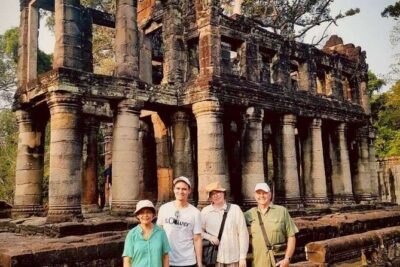
Full-Day Banteay Srei & 4 Temples – Grand Tours Join-in Tour
Read our review →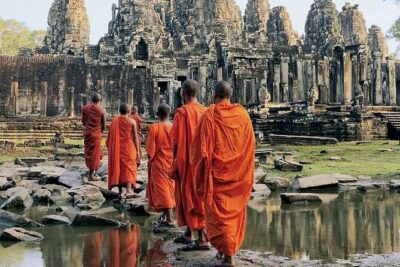
Siem Reap Tour: Angkor Wat Sunrise, Bayon, Ta Prohm, Banteay Srei
Read our review →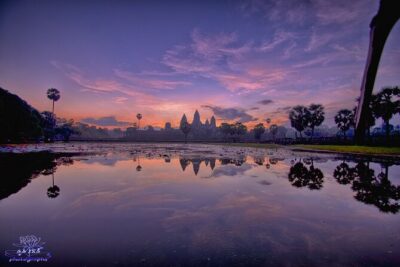
2-Day Angkor Wat With Small, Big Circuit and Banteay Srei Tour
Read our review →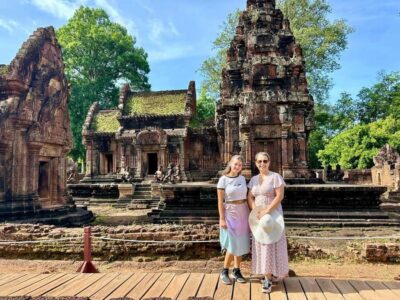
3-Days Discovery Of Angkor: Waterfalls,Floating Village and Banteay Srei temple
Read our review →
Banteay Srei, Kulen Waterfall & Beng Mealea Exploration
Read our review →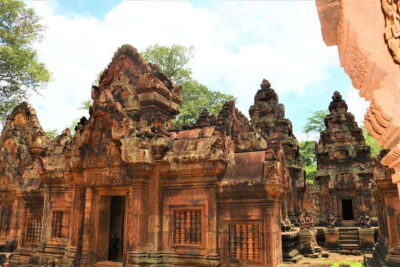
Banteay Srei and Grand Circuit Heritage Tour from Siem Reap
Read our review →Browse the lists this tour appears in