
Reviewed · BANTEAY SREI TOURS
Banteay Srei and Big Tour from Siem Reap Small-Group
Small temples, big rewards. This 6 to 7 hour trip from Siem Reap combines Banteay Srei’s pink sandstone carvings with four very different Angkor-era sites, giving you more variety than a standard central-temple outing. I especially like the chance to visit Preah Dak Village and the practical hotel pickup, though the added $37 temple pass means the real cost is closer to $89 per person.
The strongest part is the guiding. San, who teaches history, mythology, and Asian religions at a local university, has earned especially high praise for his explanations. Guides such as Reaksa and Phearom have also been singled out for clear English, useful temple details, and allowing time to explore on your own. The main caution is the group size: it is advertised as small, but one departure carried 12 people in a full minivan.
In This Review
- Key points to know before booking
- Why Banteay Srei deserves the early start
- A short look at local life in Preah Dak
- East Mebon and the memory of a vanished lake
- Neak Pean, a small temple surrounded by water
- Preah Khan gives the day a grand finish
- What the $52 price really buys you
- Small group does not always mean tiny group
- The guide matters more than the vehicle
- Timing, clothing, and physical demands
- Who should book this temple day
- Should you book the Banteay Srei and Big Tour?
- FAQ
- How long does the Banteay Srei and Big Tour last?
- What is included in the $52 tour price?
- Do I need to pay for an Angkor entrance ticket?
- What time does hotel pickup take place?
- What should I wear to the temples?
- What is the maximum group size?
Key points to know before booking
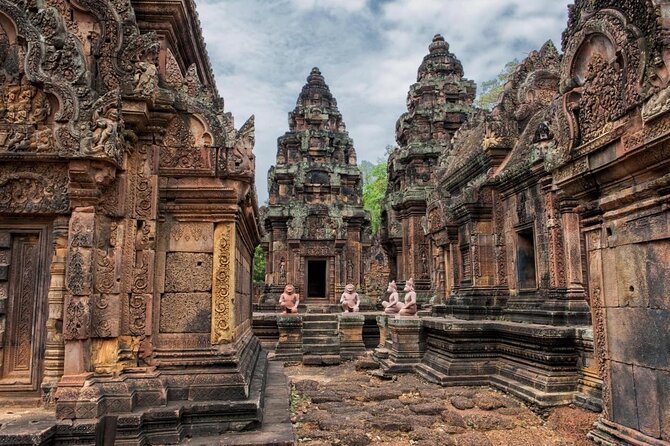
- Banteay Srei is the morning centerpiece: The small 10th-century Hindu temple is famous for fine pink sandstone carving and is about 35 kilometers north of Siem Reap.
- Four temple styles fit into one day: East Mebon, Neak Pean, and Preah Khan each offer a different setting and design, not four copies of the same monument.
- The guide can make or break the day: San, Reaksa, and Phearom have received praise for history, mythology, and close attention to small details.
- The advertised price is not the final price: You pay $52 for the tour, then another $37 for the one-day Angkor entrance ticket.
- Pickup times vary: Hotel collection is scheduled between 7:40 and 8:20 a.m., while the listed tour start is 8:30 a.m.
- Expect walking and temple steps: Long pants or knee-length clothing is required, and a moderate level of fitness is advised.
Why Banteay Srei deserves the early start
The day begins with pickup from hotels around Siem Reap. Since the vehicle collects people from several properties, you need to wait in your hotel lobby and be ready during the 7:40 to 8:20 a.m. window. That range matters. Do not plan a leisurely breakfast right up to the published 8:30 start time.
Once the group is together, you drive about 35 kilometers north to Banteay Srei. The journey takes you away from the main concentration of Angkor sites, and that change of setting is part of the appeal. This is not simply a quick stop added to a central-temple circuit.
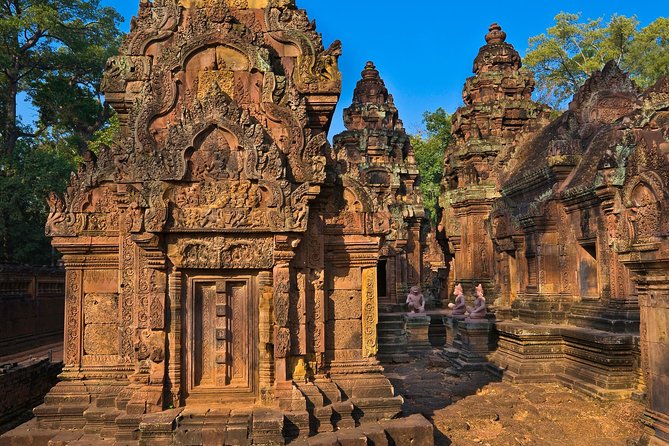
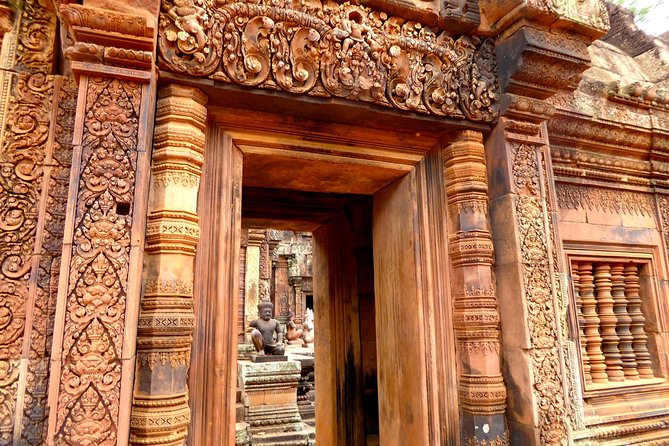
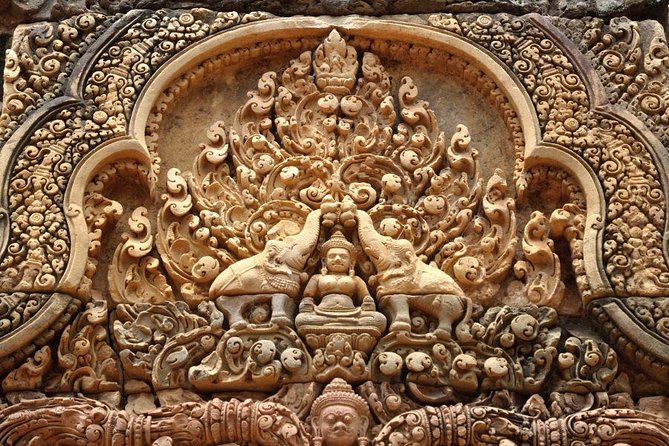
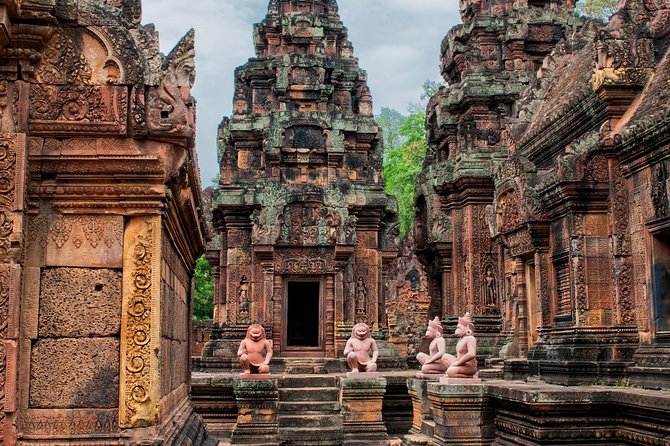
Banteay Srei means Citadel of Women. It is a relatively small Hindu temple from the 10th century, but its scale is not a weakness. The compact layout lets you focus on its carved towers and detailed pink sandstone work without feeling lost in a huge complex.
I would give this stop your best attention. The delicate carving is the reason many people choose this tour, and a good guide can point out details you might pass without noticing. Phearom, one of the praised guides, was especially good at explaining small features that are easy to miss.
The planned visit lasts about three hours, including the surrounding area and the time needed for the drive. That is a generous portion of the day. You should have time for a guided explanation, photographs, and some independent wandering.
Banteay Srei is also the clearest reason to choose this tour instead of arranging a simple tuk-tuk trip to the most central temples. You are paying for transport farther north, an English-speaking guide, and a route that joins several outlying sites in one outing.
More trips out to Banteay Srei:
- Full-Day Banteay Srei & 4 Temples – Grand Tours Join-in Tour
★ 5.0 · 1,155 reviews - Siem Reap Tour: Angkor Wat Sunrise, Bayon, Ta Prohm, Banteay Srei
★ 5.0 · 931 reviews - 2-Day Angkor Wat With Small, Big Circuit and Banteay Srei Tour
★ 5.0 · 545 reviews
A short look at local life in Preah Dak
The tour description includes a stop at Preah Dak Village, where you can see local life and shop for handmade souvenirs. The available schedule gives the village a smaller role than Banteay Srei, and the exact timing is not specified, so you should not expect a long cultural program.
Still, this stop adds a useful change of pace. Temple touring can become a blur of towers, galleries, and ancient stones. A village visit gives you a chance to see a present-day community and browse traditional handicrafts rather than spending every minute inside archaeological sites.
Shopping is optional, but it can be a more direct way to support local makers than buying generic souvenirs in a city shop. Keep your expectations sensible. This is a stop within a busy temple day, not a full workshop or extended village visit.
East Mebon and the memory of a vanished lake
After Banteay Srei, the route turns toward East Mebon. The temple once occupied a small island in the middle of the artificial East Baray, a huge reservoir measuring about 7 kilometers by 1.8 kilometers. The water is no longer the defining feature it once was, but the temple’s position tells you something about the scale of Khmer engineering.
East Mebon has five towers and was once reached by boat. Today, the visit is much easier, but the original setting helps explain why the temple was built where it was. I like this stop because it connects the stone monument to the water system around it. You are not just looking at a group of towers. You are seeing part of a much larger plan.
The scheduled visit is about an hour. That is enough for the guide to explain the site and for you to take photographs without rushing through every corner. After the ornate carvings at Banteay Srei, East Mebon offers a different impression: a temple whose importance is tied as much to its former setting as to its decoration.
The downside is simple. If you want long, quiet periods at every monument, this schedule may feel brisk. Three more temple sites still follow, and the day is designed to give you breadth.
Neak Pean, a small temple surrounded by water
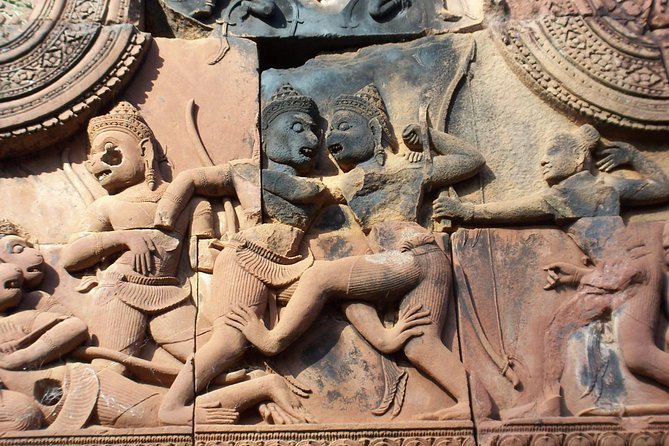
Prasat Neak Pean dates from the 12th century and has a very different design. It is a small temple linked to a collection of five ponds, which represent the Himalayan mountain lake Anaavatapta from Hindu mythology.
That religious idea is central to understanding the site. Neak Pean is not mainly about a grand entrance or a long series of galleries. Its interest comes from the relationship between the central structure and the surrounding pools.
You have about an hour here. The approach and setting give the stop a distinct feel after East Mebon. I would listen closely during the guide’s explanation, since the symbolism can be harder to understand from the stones alone.
This is also a good example of why a guide is valuable on this route. A self-guided visit might leave you with attractive photographs but little sense of why the ponds matter. Guides such as San are particularly well suited to this kind of stop, with background in mythology and Asian religions.
Neak Pean may not satisfy you if your priority is the biggest or most heavily carved monument. Its charm is quieter and more symbolic. The attraction is the design and meaning, not sheer size.
A few more options around Siem Reap worth reading up on
- Angkor Wat Sunrise or Sunset Tour with Guide from Siem Reap
★ 5.0 · 12,109 reviews - Siem Reap: Angkor Wat: Small-Group Sunrise or Sunset Tour
★ 5.0 · 9,444 reviews - From Siem Reap: Kampong Phluk Floating Village Tour by Boat
★ 4.9 · 6,979 reviews - Sunset tour of Kampong Phluk stilts home village on the Tonle Sap
★ 5.0 · 4,865 reviews
Preah Khan gives the day a grand finish
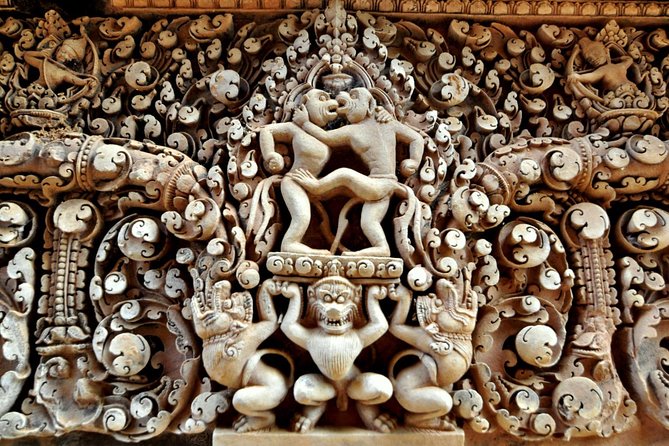
The final major stop is Preah Khan, built by King Jayavarman VII at the end of the 12th century. It is described as a large complex of pavilions, halls, and chapels enclosed by four walls.
Preah Khan is the most expansive stop on the route. The word labyrinth is appropriate here, since the complex contains many connected spaces and places to look beyond the main path. The one-hour schedule lets you get a sense of the plan, but it will not cover every corner.
I like ending with Preah Khan because it brings together several themes from the day: religious architecture, royal ambition, enclosed temple spaces, and the contrast between a small site such as Neak Pean and a broad complex with many chambers.
Your guide can help you decide where to spend your limited time. Phearom was praised for explaining temple history in detail and pointing out features that would otherwise blend into the walls. Reaksa was also praised for a good command of English and for finding strong photo spots.
At the same time, one hour is not enough for a slow, unhurried study of Preah Khan. If you are serious about temple photography or architectural detail, you may want a separate visit on another day.
What the $52 price really buys you
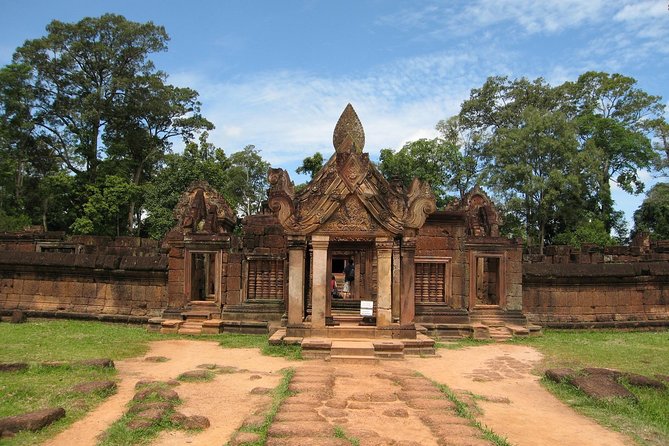
The advertised price is $52 per person. That includes hotel pickup and drop-off, shared air-conditioned transport, an English-speaking guide, bottled water, and a small-group format.
You must also buy the one-day entrance ticket, which costs $37 at the ticket office on the way to the park. That brings the basic total to $89 per person before food, drinks, tips, or travel insurance.
At $89, this is not the cheapest way to see the temples. A tuk-tuk arranged independently may cost less, especially if you are traveling with several people and already know exactly where you want to go.
The value becomes clearer if you want a simple, organized day. You do not need to negotiate several separate rides, arrange a driver for distant sites, or research the meaning of each temple as you go. You also get air conditioning, hotel transport, and an English-speaking guide.
One direct comparison is useful. A previous independent tuk-tuk day was described as cheaper, but the guided tour was considered worth the extra cost because it included a car, driver, guide, and water. That is the right way to judge this experience. You are paying for interpretation and coordination, not just a seat in a vehicle.
Food and drinks are not included. Carry some cash for your own meals and purchases in Preah Dak. Bottled water is supplied, but one departure had water offered only twice during the day. If you drink often in Cambodia’s heat, bring extra water or ask the guide early.
Small group does not always mean tiny group
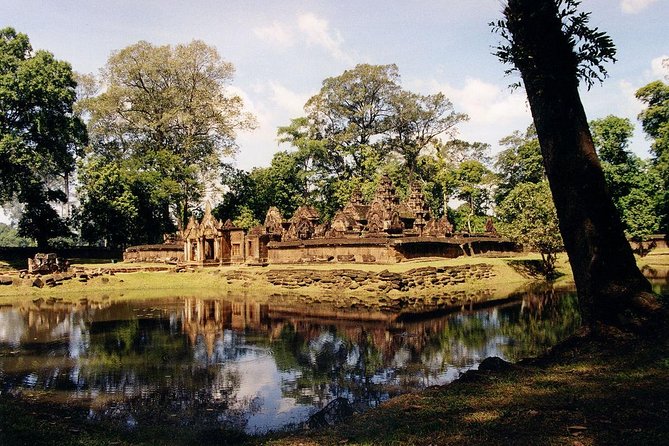
The maximum group size is listed as 15 people, and the number can change according to bookings. Some departures may be very small. One group had only three people, which would allow a relaxed pace and easy access to the guide.
You should not assume every departure will be that intimate. One less positive experience involved 12 people packed into a minivan, making the group feel large despite the small-group label.
This is an important tradeoff. A larger group can lower the cost and make the transport practical, but it may mean more time gathering people at each stop. A smaller group gives you a better chance to ask questions and stay close to the guide.
The vehicle is a shared air-conditioned minivan or bus. That is a practical choice for a full day in Cambodia, especially on a route that covers several sites outside central Siem Reap. Still, space may feel limited when the vehicle is full.
The guide matters more than the vehicle
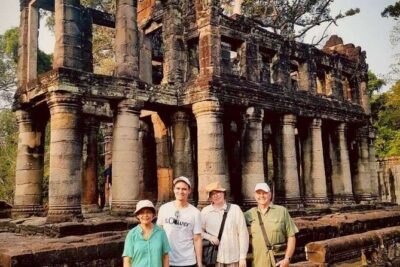
The most praised part of this experience is the guiding. San has a particularly strong background, teaching history, mythology, and Asian religions at a local university. That is an unusually good match for a temple route that includes Hindu symbolism, Buddhist-era construction, royal projects, and changing religious use.
Phearom was praised for explaining temple history in great detail, noticing small carvings, and answering questions well. Reaksa was praised for experience, clear English, and choosing useful places for photographs.
The guides also appear to leave time for you to explore independently. That balance is important. You get a structured explanation first, then a chance to look around without having a constant commentary in your ear.
Guide quality can vary by departure, so the actual person assigned to you matters. The positive experiences point to a strong standard, but you should not book solely on the assumption that San, Reaksa, or Phearom will lead your particular group.
Timing, clothing, and physical demands
The day lasts around six to seven hours, with pickup in the morning and return to Siem Reap after Preah Khan. The schedule packs in five named temple stops, plus Preah Dak Village, so you should expect a full day rather than a slow sightseeing walk.
A moderate fitness level is recommended. The information does not give a step count or specify difficult climbs, but temple grounds can involve uneven surfaces and walking between structures. Wear shoes you can walk in comfortably.
Long pants or a knee-length skirt or dress are required at the temples. This is not merely a style suggestion. Dress correctly from the start so you can enter each site without a clothing problem.
Hotel pickup and drop-off are included, but the precise pickup time varies from 7:40 to 8:20 a.m. Stay in the lobby and keep your phone available if the operator needs to locate you. The official meeting time is 8:30 a.m., but your individual pickup may be earlier.
The one-day entrance ticket is purchased at the ticket office on the way to the park if you do not already have one. Build this stop into your morning rather than treating it as an unexpected delay.
Who should book this temple day
I would choose this tour if you have limited time in Siem Reap and want to see several major outlying sites without arranging each transfer yourself. It is also a good fit if you want explanations of Hindu mythology, temple symbolism, and Khmer royal architecture.
It suits first-time visitors who prefer a clear route. The guide-led format helps you understand why Banteay Srei, East Mebon, Neak Pean, and Preah Khan feel so different.
It may also suit you if you have already seen the most famous central temples and want a day with more variety. Banteay Srei gives you fine carving, East Mebon gives you the story of an artificial lake, Neak Pean offers symbolic ponds, and Preah Khan provides a large complex to explore.
I would hesitate if you dislike shared vehicles, fixed schedules, or group stops. You may also prefer private transport if photography is your main goal, since one hour at some sites can feel short.
Should you book the Banteay Srei and Big Tour?
Book it if you want an efficient, guide-led day with strong variety and hotel transport. The $52 tour price is fair once you value the air-conditioned vehicle, guide, driver, water, and coordination, but remember the separate $37 entrance ticket.
The best reason to choose it is the combination of Banteay Srei and the less familiar temples. The main caution is that group size and water service may vary. Ask yourself one practical question: do you want maximum independence, or do you want someone to explain what you are seeing while handling the long route?
For most first-time visitors with only a day to spare, I think the structure is worthwhile. Pack water, wear proper clothing, expect a busy schedule, and treat the guide as the heart of the experience.
FAQ
How long does the Banteay Srei and Big Tour last?
The experience lasts approximately 6 to 7 hours, including hotel pickup, temple visits, and return transport to Siem Reap.
What is included in the $52 tour price?
The price includes hotel pickup and drop-off, shared air-conditioned minivan or bus transport, an English-speaking guide, bottled water, and small-group service.
Do I need to pay for an Angkor entrance ticket?
Yes. A one-day entrance ticket costs $37 per person and is not included in the tour price. The group stops at the ticket office on the way to the park for anyone who does not already have a ticket.
What time does hotel pickup take place?
Pickup times vary by hotel and are scheduled between 7:40 and 8:20 a.m. The listed start time is 8:30 a.m., so you should wait in your hotel lobby and be ready during the pickup window.
What should I wear to the temples?
Long pants or a knee-length skirt or dress are required. You should also be prepared for walking, since the tour recommends a moderate level of physical fitness.
What is the maximum group size?
The maximum group size is 15 people, but the number varies according to bookings. Some departures may be much smaller, while one reported departure had 12 people in the minivan.
Newest reviews from Siem Reap
- War Museum, Killing Field, and APOPO Hero RATs Tour★ 5.0 · 7 reviews
- Angkor Wat at Sunrise★ 4.0 · 7 reviews
- Siem Reap Angkor Airport Taxis (from Airport to Hotel)★ 5.0 · 44 reviews
- Cambodian Cooking Class and Oxcart Ride with Local Village Tour★ 5.0 · 4 reviews
- Secret Temples of Angkor – Guided Tour in Siem Reap★ 5.0 · 6 reviews
- Short Cycling at Countryside★ 5.0 · 29 reviews
- SIEM REAP E-BIKE HALF-DAY COUNTRYSIDE (25-30 km)★ 4.0 · 1 review
- Unveiling the Mystical Beauty of Phnom Kulen National Park★ 5.0 · 6 reviews
Banteay Srei Tours, compared.
Full-Day Banteay Srei & 4 Temples – Grand Tours Join-in Tour
Read our review →
Siem Reap Tour: Angkor Wat Sunrise, Bayon, Ta Prohm, Banteay Srei
Read our review →
2-Day Angkor Wat With Small, Big Circuit and Banteay Srei Tour
Read our review →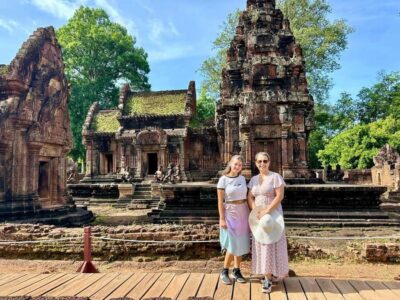

3-Days Discovery Of Angkor: Waterfalls,Floating Village and Banteay Srei temple
Read our review →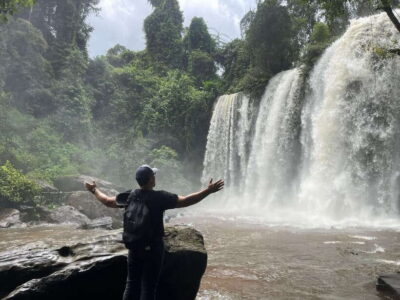
Banteay Srei, Kulen Waterfall & Beng Mealea Exploration
Read our review →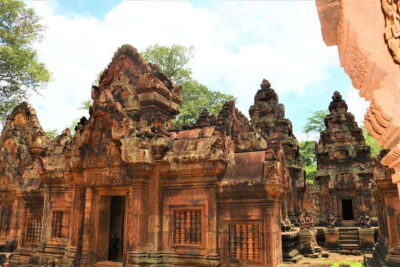
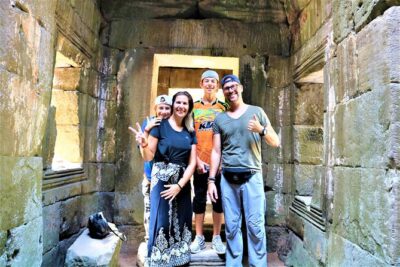
Banteay Srei and Grand Circuit Heritage Tour from Siem Reap
Read our review →Browse the lists this tour appears in