
Reviewed · ANGKOR WAT SUNRISE TOURS
Angkor Wat Sunrise, Bayon, Ta Prohm & Banteay Srei In Small Group
Wake up before the birds. This early start takes you from Angkor Wat at sunrise to Bayon, Ta Prohm, Banteay Srei, and Pre Rup in one long day. I like the maximum 12-person group, which should feel more manageable than a large coach, and I like the air-conditioned vehicle with cold water and wipes, a welcome comfort in Cambodia’s heat. The main drawback is the pace: five temples in 8 to 10 hours leaves limited time for lingering.
The price looks excellent at $24.30 per group, especially if you are sharing with several people, but it does not include the Angkor Park admission fee or meals. You will also leave around 4:30 a.m., so this suits you best if sunrise matters more than sleep and you are ready for a fairly demanding day on foot.
In This Review
- Key details before you book
- Why this temple day works best for early risers
- Angkor Wat gives the morning its grand opening
- Bayon brings you face to face with Khmer art
- Ta Prohm trades symmetry for tree-covered ruins
- Banteay Srei rewards the long ride
- Pre Rup closes the day with a climb
- The vehicle matters more than the low price suggests
- What the $24.30 group price really covers
- Clothing, weather, and fitness require planning
- Who should choose this Angkor Wat tour?
- Should you book this temple circuit?
- FAQ
- What time does the tour start?
- How long does the tour last?
- How many people can join the shared group?
- Is hotel pickup and drop-off included?
- Is the Angkor Park admission fee included?
- What should I wear for the temples?
Key details before you book
- Sunrise begins at Angkor Wat: You arrive early for the temple’s famous first light, with about three hours scheduled here.
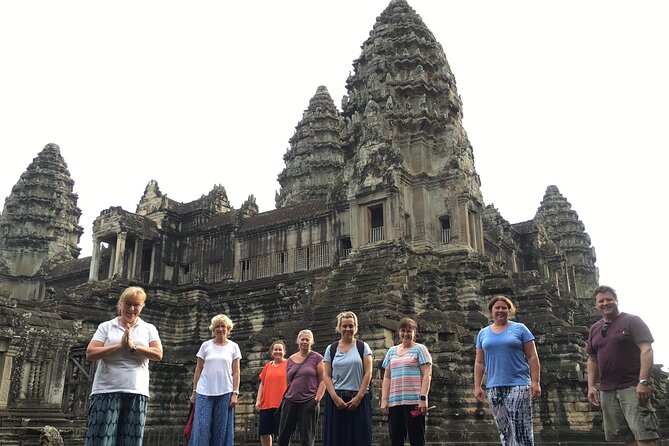
- Five major temple stops: The route includes Angkor Wat, Bayon, Ta Prohm, Banteay Srei, and Pre Rup.
- Small shared group: The vehicle carries no more than 12 people, with hotel pickup and drop-off included.
- Comfort in the heat: Air conditioning, cold drinking water, cold wipes, fuel, tolls, and parking are covered.
- Banteay Srei requires extra driving: This pink and red sandstone temple lies about 38 kilometers from Siem Reap.
- Temple admission costs extra: None of the listed stop times includes the Angkor Park entry fee.
Why this temple day works best for early risers
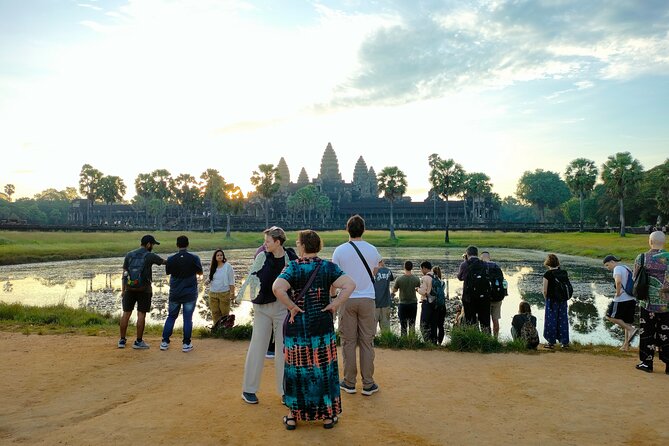
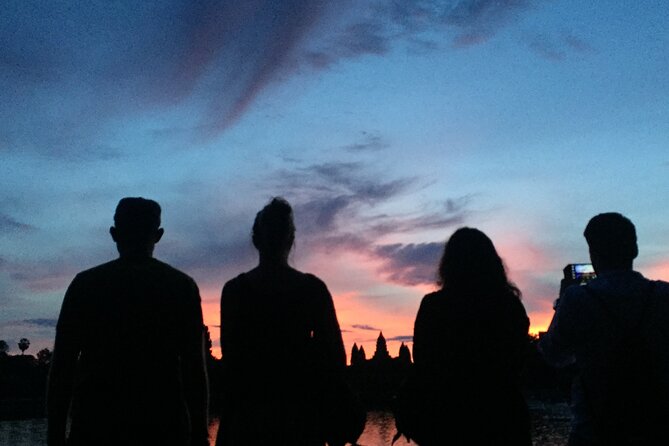
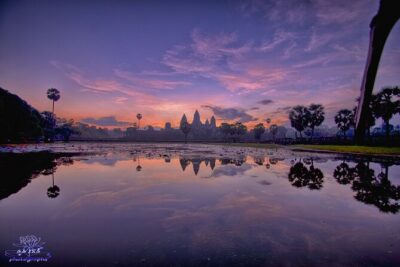
The day starts at about 4:30 a.m., an hour that feels unkind until you see the sky lighten behind Angkor Wat. The tour is built around getting there before the main crowds, giving sunrise the first and most important place in the schedule.
You should expect the opening hours to be dark and quiet, followed by a gradual shift in color across the temple silhouette. The sunrise itself depends on weather, of course, and the attraction can still be busy even with an early arrival. Still, this is the right timing if you want the best chance at a calmer first look.
The schedule allows three hours at Angkor Wat. That is enough for the sunrise, an initial look at the great towers, and time to explore beyond the first viewpoint. It is not excessive, especially if you want to study the carvings and move through the temple at a relaxed pace.
Because the day includes four more temples, you should keep some energy in reserve. Angkor Wat can easily absorb an entire morning on its own, but this tour asks you to treat it as the first chapter rather than the whole book.
More ways to see Angkor Wat:
- Angkor Wat Sunrise or Sunset Tour with Guide from Siem Reap
★ 5.0 · 12,109 reviews - Siem Reap: Angkor Wat: Small-Group Sunrise or Sunset Tour
★ 5.0 · 9,444 reviews - Siem Reap: Angkor Wat 2-Day Tour with Sunrise and Sunset
★ 4.9 · 4,429 reviews
Angkor Wat gives the morning its grand opening
Angkor Wat is the largest and most famous stop, and it deserves the longest visit. Its scale is the first thing you notice, but the smaller details reward patience: carved surfaces, galleries, towers, and the changing view as daylight replaces darkness.
You will have time to take in the exterior and explore the temple area, though the exact route may depend on conditions and the guide’s plan. The early hour can also mean a cooler start, which makes the first walk easier than visiting at midday.
The practical point is simple: wear shoes you can walk in and carry only what you need. This is a long temple day, and the combination of uneven ground, stairs, heat, and early waking can catch up with you by afternoon.
The Angkor Park admission fee is not included. Plan for that separate cost before you arrive, since the tour price covers transport and guiding rather than temple entry. The low advertised price is therefore best understood as a transport and tour service price, not the total cost of the day.
Bayon brings you face to face with Khmer art
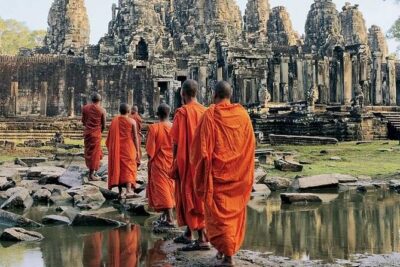
After Angkor Wat, the tour moves to Bayon Temple for about an hour. Bayon is known for more than 200 large stone faces, which appear from different angles as you move through its maze-like structure.
This stop changes the mood. Angkor Wat feels broad, ordered, and monumental. Bayon feels more enclosed and puzzling, with towers and corridors revealing new faces as you walk. I would pay attention to how the expressions and viewpoints shift, rather than rushing through simply to collect photographs.
One hour is a useful introduction, but it is not generous if you want to examine every carving. Your guide can help point out the main features and explain the temple’s role, saving you from spending the entire visit trying to work out the layout alone.
The ground may be uneven, and the route involves walking through a substantial temple complex. A moderate level of fitness is requested for good reason. You do not need to be an athlete, but you should be comfortable walking for much of the day.
Ta Prohm trades symmetry for tree-covered ruins
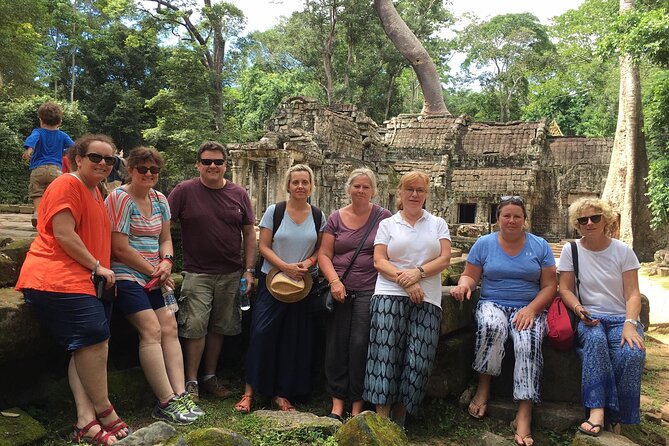
Ta Prohm is scheduled for another hour. This is the temple where trees and stone share the frame, with roots pressing around crumbling walls and doorways. The setting feels very different from Bayon and Angkor Wat, which is why it earns its place on a highlights route.
I like the contrast here. You are not simply seeing another large stone monument. You are seeing how time, vegetation, and weather have changed the site’s appearance, creating the atmospheric quality many people hope for from Angkor.
The drawback is that Ta Prohm is a popular stop, and one hour can pass quickly. If a particular doorway or tree attracts a crowd, you may need to wait or move on. A small group helps keep the visit organized, but it cannot control the number of people at the temple.
Use the time for both the famous views and the less obvious corners. Your guide can help you avoid spending every minute at the same photo point. This is also a good moment to use one of the supplied cold wipes before returning to the vehicle.
More trips out to Banteay Srei:
- Full-Day Banteay Srei & 4 Temples – Grand Tours Join-in Tour
★ 5.0 · 1,155 reviews - Siem Reap Tour: Angkor Wat Sunrise, Bayon, Ta Prohm, Banteay Srei
★ 5.0 · 931 reviews - 2-Day Angkor Wat With Small, Big Circuit and Banteay Srei Tour
★ 5.0 · 545 reviews - From Siem Reap: Banteay Srei Temple & Grand 5 Temple Tour
★ 4.8 · 262 reviews
Banteay Srei rewards the long ride
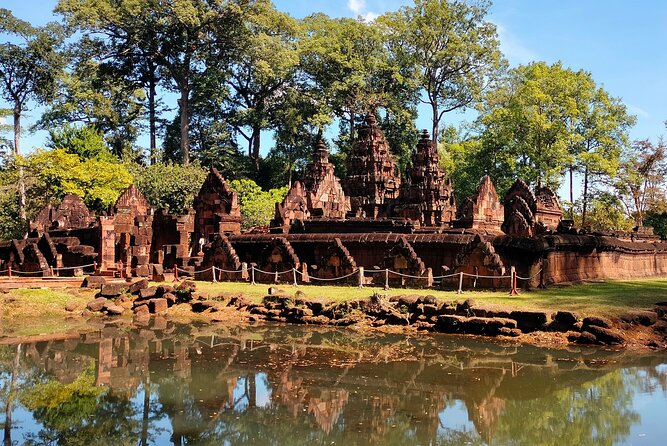
Banteay Srei is about 38 kilometers from Siem Reap, so reaching it adds a substantial drive to the day. The route passes through the countryside, giving you a change from the main temple circuit and a look at the area beyond the central ruins.
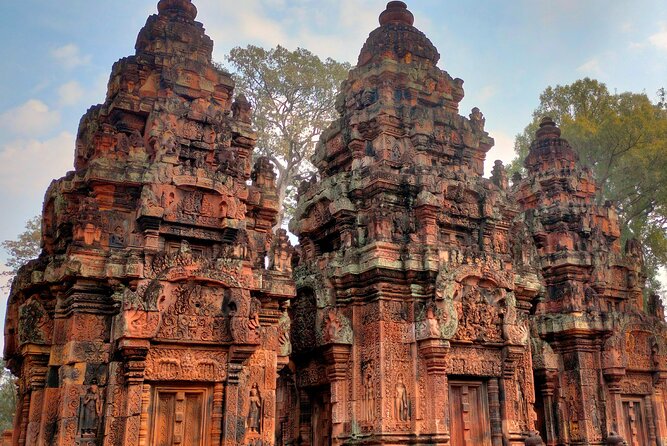
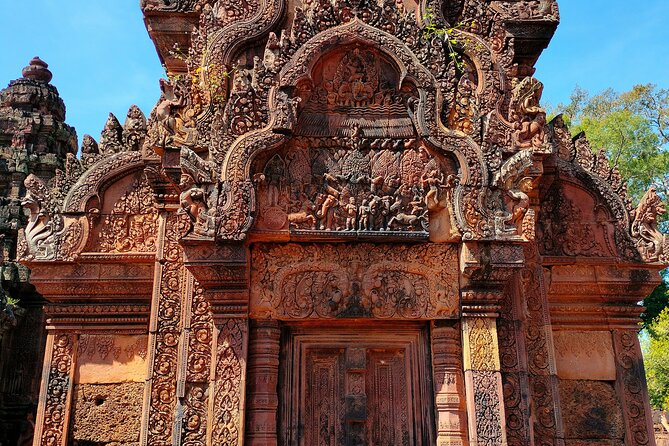
The temple is famous for its pink and red sandstone and fine carvings. Compared with the massive scale of Angkor Wat, Banteay Srei feels smaller and more delicate. Its nickname, the lady temple, reflects the graceful quality of the decoration, while its detailed stonework has earned it a place among the most admired Khmer artistic sites.
Two hours are scheduled here, which is helpful. The extra time partly balances the drive and gives you a chance to study the carvings rather than treating the temple as a quick photo stop.
The tradeoff is road time. If your priority is maximum time at the central Angkor temples, Banteay Srei makes the day less efficient. If you want a broader look at Khmer architecture and art, the journey is worthwhile. I would choose this route over a shorter loop if you have only one full day and specifically want to see the pink sandstone carvings.
Pre Rup closes the day with a climb
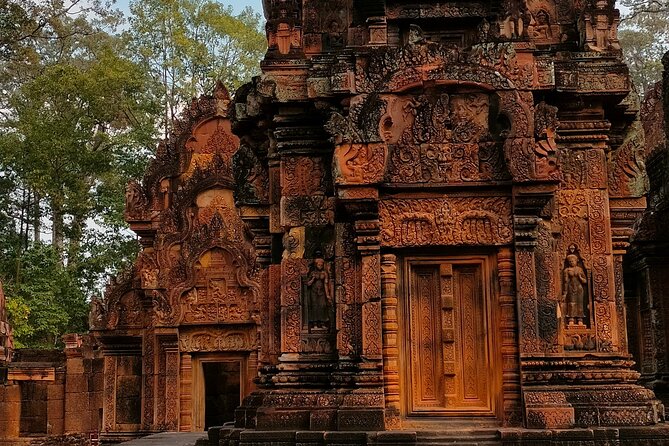
Pre Rup is the final listed stop, with about an hour set aside. This 10th-century brick temple was dedicated to Shiva and used as a royal crematorium. Its clay-colored brick construction gives it a different look from the carved sandstone of Banteay Srei and the gray stone structures elsewhere on the route.
The temple is noted for its climb and good condition. After a full day, the climb may feel more demanding than it would in the morning, so take it steadily. You should not treat the last stop as an afterthought. Pre Rup offers a strong final contrast and a chance to see a religious and royal site with a different purpose.
The schedule does not identify this as a sunset visit, so you should not book it expecting a guaranteed end-of-day view. Its value is the temple itself, its brick construction, and the historical explanation provided during the visit.
The vehicle matters more than the low price suggests
Hotel pickup and drop-off are included, along with a shared air-conditioned vehicle and a safe driver. That is important in Siem Reap, where the heat and long distances can make a self-arranged temple day tiring.
The vehicle includes cold water and cold wipes. These are modest touches, but they matter after walking through hot temple grounds. Fuel, toll roads, and parking are also covered, so you are not repeatedly reaching for cash during the day.
A maximum of 12 people is a sensible middle ground. You get the lower cost of a shared trip without the scale of a large bus. The group size can still affect how quickly everyone moves, especially at sunrise or when the guide is explaining a crowded site, but it should be easier to keep together.
The tour lasts approximately 8 to 10 hours. That range likely reflects pickup locations, traffic, time at each site, and the long drive to Banteay Srei. Keep your schedule light afterward. After a 4:30 a.m. start and five temple stops, you may want a quiet evening rather than another activity.
What the $24.30 group price really covers
At $24.30 per group of up to 12, the price is strong if you are traveling with family or friends. Divided among a full group, the transport and guide service can be remarkably inexpensive. Even with fewer people, the cost may still make sense if you value not arranging a driver, vehicle, route, parking, and temple order yourself.
The price does not include the Angkor Park admission fee. It also excludes breakfast, lunch, dinner, and other food or drinks, although cold water is provided. Bring or arrange food for the morning, since the early departure means you may not have time for a normal hotel breakfast.
I would compare the total cost, not just the headline figure. Add the park admission, meals, and any personal expenses before deciding. Even then, the included pickup, vehicle, fuel, tolls, parking, and guide service give the tour solid practical value.
Clothing, weather, and fitness require planning
The clothing instructions are strict. You need to cover your knees and shoulders at places of worship and selected museums, and shorts or sleeveless tops may lead to refused entry. Choose light clothing that still provides full coverage, and avoid assuming that hot weather will excuse the dress rule.
The information gives both formal and smart casual dress guidance. In practical terms, aim for respectful, neat clothing with covered shoulders and knees. This removes uncertainty and keeps you ready for every temple on the route.
The tour operates in all weather conditions, so dress for the forecast and bring suitable protection. Poor weather can lead to cancellation, in which case you are offered another date or a full refund. A full refund is also available if you cancel at least 24 hours before the start time. Changes or cancellations inside that window are not accepted for a refund.
You should have a moderate level of fitness. Expect repeated walking, uneven temple surfaces, and a climb at Pre Rup. The heat, early start, and long day matter as much as the physical distance.
Who should choose this Angkor Wat tour?
I would recommend it to first-time visitors who want the major Angkor sights in one organized day. It is also a good fit for small families or friend groups that can share the vehicle price and prefer a guide rather than handling the route alone.
It suits you if sunrise at Angkor Wat is a priority, Banteay Srei is on your must-see list, and you want air conditioning between temple stops. The cold water and wipes are useful details, not luxury extras, in Cambodia’s heat.
I would hesitate if you dislike early mornings, prefer long unhurried visits, or want to spend a full day at only one or two temples. The route is ambitious, and the long drive to Banteay Srei means some time is spent in transit.
The available rating information is limited, so I would not treat it as proof of every aspect of the operation. One separate experience connected with the same Siem Reap tour provider praised a guide named Sam and an air-conditioned SUV, but that comment concerned a Phnom Kulen outing, not this Angkor route. It is useful background on the provider’s service, but it should not be taken as a direct evaluation of this exact day.
Should you book this temple circuit?
Book it if you want a practical, low-cost way to see Angkor Wat at sunrise, Bayon, Ta Prohm, Banteay Srei, and Pre Rup without organizing transport yourself. The small group, air conditioning, hotel transfers, and five-stop route make it a strong choice for a first visit.
Before booking, make three checks: confirm you are comfortable with a 4:30 a.m. start, budget separately for Angkor Park admission and meals, and pack clothing that covers your shoulders and knees. If those conditions suit you, this is a well-planned introduction to Siem Reap’s major temple sights, with enough variety to keep the long day worthwhile.
FAQ
What time does the tour start?
The stated start time is 4:30 a.m.
How long does the tour last?
The experience lasts approximately 8 to 10 hours.
How many people can join the shared group?
The maximum group size is 12 travelers.
Is hotel pickup and drop-off included?
Yes. Hotel pickup and drop-off are included.
Is the Angkor Park admission fee included?
No. Admission to Angkor Park is not included in the tour price.
What should I wear for the temples?
Your knees and shoulders must be covered for entry to places of worship and selected museums. Shorts and sleeveless tops are not allowed, and you should dress appropriately for the weather.
More Visits to Ta Prohm
- Siem Reap Private Day Tour: Angkor Wat Sunrise, Bayon & Ta Prohm
★ 5.0 · 48 reviews - A Day Angkor Wat Sunrise Tour, Ta Prohm & Hidden Gems Beng Mealea
★ 5.0 · 36 reviews - Unveiling Angkor Wat Sunrise, Bayon, Ta Prohm In Small Group Tour
★ 5.0 · 28 reviews - Shared Tour to Angkor Wat, Bayon and Ta Prohm Temples
★ 5.0 · 27 reviews
More of Angkor Thom and the Bayon
- Angkor Wat Private Driver Tours to Angkor Wat Sunrise, Angkor Thom & Ta Prohm
★ 5.0 · 98 reviews - Angkor Wat Sunrise and Angkor Thom Sunset Tour
★ 5.0 · 89 reviews - Private Temples Guided Tour (Angkor Wat, Ta Prom & Angkor Thom)
★ 5.0 · 75 reviews - One Full Day Private tour of Angkor Wat, Ta Prohm, Angkor Thom & Banteay Srie
★ 5.0 · 64 reviews
Newest reviews from Siem Reap
- Village walking & Cooking class in Siem Reap★ 5.0 · 2 reviews
- Ultimate Sunrise to Angkor Wat, Angkor Thom and Bayon Temple★ 5.0 · 3 reviews
- Angkor Wat Sunrise Shared Tours: Bayon, Ta Prohm And Kravan★ 5.0 · 1 review
- Twilight Tastes of Siem Reap Include Dinner★ 5.0 · 13 reviews
- Two Days Tour Angkor Complex; Banteay Srei, and Kulen Hill★ 5.0 · 1 review
- Trip to Big Circle included Banteay Srey and Banteay Samre★ 5.0 · 1 review
- Trekking Tour at Phnom Kulen National Park from Siem Reap★ 5.0 · 3 reviews
- Full-Day Private Tour of Angkor Wat with Pick Up★ 5.0 · 12 reviews
Angkor Wat Sunrise Tours, compared.
Angkor Wat Sunrise or Sunset Tour with Guide from Siem Reap
Read our review →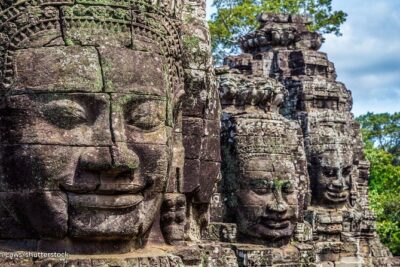
Angkor Wat Sunrise tour with Small – Group and Guide tours
Read our review →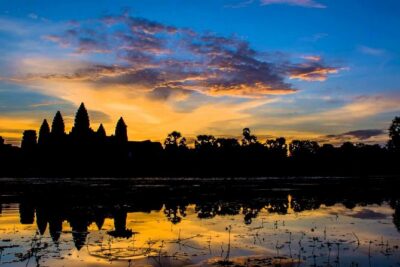
Full-Day Angkor Wat Sunrise Private Tour with Guide from Siem Reap
Read our review →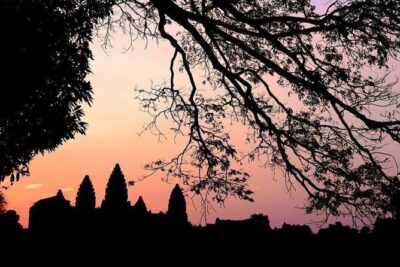
Angkor Wat Sunrise & 3 Main Temples with Breakfast – Small Group
Read our review →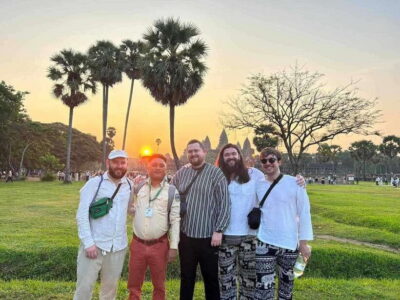
Angkor Wat Sunrise and Full-Day Sightseeing Tour
Read our review →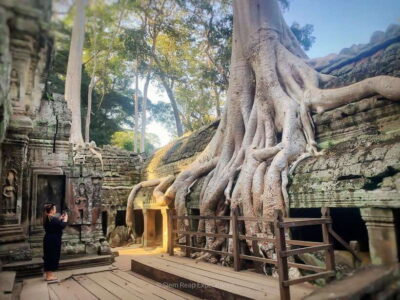
Siem Reap Tour: Angkor Wat Sunrise, Bayon, Ta Prohm, Banteay Srei
Read our review →
Angkor Wat Sunrise Explore The Most Iconic Temples
Read our review →Browse the lists this tour appears in