
Reviewed · ANGKOR WAT TOURS
Private Day Angkor Wat Temple and Banteay Srei Temple Tour
Angkor rewards a well-planned day. This private Siem Reap tour combines personal transport with an English-speaking guide, taking you from Ta Prohm and Banteay Srei to Angkor Thom and Angkor Wat. I like the flexible private format, and I like that the guide can adjust the experience to suit your interests. The main drawback is the long list of temples in one day, which means plenty of walking and a fairly quick look at several sites.
At $43 per person, the price is reasonable for a private vehicle, guide, parking, tolls, cold water, towels, and airport pickup or drop-off. You must add the one-day temple pass, listed at $37 per person, bringing the known total to $80. I would also note the physical demands: one guest with a hurt foot needed help with closer vehicle access, a moped, and a tuk-tuk, which the guide arranged.
In This Review
- Key points to know before booking
- Why this private Angkor day works well
- Ta Prohm: roots, corridors, and a royal monastery
- Pre Rup offers a short look at Khmer temple design
- Banteay Srei rewards close attention
- Angkor Thom begins at the South Gate
- Bayon and its 173 stone faces
- Baphuon and Phimeanakas reveal Angkor Thom’s royal center
- The royal terraces turn history into a long stone platform
- Three hours at Angkor Wat
- What the $43 price really covers
- Who should book this day
- Should you book the Angkor Wat and Banteay Srei tour?
- FAQ
- How long does the tour last?
- Is the tour private?
- Is transportation included?
- Is an English-speaking guide included?
- Is the temple admission pass included?
- Which temples and monuments are visited?
- Can the tour be canceled for a full refund?
Key points to know before booking
- Ta Prohm begins the day with jungle-covered ruins, giant roots, and a former Buddhist monastery setting.
- Banteay Srei is the artistic highlight, with small-scale 10th-century carvings dedicated to Shiva.
- Angkor Thom packs several major monuments together, including Bayon’s enormous stone faces and the long royal terraces.
- Angkor Wat receives three hours, enough for a serious visit, though the full day can feel busy.
- The tour is private, so your group can request changes and spend more time at favorite sites.
- The temple pass costs extra, so budget $80 per person before any other personal expenses.
Why this private Angkor day works well
The strength of this experience is control. You are not tied to a large group moving at one fixed pace. The guide can explain a carving, shorten a stop, or change the order of the day when practical. Chanra, one guide associated with the tour, communicated through WhatsApp and helped customize the route, adding suggestions along the way.
That matters at Angkor. The ruins are spread across a large area, and the difference between a comfortable visit and a tiring one often comes down to how well the day is arranged. An air-conditioned vehicle gives you a place to cool down between stops, while water and towels are small but useful comforts in Cambodia’s heat.
The tour runs for about eight and a half hours. That is a substantial day, not a quick temple sampler. You will see the headline monuments, but the schedule also gives you only 15 minutes at the Terrace of the Leper King and 20 minutes at the South Gate and Pre Rup. Those shorter stops are best treated as focused visits rather than full explorations.
More ways to see Angkor Wat:
- Angkor Wat Sunrise or Sunset Tour with Guide from Siem Reap
★ 5.0 · 12,109 reviews - Siem Reap: Angkor Wat: Small-Group Sunrise or Sunset Tour
★ 5.0 · 9,444 reviews - Siem Reap: Angkor Wat 2-Day Tour with Sunrise and Sunset
★ 4.9 · 4,429 reviews
Ta Prohm: roots, corridors, and a royal monastery
The day begins at Ta Prohm, where you have about one hour. Its original name was Rajavihara, meaning monastery of the King. King Jayavarman VII built it in 1186 as a Mahayana Buddhist monastery and university.
Ta Prohm is famous for the way trees and roots spread across the stone ruins. The vegetation is not just decoration. It gives the site a rough, partly reclaimed appearance that feels different from the more ordered Angkor Wat. You move through galleries, courtyards, and narrow passages where the stonework and jungle seem to compete for space.
I like starting here because it gives you an immediate sense of how varied Angkor can be. You are not looking at one grand monument repeated ten times. You are seeing a former religious complex shaped by time, plants, restoration, and royal ambition.
The one-hour stop is useful, but it may feel short if you want to study every corridor. Admission is not included in the tour price, and the one-day pass covers the temples separately. Wear shoes suitable for uneven ground and expect some walking, since temple visits here are not simply roadside photo stops.
Pre Rup offers a short look at Khmer temple design
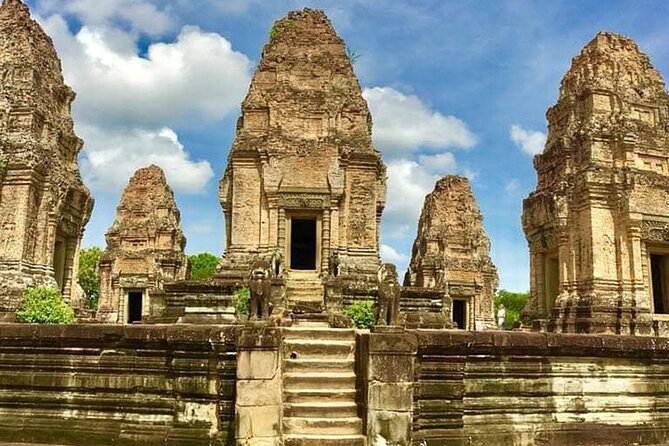
Pre Rup gets about 20 minutes. King Rajendravarman built it as a state temple in 961 or 962, only nine years after East Mebon, which lies about 1.3 kilometers to the north.
With such a short visit, you will likely focus on the central structure and overall form rather than every detail. Pre Rup is a useful change of scale after Ta Prohm. Its strong brick and laterite appearance gives the stop a more formal, geometric character.
I would treat this as a quick architectural pause. If you are especially interested in Pre Rup, ask your guide whether the timing can be adjusted, since the private format may allow some flexibility. The tour does not promise that every stop can be extended, so keep expectations realistic.
Banteay Srei rewards close attention
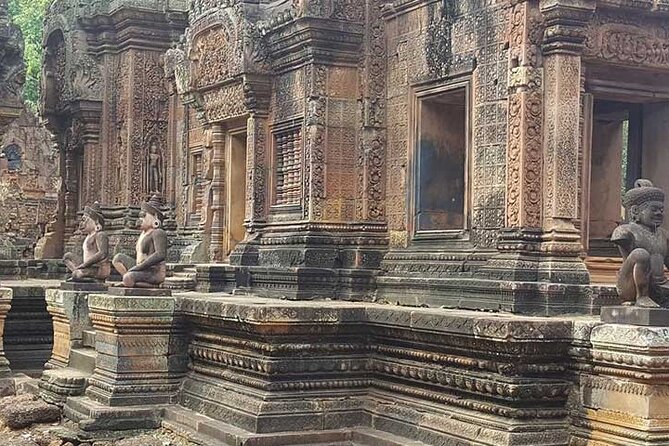
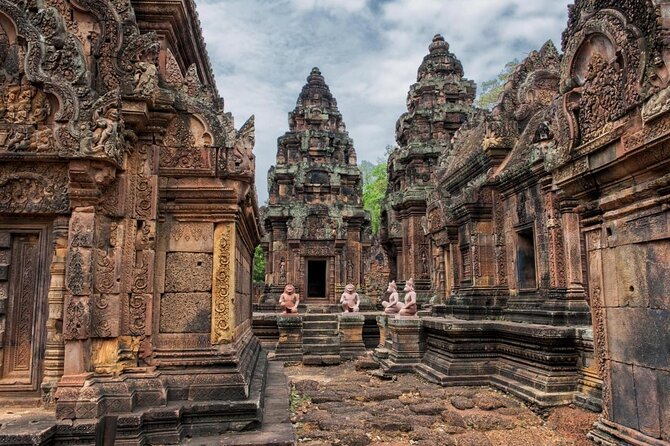
Banteay Srei receives about an hour, and I consider it one of the most worthwhile stops on the route. The temple dates from the 10th century and is dedicated to Shiva. Its name is often translated as Temple of Women, and it is also known as the Pink Ladies Temple.
Unlike the huge compounds at Angkor Wat and Angkor Thom, Banteay Srei is smaller. That is part of its appeal. The scale lets you concentrate on the carvings, which include detailed motifs and figures of Hindu gods. The artistry is especially easy to appreciate when you stand close enough to see the fine patterns in the sandstone.
Banteay Srei lies about 25 kilometers northeast of the main Angkor area, so including it adds driving time. That is the trade-off. You give up some leisurely time at the central temples, but you gain a monument with a very different look and feel.
I like this stop for people who care about craftsmanship as much as size. Angkor Wat is the grand statement. Banteay Srei is the careful carving lesson.
More trips out to Banteay Srei:
- Full-Day Banteay Srei & 4 Temples – Grand Tours Join-in Tour
★ 5.0 · 1,155 reviews - Siem Reap Tour: Angkor Wat Sunrise, Bayon, Ta Prohm, Banteay Srei
★ 5.0 · 931 reviews - 2-Day Angkor Wat With Small, Big Circuit and Banteay Srei Tour
★ 5.0 · 545 reviews - From Siem Reap: Banteay Srei Temple & Grand 5 Temple Tour
★ 4.8 · 262 reviews
Angkor Thom begins at the South Gate
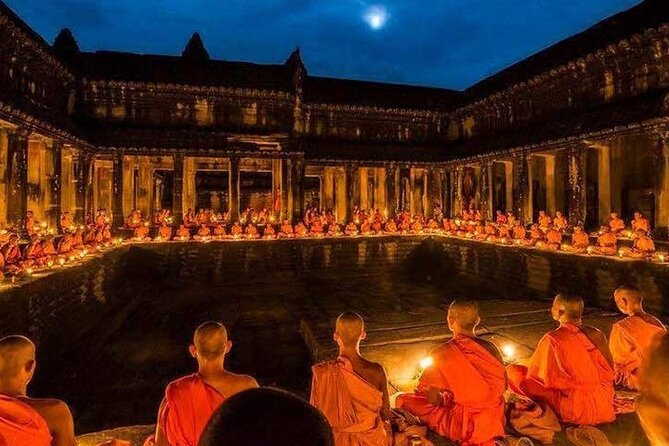
The Angkor Thom section starts with a 20-minute visit to the South Gate. The approach crosses a moat about 100 meters wide, along a causeway lined with naga balustrades. Large stone figures frame the route, creating a ceremonial entrance rather than an ordinary gateway.
This is a good place to pause and look at the full approach before focusing on the gate itself. The causeway helps you understand that Angkor Thom was planned as a major royal city, not simply a collection of temples.
Twenty minutes is enough for photographs and a short explanation. It is not enough for a slow study of every figure. Keep your camera ready, but do not forget to look sideways along the causeway, where the repeated sculptures create much of the effect.
Bayon and its 173 stone faces
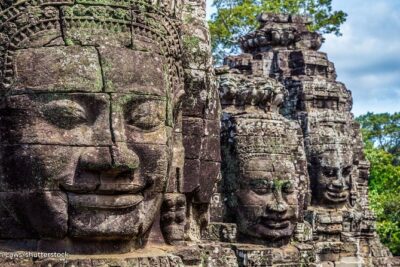
Bayon gets 50 minutes, making it one of the more substantial stops before Angkor Wat. The temple is known for its gigantic carved faces, with 173 faces remaining on its towers.
Their identity is still debated. Local Khmer tradition connects them with the Four Faces of Prohm, while the monument has also been linked to the royal and religious ideas of the period. Your guide can help you sort through those interpretations without reducing the temple to a single easy answer.
Bayon is confusing in the best way. Towers, galleries, and passages create a crowded arrangement that rewards slow looking. The giant faces appear from different angles, and their expressions can change as you move around the structure.
Fifty minutes gives you time to see the main features, but this is another stop where uneven surfaces and stairs can make the visit tiring. If you have limited mobility, discuss the route with your guide early. The private arrangement offers more room to adapt than a large fixed group.
Baphuon and Phimeanakas reveal Angkor Thom’s royal center
Baphuon receives 40 minutes. It was the state temple of King Udayadityavarman II and sits inside Angkor Thom between the Royal Palace and Bayon. The sandstone monument was dedicated to Shiva, giving the complex another important Hindu site alongside Buddhist monuments.
Its position matters. You are not only visiting an isolated temple. You are moving through the center of the old Khmer capital, where religious buildings and royal spaces were closely connected.
Phimeanakas follows with about 30 minutes. It forms part of the royal enclosure and carries a story that makes it more memorable than its size might suggest. The surrounding area is thick with trees, and the temple can feel quieter and less visually overwhelming than Bayon or Angkor Wat.
Together, Baphuon and Phimeanakas give the middle of the day a useful rhythm. Bayon supplies the famous faces. Baphuon shows another temple style. Phimeanakas connects the monuments to the royal enclosure.
The royal terraces turn history into a long stone platform
The Terrace of the Elephants takes about 30 minutes. Built by King Jayavarman VII at the end of the 12th century, it stretches for more than 300 meters from Baphuon in the south to the Terrace of the Leper King in the north.
The scale is the main point. This is not a compact shrine where you step inside and leave. The terrace faces the parade grounds and formed part of the eastern boundary of the Royal Palace grounds. Its long decorated wall helped create a ceremonial public setting.
The Terrace of the Leper King follows for 15 minutes. Together, the two royal terraces define the edge of the palace area. The shorter stop means you will mainly see the terrace, its carved surfaces, and its relationship to the grounds around it.
I would pay attention to how open these spaces feel after the enclosed corridors of Bayon. Angkor Thom makes more sense when you notice the relationship between temple, palace, parade ground, moat, gate, and terrace.
Three hours at Angkor Wat
The final major stop is Angkor Wat, with three hours. That is the right kind of time for the largest and most famous temple in the complex, though even three hours cannot cover every corner at a leisurely pace.
Angkor Wat is built around five concentric rectangular walls and surrounding moats. The design represents a cosmic arrangement of mountains and ocean, with the central tower symbolizing Mount Meru, the center of the Hindu and Buddhist universe.
That symbolism is easier to understand when you take the time to notice the progression inward. The moat creates separation from the outside world. The walls and galleries guide you toward the central towers. The monument is not just large; it is organized around a religious idea of the universe.
I would use the three hours in stages. First, take in the scale and main approach. Then look at the galleries, carvings, towers, and interior spaces. Finally, leave time to simply sit or pause and understand the proportions. Rushing from one photograph to the next is the easiest way to make Angkor Wat feel like a checklist.
The site can also be physically demanding. You will walk across broad open areas and uneven stone surfaces, and some parts may require extra care. If you have a hurt foot or use crutches, tell the guide before the day begins. The tour’s guide arranged closer access and alternative transport for one guest, helping her see sites she might otherwise have missed.
What the $43 price really covers
The advertised price is $43 per person, but the temple pass is separate at $37 for one day. Your known cost is therefore $80 per person.
For that amount, you receive a private, air-conditioned vehicle, an English tour guide, parking fees, road tolls, cool water, towels, and pickup or drop-off at the airport. A private vehicle is particularly useful here because the temples are spread out and the day includes Banteay Srei, which is outside the main central cluster.
The value improves for a small group sharing the private experience. You are paying not just for transport, but for a guide who can help explain what you are seeing and make practical adjustments. Group discounts are offered, though the exact discount is not specified, so ask for the current amount before booking.
The price is less attractive if you want a slow, highly specialized study of only two or three temples. This itinerary aims for range. You see many major monuments in one day, but some stops are necessarily brief.
Who should book this day
I would recommend it to a first-time visitor with one full day for Angkor who wants the essential monuments without arranging transport between each one. It also suits couples, families, and small groups who value privacy and the ability to ask for changes.
The tour is a good choice if you want Banteay Srei included. Some central Angkor routes skip it because of the extra driving, but its detailed carvings make the added distance worthwhile for many people.
It is less suitable if you dislike early starts, long temple days, or repeated walking on uneven ground. The schedule is full, and the combination of Ta Prohm, Angkor Thom, Banteay Srei, and Angkor Wat demands stamina.
Confirmation is provided at booking, and the activity is listed as suitable for most people. Pickup and drop-off at the airport are included. The listed operating hours are Monday through Sunday, 8:00 AM to 4:00 PM, from September 8, 2023 through November 25, 2026.
Should you book the Angkor Wat and Banteay Srei tour?
Book it if you want a private, well-covered first day with a guide, air-conditioned transport, and both the famous monuments and the finely carved Banteay Srei. The strongest features are the flexible format, Chanra’s reported WhatsApp communication, and the practical help available for a guest with limited mobility.
Skip it if you prefer to spend an entire morning at one temple or avoid a packed schedule. At $80 per person after the temple pass, it offers solid value for a private day, but its success depends on accepting a busy route. For most first visits to Siem Reap, the mix of Ta Prohm’s roots, Bayon’s faces, Banteay Srei’s carvings, and Angkor Wat’s grand design makes the day worthwhile.
FAQ
How long does the tour last?
The tour lasts approximately 8 hours and 30 minutes.
Is the tour private?
Yes. Only your group participates in the activity.
Is transportation included?
Yes. An air-conditioned vehicle is included, along with parking fees and road tolls. Pickup and drop-off at the airport are also included.
Is an English-speaking guide included?
Yes. The tour includes an English tour guide.
Is the temple admission pass included?
No. The one-day temple pass is listed separately at $37 per person.
Which temples and monuments are visited?
The route includes Ta Prohm, Pre Rup, Banteay Srei, Angkor Thom South Gate, Bayon, Baphuon, Phimeanakas, the Terrace of the Elephants, the Terrace of the Leper King, and Angkor Wat.
Can the tour be canceled for a full refund?
Yes, if you cancel at least 24 hours before the experience start time. Cancellations made less than 24 hours before the start time are not refunded, and changes within that period are not accepted.
Newest reviews from Siem Reap
- War Museum, Killing Field, and APOPO Hero RATs Tour★ 5.0 · 7 reviews
- Angkor Wat at Sunrise★ 4.0 · 7 reviews
- Siem Reap Angkor Airport Taxis (from Airport to Hotel)★ 5.0 · 44 reviews
- Cambodian Cooking Class and Oxcart Ride with Local Village Tour★ 5.0 · 4 reviews
- Secret Temples of Angkor – Guided Tour in Siem Reap★ 5.0 · 6 reviews
- Short Cycling at Countryside★ 5.0 · 29 reviews
- SIEM REAP E-BIKE HALF-DAY COUNTRYSIDE (25-30 km)★ 4.0 · 1 review
- Unveiling the Mystical Beauty of Phnom Kulen National Park★ 5.0 · 6 reviews
Angkor Wat Tours, compared.
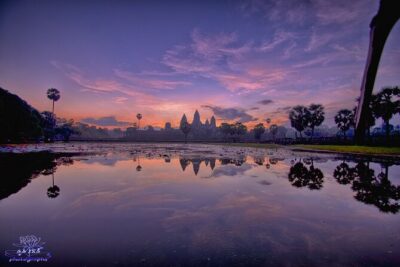
Angkor Wat Sunrise or Sunset Tour with Guide from Siem Reap
Read our review →
Angkor Wat: Small-Group Sunrise or Sunset Tour
Read our review →
Angkor Wat 2-Day Tour with Sunrise and Sunset
Read our review →
Angkor Wat Sunrise tour with Small – Group and Guide tours
Read our review →
Angkor Wat Highlights and Sunrise Guided Tour from Siem Reap
Read our review →
Angkor Wat Sunset Small Group Tour with Lunch Included
Read our review →
Full-Day Angkor Wat Sunrise Private Tour with Guide from Siem Reap
Read our review →Browse the lists this tour appears in