Reviewed · ANGKOR WAT TOURS
Small group: Angkor Wat tour with sunset
Temple time is best shared wisely. This $22 small-group Angkor Wat tour packs Ta Prohm, Angkor Thom, Bayon, and Angkor Wat into a guided day with hotel pickup, air conditioning, cool water, and towels. A licensed English-speaking guide adds the Khmer history and religious context that can be hard to grasp when you are walking among enormous stones on your own.
I like the maximum group size of 10, which should make it easier to hear the guide and ask questions. I also like the price, since shared transport and a local guide for a full temple circuit can save you money. The main drawback is that the $22 price does not include the Angkor Pass, which costs another $37, lunch, or personal expenses. Also, the published schedule begins at 8:30 a.m., so you should confirm exactly how the sunset portion fits into the day.
The route is well chosen. You see the jungle-covered Ta Prohm, the smiling faces of Bayon, several royal terraces, and the enormous Angkor Wat itself. It is a lot for one day, but the stops are arranged to give you a useful first look at the Angkor Archaeological Park without paying for a private vehicle.
In This Review
- Key points to know before booking
- What the $22 tour really gives you
- Ta Prohm: where stone and trees meet
- Angkor Thom South Gate: a short but important approach
- Bayon Temple and its many stone faces
- Baphuon: a temple mountain inside the old capital
- The royal terraces of Angkor Thom
- Lunch near Angkor Wat
- Angkor Wat: the main event
- How the sunset claim fits the schedule
- Guide quality and the shared-tour rhythm
- Who should book this Angkor Wat tour?
- My booking verdict
- FAQ
- What is the price of the Angkor Wat tour?
- How long does the tour last?
- Is hotel pickup included?
- How large is the group?
- Is food included?
- What does the tour provide during the day?
- Can I cancel for a full refund?
Key points to know before booking
- The group is capped at 10 people: This is small enough for a more personal guide experience than a large coach tour.
- The $22 price excludes the $37 Angkor Pass: Add the admission cost before comparing this tour with other options.
- Pickup and drop-off are included: You begin and end at your accommodation in Siem Reap, with transport in an air-conditioned vehicle.
- Ta Prohm comes first: You reach the famous tree-covered temple before the day’s main Angkor Thom circuit.
- Lunch is at a nearby local restaurant: Food is not included, so bring money and allow for the extra cost.
- The title includes sunset, but the timing needs checking: The listed start time is 8:30 a.m., while the written schedule does not give a separate sunset time.
What the $22 tour really gives you
At first glance, $22 sounds almost too cheap for a full day at Angkor. The price makes sense because this is a join-in tour, not a private excursion. You share the vehicle, guide, and schedule with a small group, while the major expenses remain your responsibility.
The included services are useful rather than flashy. Hotel pickup and drop-off remove the need to arrange tuk-tuk transport for the day. Air conditioning matters in Cambodia, especially after walking across sun-baked temple courtyards. Cool water and towels are small touches, but they are exactly the sort of things you appreciate once the heat catches up with you.
The admission fee is the big extra. You pay $37 for the Angkor Pass, so your basic day cost becomes $59 before lunch and any personal spending. That is still a fair price for transport, a licensed English-speaking guide, and a visit to several major sites, but you should not mistake the advertised fare for the full cost.
The shared format suits you best if you want structure and basic comfort without paying for a private guide. It is less suitable if you want to linger at one temple, change the order of stops, or spend long stretches taking photographs. A fixed route keeps the day moving.
The group limit of 10 is encouraging. A guide can usually speak to a group this size without turning every explanation into a loud announcement. You may still have to wait for other people at photo stops, but the experience should feel more manageable than a large bus tour.
More ways to see Angkor Wat:
- Angkor Wat Sunrise or Sunset Tour with Guide from Siem Reap
★ 5.0 · 12,109 reviews - Siem Reap: Angkor Wat: Small-Group Sunrise or Sunset Tour
★ 5.0 · 9,444 reviews - Siem Reap: Angkor Wat 2-Day Tour with Sunrise and Sunset
★ 4.9 · 4,429 reviews
Ta Prohm: where stone and trees meet
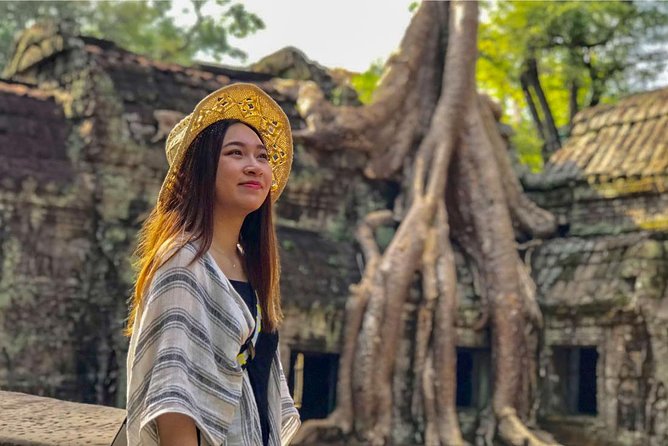
Ta Prohm is the dramatic opening act. It is known as the Tomb Raider temple, but its real appeal is older and more interesting than its film connection. Massive roots spread over stone walls and doorways, showing how the forest reclaimed parts of the site.
You have about one hour here. That is enough to see the major details and get photographs, though you will need to keep moving if the group is on schedule. Look closely at the carved doorways, galleries, and areas where roots press against the masonry. The contrast between careful Khmer construction and uncontrolled plant growth gives Ta Prohm a mood unlike the other stops.
The guide can help explain how the temple relates to Khmer religious life and architecture. That context matters here because Ta Prohm can otherwise become a quick photo stop. The tree roots are memorable, but the carved stone and the original purpose of the temple deserve attention too.
There is one practical limitation. Ta Prohm can feel crowded, and the narrow passages may make it difficult to stop wherever you like. A shared tour gives you a set amount of time, so arrive ready to follow the route rather than search out every corner.
Angkor Thom South Gate: a short but important approach
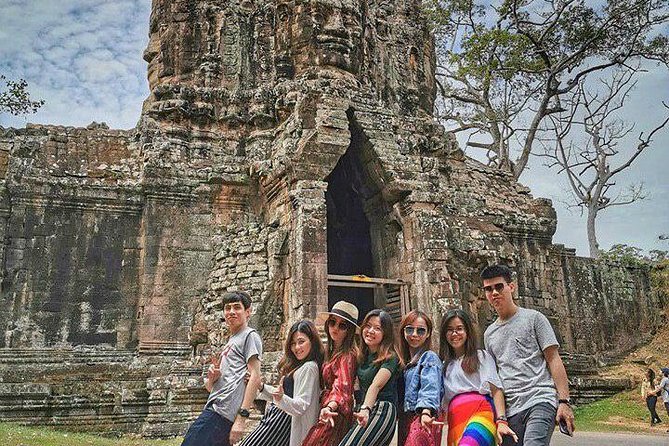
The 15-minute stop at Angkor Thom South Gate is brief. You are not getting a full tour of the gate area, but this entrance gives you a strong introduction to the scale of Jayavarman VII’s capital.
Angkor Thom became the capital of Jayavarman VII’s empire and the center of an enormous building program. The city was once a major royal and religious center, and the South Gate helps you see that this was not simply a collection of isolated temples. It was a planned city with walls, entrances, roads, and ceremonial spaces.
Use this stop to take in the approach, the gate design, and the carved figures along the causeway. Your guide can connect the gate to the larger story of Angkor Thom before you move on to Bayon.
Fifteen minutes goes quickly. You may want to take a few photographs, but do not expect a long lecture or time to explore the surrounding area. This is a useful orientation stop, not a standalone visit.
Bayon Temple and its many stone faces
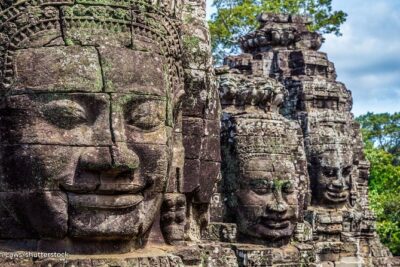
Bayon receives about 45 minutes, and this is one of the most valuable portions of the route. Located at the center of Angkor Thom, the temple is famous for its towers carved with large, calm faces. The faces appear from different angles as you move through the site, creating a sense that the temple is watching you back.
Bayon was built in the late 12th or early 13th century as the state temple of the Mahayana Buddhist King Jayavarman VII. That detail helps explain why the temple feels different from Angkor Wat, which began as a Hindu temple dedicated to Vishnu.
I would listen carefully here. Bayon’s layout can be confusing, with towers, galleries, stairways, and carved surfaces competing for your attention. A guide can point out how the structure was intended to work and explain the religious setting behind the images.
Forty-five minutes is reasonable for a first visit, but it is not generous. You will see the central features, take photographs, and hear the main explanation. If you already know Bayon well or want to study every relief, the group schedule may feel restrictive.
A few more options around Siem Reap worth reading up on
- From Siem Reap: Kampong Phluk Floating Village Tour by Boat
★ 4.9 · 6,979 reviews - Sunset tour of Kampong Phluk stilts home village on the Tonle Sap
★ 5.0 · 4,865 reviews - Siem Reap: Kampong Phluk Floating Village Tour with Boat
★ 4.9 · 3,843 reviews - Siem Reap: Full-Day Angkor Wat Guided Tour with Sunset
★ 4.9 · 3,803 reviews
Baphuon: a temple mountain inside the old capital
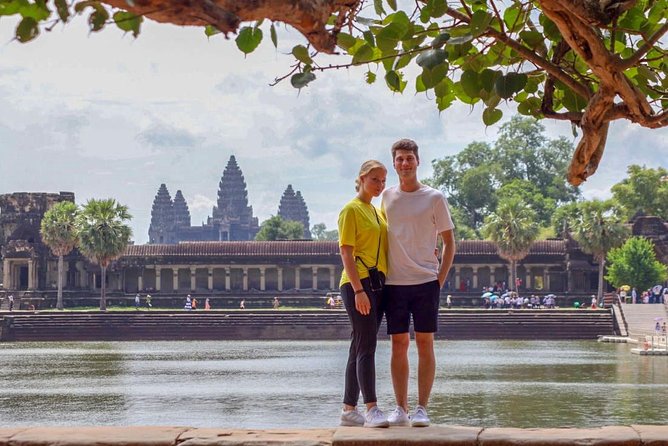
The next stop gives you 30 minutes at Baphuon, a three-tiered temple mountain northwest of Bayon. It was built in the mid-11th century as the state temple of Udayadityavarman II and dedicated to Shiva.
Baphuon adds an earlier chapter to the day. After seeing Jayavarman VII’s Buddhist monuments, you encounter a Hindu temple from a different period and ruler. This change helps you understand that Angkor was not built all at once. Its religious and political character shifted across centuries.
The temple’s rising form is worth noticing. It was designed as a symbolic mountain, a common idea in Khmer temple architecture. The climb and elevated structure also give the site a different feel from the enclosed galleries at Bayon.
Thirty minutes should let you appreciate the design and hear the basic story. It may not be enough if you want a slow architectural study. Wear secure footwear, since temple steps and uneven surfaces are part of the visit, though the supplied tour information does not specify the exact walking conditions.
The royal terraces of Angkor Thom
The Terrace of the Elephants gets 15 minutes. Jayavarman VII used this long platform to watch victorious armies return, so the site connects architecture with royal ceremony and military display.
The terrace is attached to the area of the former palace of Phimeanakas, though only a few ruins of that palace remain. Look for elephant motifs and the long ceremonial frontage. This stop is more about scale, position, and royal function than about entering a complete temple.
The Terrace of the Leper King follows with just 10 minutes. It occupies the northwest corner of Angkor Thom’s Royal Square and was built in the Bayon style under Jayavarman VII. Its modern name comes from a 15th-century statue found at the site, though the figure depicts Yama, the Hindu god of death.
Ten minutes is enough for a quick look and a guide’s explanation. It is not enough for a slow inspection of the walls and sculpture. Still, the two terraces add useful variety to the morning. They show how Angkor Thom functioned as a royal city, not just a religious complex.
Lunch near Angkor Wat
The tour includes a one-hour lunch break at a local restaurant near Angkor Wat. Food is not included, so you should budget separately for your meal and drinks beyond the supplied water.
This break is practical. By this point, you will have spent several hours walking through temples, and a pause before Angkor Wat keeps the afternoon from becoming a blur. You may prefer a longer meal, but the one-hour stop is designed to keep the group on schedule.
Because the restaurant is described only as local and nearby, you should not expect a planned food tasting or a special dining experience. Think of lunch as a convenient refueling stop. Bring small personal spending money and use the break to cool down before the largest temple of the day.
Angkor Wat: the main event
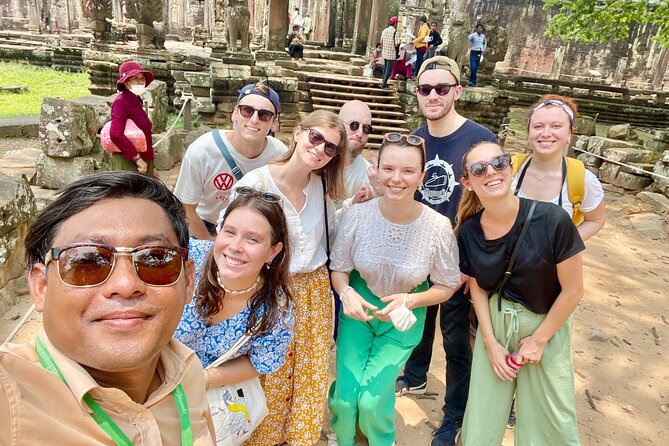
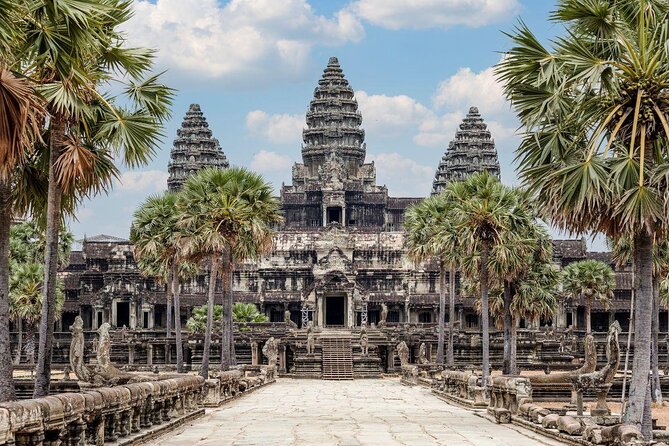
Angkor Wat receives about 90 minutes, making it the longest stop on the published route. It deserves that time, but you should understand what 90 minutes means at a site this large. You will get an introduction and a focused walk, not an exhaustive exploration of every gallery.
Angkor Wat covers a site measuring 162.6 hectares and is the largest religious monument in the world. It was first built as a Hindu temple dedicated to Vishnu for the Khmer Empire, then gradually became a Buddhist temple toward the end of the 12th century.
The scale can be difficult to grasp from photographs. As you approach, pay attention to the long axis, towers, galleries, and water-filled moat. Inside, the carved walls and layered design reward patience, but the guide will need to keep the group moving.
This is where the guide’s role becomes especially useful. The tour description promises help with Angkor history and photographs, and the sole written rating praises the experience as insightful, well organized, and delivered with light humor. That is a good sign for a long temple day, when a clear explanation and a bit of levity can make the schedule easier to manage.
Do not assume you will have unlimited time for the famous reflection photographs or every interior section. The listed 90 minutes is a sensible first visit, but you may want to return independently if Angkor Wat becomes the main reason for your trip.
How the sunset claim fits the schedule
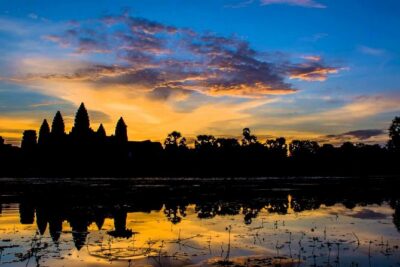
The experience is presented as an Angkor Wat tour with sunset, yet the provided schedule begins at 8:30 a.m. and lists the temple stops through Angkor Wat without a separate sunset time. The total duration is given as approximately six to eight hours, which also leaves some uncertainty about how late the day runs.
That does not mean sunset is absent. It means you should confirm the exact timing before booking, especially if photographing sunset is your main goal. Ask where the sunset portion takes place, how long you stay, and when you return to Siem Reap.
This matters because the schedule as written is already full. Ta Prohm, Angkor Thom, lunch, and 90 minutes at Angkor Wat create a busy day even before waiting, traffic, and sunset timing are considered. A clear answer from the operator will help you decide if the experience matches your plans.
Guide quality and the shared-tour rhythm
The strongest praise attached to this experience focuses on organization, insight, and light humor. The rating evidence is limited to one published review, so I would treat that as encouraging rather than conclusive. Still, those qualities are exactly what you want from a temple guide.
The guide is licensed and speaks English. You can expect help understanding Khmer history, religion, and architecture, plus assistance with photographs. The quality of the day will depend heavily on how clearly the guide manages the schedule and explains the sites.
A group of up to 10 gives you a fair chance to hear the commentary. You should still expect some waiting while people take pictures or regroup. If you dislike fixed timing, a private tour would offer more freedom, but it would cost more.
The free water and cool towels also support the day’s rhythm. You will not need to arrange basic transport or carry drinks for every stage, though you should still bring suitable clothing, sun protection, and footwear for temple walking.
Who should book this Angkor Wat tour?
I would recommend this tour if you want to see the major Angkor highlights in one organized day at a modest price. It is especially suitable for first-time visitors who want a guide, hotel transport, and a small group without paying private-tour rates.
It also works well if you have limited time in Siem Reap. The route covers several major monuments and gives you an introduction to both Hindu and Buddhist influences at Angkor. The guide’s historical explanations can help you make sense of the sites instead of treating them as a series of impressive ruins.
You may want another option if you want to photograph each temple at length, avoid midday touring, or choose your own meal and departure times. The fixed schedule is efficient, but efficiency always means giving up some freedom.
Budget carefully. The tour is $22 per person, but the $37 Angkor Pass, lunch, and personal expenses are extra. Free cancellation is available if you cancel at least 24 hours before the start time. Changes or cancellations within 24 hours are not refundable, and poor weather or failure to reach the minimum group size can lead to a different date or a full refund.
My booking verdict
I would book this as a good-value first day at Angkor, provided the sunset timing is confirmed before payment. The route includes the temples most people hope to see, the group is limited to 10, and the practical inclusions remove much of the day’s transport hassle.
The key is to keep expectations realistic. This is a shared introduction, not a private archaeological expedition. You will see a lot, hear useful explanations, and spend less than you would on a private vehicle, but you will need to follow the clock. Add the Angkor Pass and lunch to your budget, then book if that balance suits you.
FAQ
What is the price of the Angkor Wat tour?
The tour costs $22 per person. The Angkor Pass, priced at US$37, is not included.
How long does the tour last?
The experience lasts approximately six to eight hours. The listed start time is 8:30 a.m.
Is hotel pickup included?
Yes. Pickup and drop-off at your accommodation in Siem Reap are included.
How large is the group?
The tour has a maximum of 10 travelers.
Is food included?
No. Accommodation, food, and personal expenses are not included. The tour provides a one-hour lunch break at a local restaurant near Angkor Wat.
What does the tour provide during the day?
The package includes a licensed English-speaking guide, an air-conditioned vehicle, hotel pickup and drop-off, cool water, and a cool towel.
Can I cancel for a full refund?
Yes, if you cancel at least 24 hours before the experience start time. Cancellations or changes made within 24 hours are not refunded. If poor weather or an insufficient number of participants causes cancellation, you will be offered another date or experience, or a full refund.
Newest reviews from Siem Reap
- War Museum, Killing Field, and APOPO Hero RATs Tour★ 5.0 · 7 reviews
- Angkor Wat at Sunrise★ 4.0 · 7 reviews
- Siem Reap Angkor Airport Taxis (from Airport to Hotel)★ 5.0 · 44 reviews
- Cambodian Cooking Class and Oxcart Ride with Local Village Tour★ 5.0 · 4 reviews
- Secret Temples of Angkor – Guided Tour in Siem Reap★ 5.0 · 6 reviews
- Short Cycling at Countryside★ 5.0 · 29 reviews
- SIEM REAP E-BIKE HALF-DAY COUNTRYSIDE (25-30 km)★ 4.0 · 1 review
- Unveiling the Mystical Beauty of Phnom Kulen National Park★ 5.0 · 6 reviews
Angkor Wat Tours, compared.
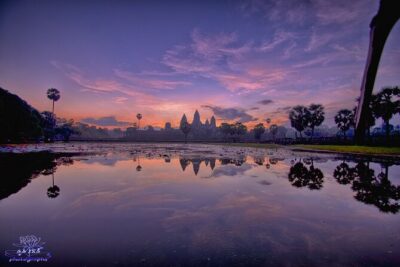
Angkor Wat Sunrise or Sunset Tour with Guide from Siem Reap
Read our review →
Angkor Wat: Small-Group Sunrise or Sunset Tour
Read our review →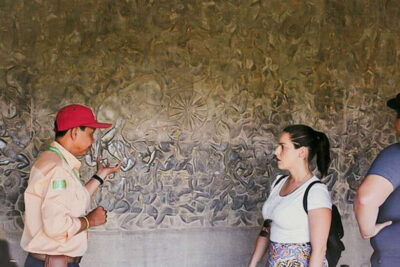
Angkor Wat 2-Day Tour with Sunrise and Sunset
Read our review →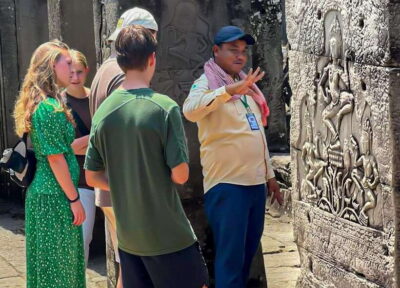
Angkor Wat Sunrise tour with Small – Group and Guide tours
Read our review →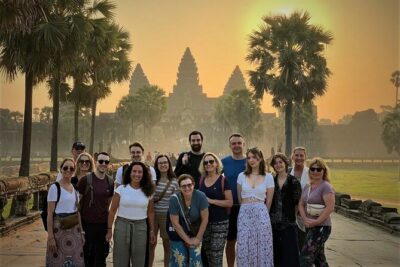
Angkor Wat Highlights and Sunrise Guided Tour from Siem Reap
Read our review →
Angkor Wat Sunset Small Group Tour with Lunch Included
Read our review →