Reviewed · ANGKOR WAT TOURS
Private Angkor Wat Day Tour
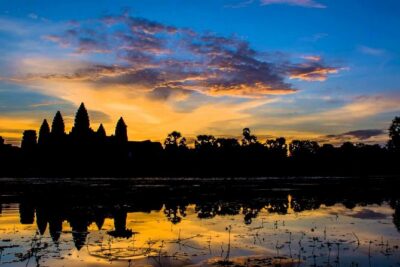
Angkor rewards a well-planned day. This private tour gives you hotel pickup, an English-speaking guide, and air-conditioned transport to Cambodia’s great temple complex, with Angkor Wat, Angkor Thom, Bayon, and Ta Prohm packed into roughly five to seven hours. I especially like the door-to-door service and the guide’s focus on explaining what you are seeing rather than simply pointing at old stones. The main drawback is cost: the $49 tour price does not include the required $37 Angkor National Park ticket, lunch, drinks, or travel insurance.
I also like the small maximum group of 10 and the choice of transport based on party size. One to three people travel by tuk tuk, while groups of four or more use an air-conditioned minivan. The day is physically active, with walking around large temple compounds, so you should have a moderate level of fitness and be ready for heat.
In This Review
- Key Things to Know Before You Book
- Why This Tour Works for a First Day at Angkor
- Angkor Wat: Begin With Cambodia’s Great Symbol
- Angkor Thom: Entering the Former Royal City
- Bayon Temple and Its Stone Faces
- Lunch Break: A Necessary Pause
- Ta Prohm: The Day’s Most Atmospheric Stop
- Transport, Group Size, and Comfort
- What the Guide Adds to the Visit
- The Real Cost and Overall Value
- Who Should Choose This Angkor Day Tour?
- Should You Book It?
- FAQ
- Is the Angkor National Park entrance ticket included?
- How long does the tour last?
- What transportation is provided?
- Does the tour include lunch?
- How many people can join the tour?
- Can I cancel for a full refund?
Key Things to Know Before You Book
- Four major temple stops in one day: You visit Angkor Wat, Angkor Thom, Bayon, and Ta Prohm, with time set aside for lunch.
- The guide adds real value: The guide explains Khmer history, architectural details, and the purpose of each site, with practical advice about good photo positions.
- The $49 price is not the full cost: Add the $37 one-day park ticket, plus lunch and drinks.
- Transport depends on group size: One to three people ride by tuk tuk; four or more use an air-conditioned minivan.
- Hotel pickup and drop-off simplify the day: You do not need to arrange separate transport to the temples.
- A flexible cancellation window helps: You can cancel at least 24 hours before the start time for a full refund.
Why This Tour Works for a First Day at Angkor
Angkor is not one temple. It is a huge archaeological park filled with monuments spread across a broad area. Without a plan, you can spend too much time getting from one place to another or miss the story connecting the temples.
This route gives you a clear first look at the park. You begin with Angkor Wat, move into the walled city of Angkor Thom, visit Bayon and its famous stone faces, then finish at Ta Prohm, the temple associated with jungle-covered ruins. The sequence makes sense, both geographically and historically.
I like this arrangement because each stop feels different. Angkor Wat is formal and grand. Angkor Thom gives you a sense of the old capital city. Bayon is crowded with sculpted faces and narrow galleries. Ta Prohm feels more unruly, with trees and stone sharing the same space.
The tour lasts about five to seven hours, so this is a focused introduction rather than an exhaustive survey of Angkor. That is a good trade for many people. You see the essential monuments without trying to cover every temple in the park.
More ways to see Angkor Wat:
- Angkor Wat Sunrise or Sunset Tour with Guide from Siem Reap
★ 5.0 · 12,109 reviews - Siem Reap: Angkor Wat: Small-Group Sunrise or Sunset Tour
★ 5.0 · 9,444 reviews - Siem Reap: Angkor Wat 2-Day Tour with Sunrise and Sunset
★ 4.9 · 4,429 reviews
Angkor Wat: Begin With Cambodia’s Great Symbol
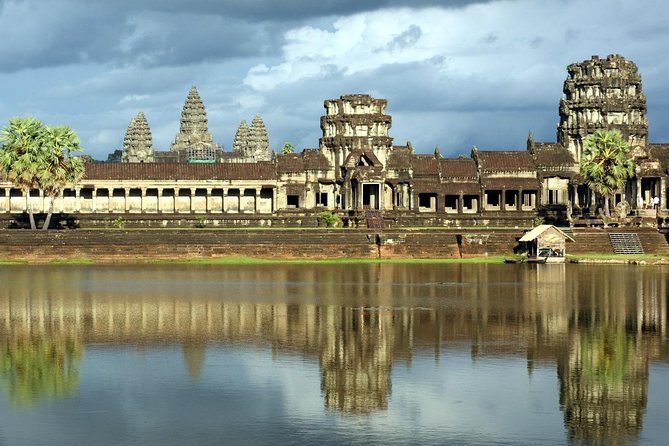
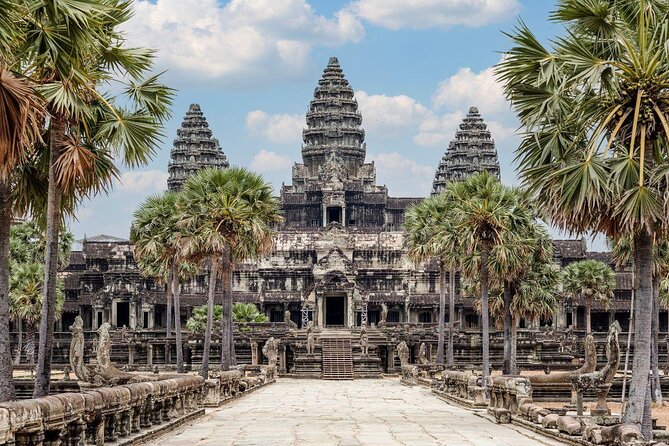
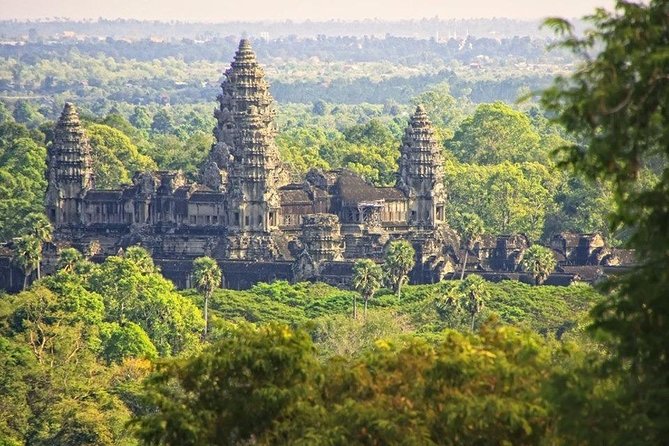
Your first major stop is Angkor Wat, built in the early 12th century for King Suryavarman II. It began as a Hindu temple dedicated to Vishnu and later became Buddhist. It remains an important religious site and is the largest religious building in the world.
This is the place where the scale can be hard to grasp at first. The temple combines the temple-mountain design with long galleries, towers, courtyards, and carefully planned approaches. You will have around two hours here, which gives your guide enough time to explain the basic plan and point out architectural details.
I recommend paying attention to the layout rather than rushing straight to the most famous view. Angkor Wat was designed as a complete religious and political statement. Its towers, galleries, and central sanctuary were meant to represent a sacred mountain, not simply create an impressive facade.
The bas-reliefs are another reason to listen closely. A guide can help you understand what the carvings show and how they connect to Hindu stories and Khmer royal power. Even if you are not familiar with the mythology, the scenes become easier to appreciate when you know what to look for.
The tour price does not include admission. You must purchase the one-day Angkor National Park ticket separately, listed at $37 per person. Build that cost into your planning before you compare this tour with other options.
Angkor Wat is also the busiest and most photographed stop on the route. Your guide can suggest useful places to stand for pictures, a detail praised in the available feedback. That kind of help matters here, since the complex has many viewpoints and the obvious spot is not always the best one.
Angkor Thom: Entering the Former Royal City
From Angkor Wat, the route continues to Angkor Thom, the late 12th-century capital built under King Jayavarman VII. The name means great city, and the scale explains why.
Angkor Thom was enclosed by walls about eight meters high and more than 12 kilometers long, with a wide moat and five major gates. You enter through the South Gate, one of the most memorable approaches in the park. The gate gives you a visual shift from temple grounds to fortified capital.
The one-hour visit helps you see Angkor Thom as more than a collection of monuments. It was a planned city and a center of Khmer power. The walls, moat, gates, and central temple all formed part of a defensive and ceremonial design.
You may find this stop less immediately dramatic than Angkor Wat, but it supplies useful context. Once you understand that Bayon sat at the heart of a royal capital, its strange design makes more sense.
There is also a practical point here. Angkor Thom includes several features in a relatively broad area, so your walking time can add up. Wear shoes that can handle uneven surfaces and bring water. Cold bottled water is included, but lunch and other drinks are not.
Bayon Temple and Its Stone Faces
Bayon is the centerpiece of Angkor Thom. King Jayavarman VII built it in the late 12th or early 13th century as a Mahayana Buddhist state temple.
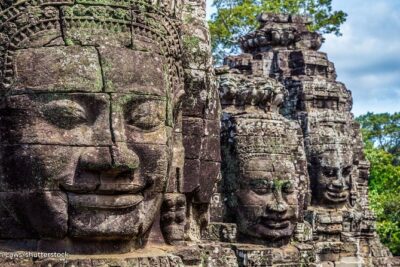
The first thing you notice is the forest of enormous stone faces. They appear from towers and galleries, often watching from several directions at once. These faces give Bayon its unmistakable character, but the temple deserves more than a quick photograph.
Its plan is complex. The first and second levels contain square galleries with bas-reliefs, while a circular central sanctuary dominates the third level. The arrangement can feel maze-like, which is exactly where an English-speaking guide earns their fee.
A good guide can keep you oriented while explaining how the levels fit together. One available account describes a guide who carefully explained the history and details at each place, and who suggested good positions for photographs. That is the kind of service you want at Bayon, where it is easy to wander through corridors without understanding the larger design.
The bas-reliefs are especially useful for connecting temple art with everyday Khmer life and royal events. You will need to pay attention, since the carvings are spread through galleries and some are easy to pass without noticing.
Allow about an hour for Bayon. That is enough for a guided overview, though not enough for every gallery and carving. If you prefer slow architectural study, this full-day route may feel brisk. If your goal is to see the main monuments in one organized outing, the timing is practical.
A few more options around Siem Reap worth reading up on
- From Siem Reap: Kampong Phluk Floating Village Tour by Boat
★ 4.9 · 6,979 reviews - Sunset tour of Kampong Phluk stilts home village on the Tonle Sap
★ 5.0 · 4,865 reviews - Siem Reap: Kampong Phluk Floating Village Tour with Boat
★ 4.9 · 3,843 reviews - Siem Reap: Full-Day Angkor Wat Guided Tour with Sunset
★ 4.9 · 3,803 reviews
Lunch Break: A Necessary Pause
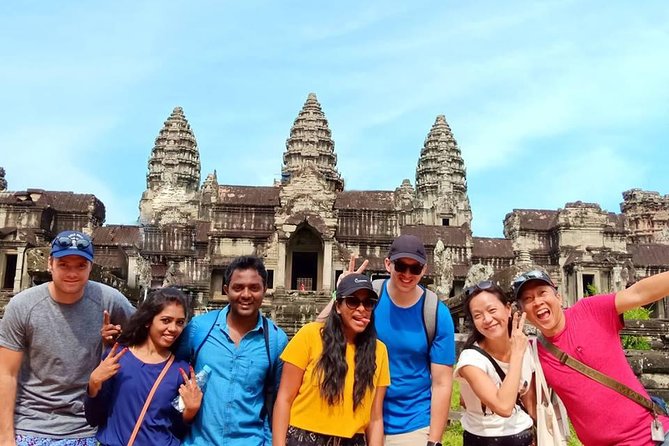
The tour includes a lunch break, but lunch is at your own expense. This keeps the tour price lower, but it also means you should budget for food and drinks separately.
The break matters because the first half of the day involves outdoor walking across large temple compounds. Even a five-hour route can feel longer when you are moving through stone courtyards and galleries in warm conditions.
Do not expect lunch to be part of the $49 package. The included items are hotel pickup and drop-off, the guide, transportation, private touring, and cold bottled water. The park ticket, meal, extra drinks, and travel insurance are separate.
Ta Prohm: The Day’s Most Atmospheric Stop
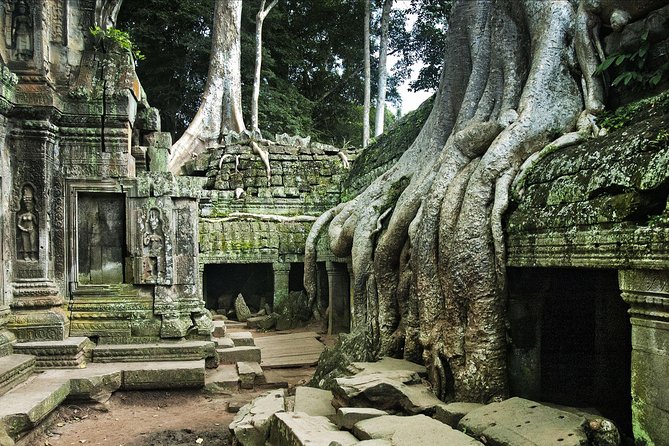
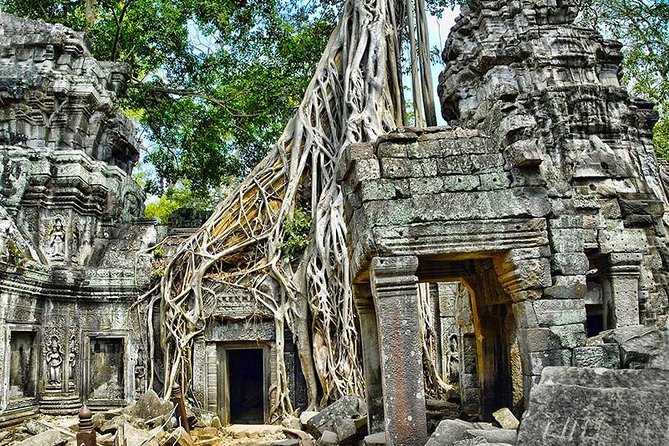
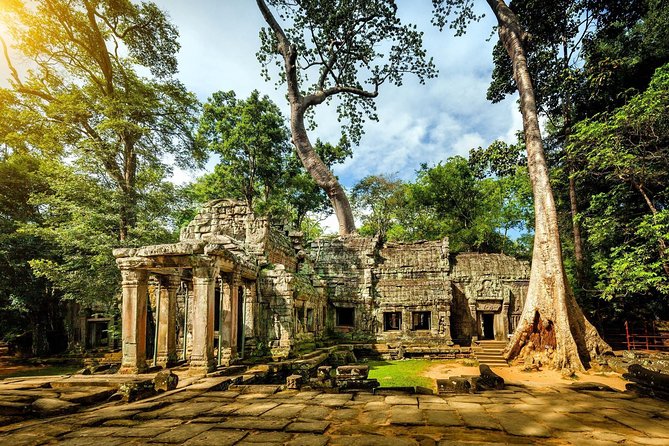
Ta Prohm is often called the Jungle Temple, and it is easy to see why. The monument was built around 1186 by King Jayavarman VII and dedicated to his mother. Its ruined walls and tree-covered sections create a look unlike the more ordered spaces at Angkor Wat and Bayon.
Ta Prohm is beautiful partly because it has not been made perfectly tidy. Roots press against stone, trees rise over walls, and broken galleries make the temple feel exposed to time. The ruins are not simply decoration. They show the continuing work required to preserve a site where nature and architecture have been pushing against each other for centuries.
You have about an hour here. That gives you time to walk through the main areas, see the famous tree-covered structures, and hear why the temple is connected with the jungle. The route enters from the west and leaves from the east, so you should expect a walking visit rather than a quick roadside stop.
The supplied advice points out that Ta Prohm can be especially peaceful and attractive early in the day. This tour places it after Angkor Wat, Angkor Thom, Bayon, and lunch, so it may not offer the quietest possible timing. That is worth knowing if your main goal is a calm photographic visit.
Still, ending here is a strong choice. Ta Prohm provides a change of mood after the formal scale of Angkor Wat and the dense stonework of Bayon. It is the stop most likely to make you slow down and look closely.
Transport, Group Size, and Comfort
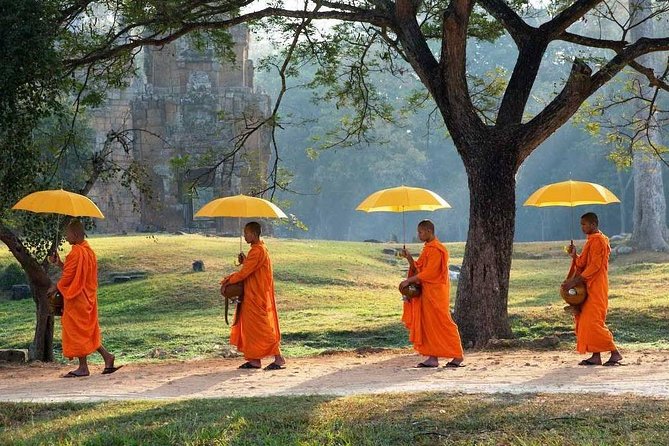
Pickup and drop-off at your Siem Reap hotel remove one of the day’s small hassles. You do not have to find a driver before sunrise or arrange a return ride after several hours of walking.
For one to three people, transport is by tuk tuk. This gives you an open-air ride between temple areas, though it offers less protection from heat and weather than the minivan. Groups of four or more use an air-conditioned minivan, a more comfortable choice for a longer day.
The tour is private and limited to a maximum of 10 people. The wording suggests a small-scale outing rather than a large bus tour, but you should still confirm how the private arrangement applies to your booking if that distinction matters to you.
Cold bottled water is included. That is a modest benefit, but a useful one in a park where you are walking for hours. Lunch and drinks beyond the supplied water remain your responsibility.
What the Guide Adds to the Visit
The guide is the main reason to choose this outing instead of arranging basic transport alone. Angkor’s monuments are visually powerful, but their meaning can be difficult to read without context.
The guide explains the Khmer Empire, the rulers connected with each temple, and the changes from Hindu worship to Buddhism. At Angkor Wat, that helps you understand the temple’s original purpose. At Angkor Thom and Bayon, it connects the buildings to Jayavarman VII’s capital and religious program.
The strongest praise in the available feedback concerns thorough explanations and enthusiasm. The guide was described as having memorized many details and sharing them with energy. That is important because a rushed or silent guide would reduce this tour to transportation between photo stops.
Photo advice is another useful touch. Angkor has wide courtyards, long galleries, towers, faces, gates, and tree-covered ruins. A guide who points out good places to stand can save you time and help you return with more than the standard postcard view.
No guide’s style is guaranteed to match every person. If you prefer to explore alone and read at your own pace, you may find the commentary less appealing. If you want the meaning of the buildings explained as you go, the guide is a major part of the value.
The Real Cost and Overall Value
The listed price is $49 per person. Add the required $37 one-day Angkor National Park ticket, and the known cost becomes $86 per person before lunch, drinks, or travel insurance.
That is not a bargain-basement day, but the price includes several services that are useful in Siem Reap: hotel transportation, a dedicated English-speaking guide, temple-to-temple transport, bottled water, and return drop-off. You are paying for structure and explanation, not just a ride.
The value is strongest for first-time visitors who want the main Angkor sights in one day. It is also useful if you do not want to negotiate transport or plan the route yourself.
The value is weaker if you already know the temples well, want a very slow visit, or plan to spend several days in the park. In those cases, a basic transport arrangement could give you more control. You would then need to provide your own historical context and route planning.
Group discounts are offered, which may improve the price for larger parties. Since the tour has a maximum of 10 people, it can suit families or friends who want to travel together without joining a large coach group.
Who Should Choose This Angkor Day Tour?
I would recommend this tour to a first-time visitor staying in Siem Reap who wants to see the four most important stops with clear explanations. The route is efficient, the transport is arranged, and the guide helps turn a large archaeological park into a readable story.
It also suits people who like taking photographs but do not want to spend the day finding viewpoints alone. The guide’s suggestions about where to stand can be particularly helpful at Angkor Wat and Bayon.
You should think twice if you need a slow pace, have difficulty with extended walking, or want to focus on less-visited temples. The stated fitness level is moderate, and the route includes several large sites in one day.
Book at least a little ahead if possible. The experience is booked an average of 13 days in advance, which suggests that leaving it until the last minute may not be wise during busy periods.
Free cancellation is available if you cancel at least 24 hours before the start time. Changes or cancellations made within 24 hours are not accepted for a refund, and the cut-off follows local time.
Should You Book It?
Book this private Angkor Wat day tour if you want a well-organized first day, hotel pickup, a guide who explains the monuments in detail, and the classic route through Angkor Wat, Angkor Thom, Bayon, and Ta Prohm.
Go in knowing the true cost is at least $86 per person before food and drinks. If that fits your budget and you are comfortable with a fairly full walking day, this is a sensible way to meet Angkor’s essential temples without wasting time on transport or guesswork.
FAQ
Is the Angkor National Park entrance ticket included?
No. The required one-day ticket costs $37 per person and is not included in the tour price.
How long does the tour last?
The tour lasts approximately five to seven hours.
What transportation is provided?
One to three people travel by tuk tuk. Groups of four or more travel by air-conditioned minivan.
Does the tour include lunch?
No. Lunch and drinks are at your own expense. Cold bottled water is included.
How many people can join the tour?
The tour has a maximum of 10 people.
Can I cancel for a full refund?
Yes, if you cancel at least 24 hours before the experience start time. Cancellations or changes made less than 24 hours in advance are not eligible for a refund.
Newest reviews from Siem Reap
- War Museum, Killing Field, and APOPO Hero RATs Tour★ 5.0 · 7 reviews
- Angkor Wat at Sunrise★ 4.0 · 7 reviews
- Siem Reap Angkor Airport Taxis (from Airport to Hotel)★ 5.0 · 44 reviews
- Cambodian Cooking Class and Oxcart Ride with Local Village Tour★ 5.0 · 4 reviews
- Secret Temples of Angkor – Guided Tour in Siem Reap★ 5.0 · 6 reviews
- Short Cycling at Countryside★ 5.0 · 29 reviews
- SIEM REAP E-BIKE HALF-DAY COUNTRYSIDE (25-30 km)★ 4.0 · 1 review
- Unveiling the Mystical Beauty of Phnom Kulen National Park★ 5.0 · 6 reviews
Angkor Wat Tours, compared.
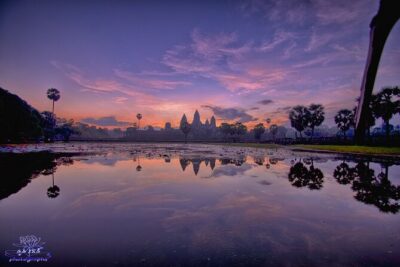
Angkor Wat Sunrise or Sunset Tour with Guide from Siem Reap
Read our review →
Angkor Wat: Small-Group Sunrise or Sunset Tour
Read our review →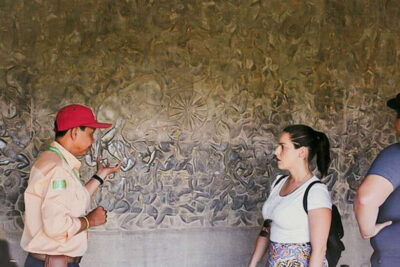
Angkor Wat 2-Day Tour with Sunrise and Sunset
Read our review →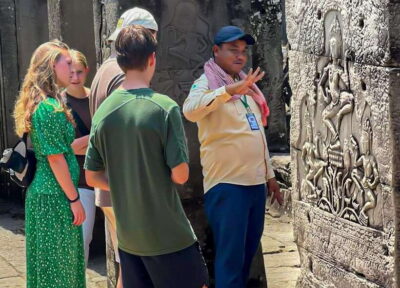
Angkor Wat Sunrise tour with Small – Group and Guide tours
Read our review →
Angkor Wat Highlights and Sunrise Guided Tour from Siem Reap
Read our review →
Angkor Wat Sunset Small Group Tour with Lunch Included
Read our review →