Reviewed · 1-DAY TOURS
One day normal Angkor tour
Angkor rewards an early start. This eight-hour private tour packs Siem Reap’s major temple sights into one well-planned day, with hotel pickup, air-conditioned transport, bottled water, and a guide who explains the art, beliefs, and royal ambition behind the stones. I especially like the private vehicle, which gives you a quiet break between temples, and the art historian guide, particularly Bun Leat, whose patient explanations and help with photographs receive repeated praise. The main catch is simple: the $45 tour price does not include the one-day Angkor ticket, which costs another $37, or lunch.
You begin at about 7:30 AM, when the first temple visit is cooler and less crowded than later in the day. You will see Angkor Wat, Ta Prohm, Angkor Thom, Bayon, Baphuon, Phimeanakas, the Royal Palace area, the Royal Terraces, and Baksei Chamkrong. That is a lot for one day, so this suits you best if you want the essential circuit with historical guidance rather than a slow, quiet study of only two or three temples.
In This Review
- Key points to know before you book
- Why the 7:30 AM departure matters
- Angkor Wat: begin with Cambodia’s great symbol
- Baksei Chamkrong and the smaller stop with a big comparison
- Angkor Thom and Bayon’s stone faces
- Baphuon, Phimeanakas, and the Royal Palace area
- The Royal Terraces and Angkor’s public face
- Ta Prohm and the appeal of ruins reclaimed by nature
- What the guide adds to the day
- Transport, lunch, and the real cost
- Who should book this Angkor day tour?
- Final verdict: a strong one-day introduction
- FAQ
- How long does the Angkor tour last?
- What time does the tour begin?
- Is sunrise at Angkor Wat included?
- Is hotel pickup included?
- What type of transport is used?
- Is the Angkor entrance ticket included?
- Is lunch included?
- Is bottled water included?
- What should I wear?
- Is a vegetarian meal possible?
- What level of fitness is needed?
- Is the tour private?
- Who guides the tour?
- Can I cancel for a refund?
Key points to know before you book
- 7:30 AM start: The early departure helps you see Angkor Wat before the strongest heat and busiest part of the day.
- Private transport: Your group travels alone in an air-conditioned car or minivan, with hotel pickup and drop-off included.
- Bun Leat as guide: He is praised for clear explanations, patience, cultural context, and practical photo advice.
- Major temple circuit: Angkor Wat, Ta Prohm, Angkor Thom, Bayon, Baphuon, Phimeanakas, the Royal Terraces, and Baksei Chamkrong are included.
- Extra costs: Add the $37 one-day temple ticket and money for lunch to the $45 tour price.
- Dress matters: Knees and shoulders must be covered for men and women at places of worship and selected museums.
Why the 7:30 AM departure matters
Angkor is hot, open, and exposed. Starting at 7:30 AM gives you a better chance of seeing the first major temple in a calmer mood, before the day’s heat settles over the stone courtyards.
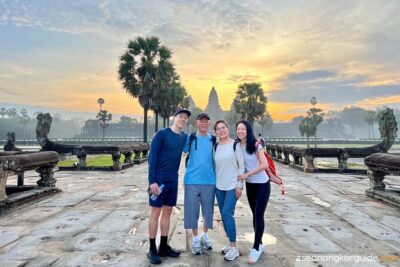
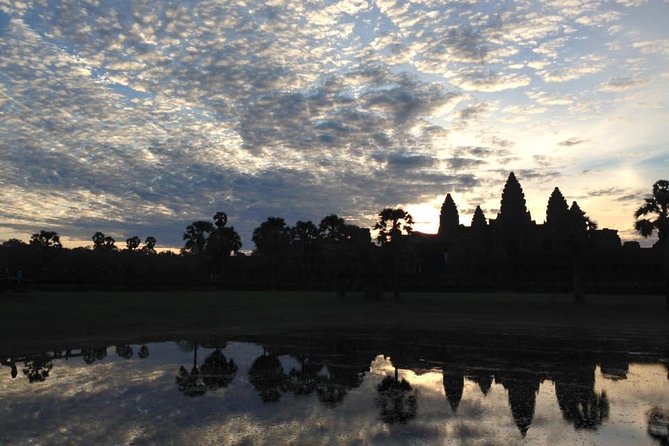
This is not advertised as a sunrise tour, so do not book it expecting to watch dawn from the Angkor Wat moat. It is an early morning tour, not a sunrise package. That distinction matters if sunrise photography is your main goal.
The schedule runs for roughly seven to eight hours. You will spend much of that time walking, climbing steps, and moving between large temple compounds. The air-conditioned car or minivan provides a welcome reset, and bottled water is included. Some praise also highlights cold water, cold towels, and a clean private vehicle, though you should treat cold towels as a possible extra comfort rather than a guaranteed feature in the formal inclusions.
A few more options around Siem Reap worth reading up on
- Angkor Wat Sunrise or Sunset Tour with Guide from Siem Reap
★ 5.0 · 12,109 reviews - Siem Reap: Angkor Wat: Small-Group Sunrise or Sunset Tour
★ 5.0 · 9,444 reviews - From Siem Reap: Kampong Phluk Floating Village Tour by Boat
★ 4.9 · 6,979 reviews
Angkor Wat: begin with Cambodia’s great symbol
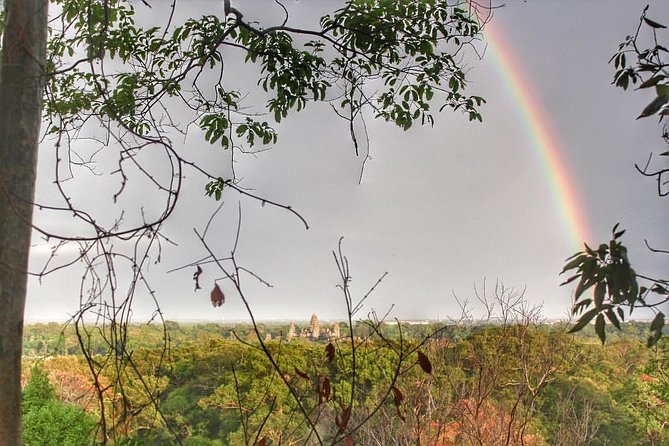
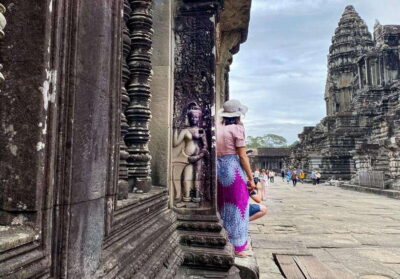
Angkor Wat is the natural opening stop. Built as a Hindu temple dedicated to Vishnu, it later became an important Buddhist site. Its long causeway, outer galleries, towers, bas-reliefs, and central sanctuary give you an immediate sense of the scale of the Angkor kingdom.
I like starting here because the temple asks for fresh attention. The layout is broad and ceremonial, and a guide can explain how the galleries, towers, and surrounding moat fit together. Without context, you may see a grand stone complex. With a guide, you can better understand the religious ideas and royal power built into its design.
Allow your guide to shape the visit, but do not rush your own looking. Pause at the carved scenes and notice how the light changes across the sandstone. The guide is also useful for photographs. Bun Leat is repeatedly praised for showing good viewpoints and helping with camera angles, a small service that can make a real difference at a place where scale is difficult to capture.
You should wear clothing that covers your knees and shoulders from the start. The dress rule applies to both men and women, and failure to follow it can lead to refused entry at religious sites or selected museums.
Baksei Chamkrong and the smaller stop with a big comparison
After Angkor Wat, the route heads north to Baksei Chamkrong. This pyramid temple was built in 947 AD by Harshavarman I and completed by Rajendravarman II. It was dedicated to Shiva, giving you a clear reminder that Angkor’s sacred buildings were not created for one single faith or period.
The temple is described as having a plan similar to the pyramid at Tikal in the ancient Maya city in Central America. That comparison gives your guide a useful way to discuss pyramid design across distant cultures, though the two traditions developed separately. The stop also breaks up the day after the huge scale of Angkor Wat.
Baksei Chamkrong is a smaller visit than Angkor Wat or Bayon. That is part of its appeal. You can focus on the stepped form and the way the temple rises above its surroundings without needing an hour to understand the site. If your priority is seeing every major feature of Angkor, this stop adds variety. If you prefer long visits at fewer monuments, it may feel like one more item in a packed schedule.
Angkor Thom and Bayon’s stone faces
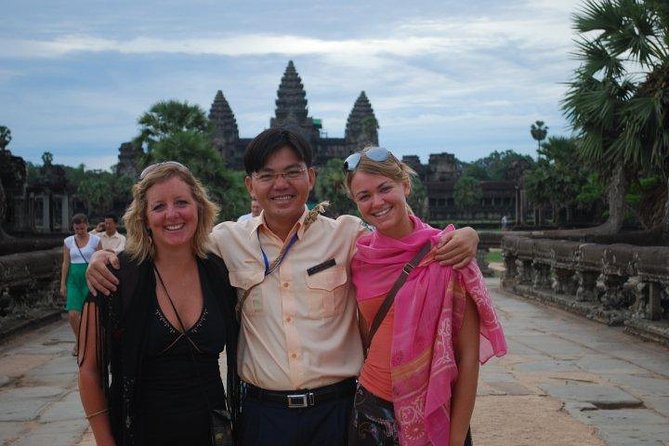
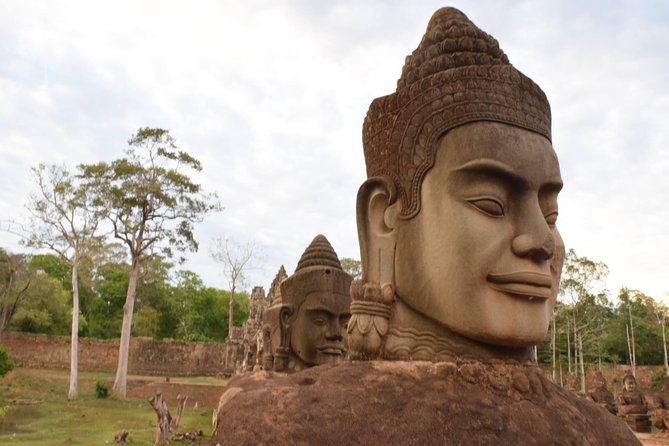
The next major section brings you into Angkor Thom, the ancient city at the center of the tour route. Bayon sits in the middle of this former royal city and is famous for its serene, smiling stone faces.
Bayon can feel confusing at first. Towers crowd together, galleries turn unexpectedly, and the faces appear from several levels and angles. That is exactly where a guide earns the fee. You can ask what you are seeing instead of spending your limited time trying to reconstruct the plan alone.
The stone faces are the visual heart of the visit, but Bayon is also useful for understanding the shift from Hindu to Buddhist royal expression during the reign of Jayavarman VII. The temple’s carvings and structure carry religious and political meaning, and the guide is expected to explain that background live as you move through the site.
The practical drawback is crowding. Bayon’s narrow passages and famous faces attract plenty of attention, even with an early start. Be ready to pause while other groups pass and keep your walking pace flexible. The private format helps because you can stay with your own guide rather than being tied to a large coach group.
Something completely different for another day:
- Sunset tour of Kampong Phluk stilts home village on the Tonle Sap
★ 5.0 · 4,865 reviews - Siem Reap: Angkor Wat 2-Day Tour with Sunrise and Sunset
★ 4.9 · 4,429 reviews - Siem Reap: Kampong Phluk Floating Village Tour with Boat
★ 4.9 · 3,843 reviews - Siem Reap: Full-Day Angkor Wat Guided Tour with Sunset
★ 4.9 · 3,803 reviews
Baphuon, Phimeanakas, and the Royal Palace area

Near Bayon, the tour continues to Baphuon, Phimeanakas, and the Royal Palace area. These stops help fill in the story of Angkor Thom beyond Bayon’s famous faces.
Baphuon is a large temple mountain with a strong sense of height and geometry. Phimeanakas is connected with the royal center, while the Royal Palace area offers a glimpse of how religious monuments and court life occupied the same urban world. The remains do not always announce their purpose as clearly as Angkor Wat does, so commentary is especially valuable here.
This is also where your physical fitness matters. The tour requires walking across uneven ground and negotiating temple steps. The information advises a moderate fitness level, which is a fair description. You do not need to be an athlete, but comfortable walking shoes and a willingness to climb are sensible choices.
The route’s strength is breadth. In one day, you move from a major state temple to an urban center and then into the remains of royal and religious buildings. Its weakness is time. You may not have the leisure to linger at every carved doorway or explore every side path.
The Royal Terraces and Angkor’s public face
The Royal Terraces form another part of the Angkor Thom visit. They are linked to the city’s ceremonial and royal spaces and add a more public, processional element to the day.
Here, I would listen closely to how your guide explains the relationship between the terraces, the royal center, and the surrounding city. The value is not only in looking at carved stone. It is in imagining how these spaces worked as part of a powerful capital, with rulers, religious ceremonies, and public display all connected.
The terraces may be less instantly famous than Angkor Wat or Ta Prohm, but they help prevent the day from becoming a parade of isolated monuments. You begin to see Angkor as a city rather than a collection of postcard views.
Ta Prohm and the appeal of ruins reclaimed by nature
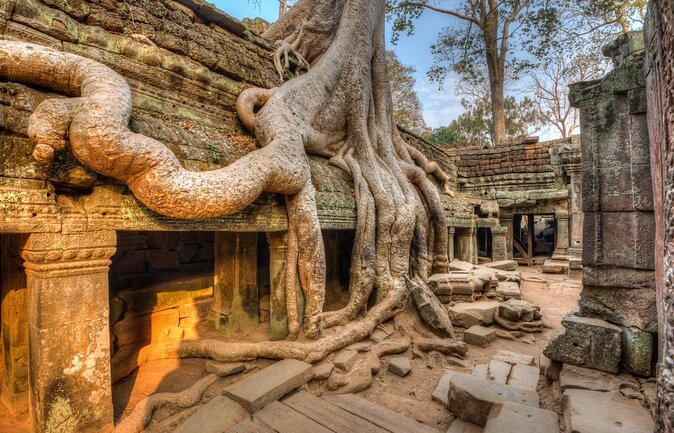
Ta Prohm is one of the day’s most memorable stops. It is known for its atmospheric ruins and trees growing through and around the temple structures. The setting has become famous in photographs and films, but the temple is more than a dramatic backdrop.
Ta Prohm lets you see the tension between preservation and the forces of nature. Roots press against walls, galleries narrow into shadow, and damaged sections show how difficult it is to care for an ancient site while keeping its character. Your guide can also explain the temple’s religious and historical role, giving meaning to details that might otherwise become background scenery.
This stop can be busy, and the most photographed corners may require patience. If you want a quiet, solitary ruin, a one-day major-temple circuit cannot promise that. Still, Ta Prohm earns its place because its mood differs sharply from Angkor Wat’s ordered grandeur and Bayon’s dense stone faces.
What the guide adds to the day
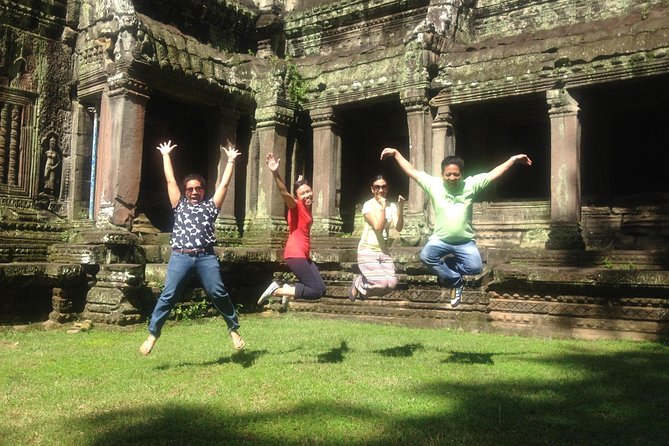
The strongest part of this experience is the live interpretation. The guide is not simply taking you from gate to gate. You are given explanations of Hinduism, Buddhism, temple construction, restoration, royal history, and the meaning of the carvings as you go.
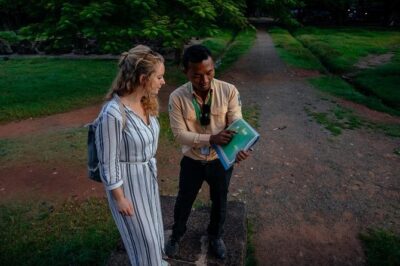
Bun Leat is the guide name most closely associated with the tour. He is described as having more than ten years of guiding experience at Angkor and is praised for patience, clear historical presentations, cultural respect, and an ability to answer questions without rushing you. He is also singled out for suggesting useful photo positions and taking photographs for visitors.
That combination matters. Angkor is easy to admire and surprisingly hard to understand. A guide helps you connect the temples rather than seeing each one as a separate ruin. You can ask about the difference between Hindu and Buddhist imagery, why a temple was built, or how restoration affects what you see today.
There is also a human advantage to a private tour. Only your group participates, so the pace can feel more personal than a large group excursion. The formal description does not promise a fully customized itinerary, so you should not assume that every stop can be changed. Still, a private group gives you a better setting for questions and practical requests.
Transport, lunch, and the real cost
The $45 price covers hotel pickup and drop-off, local taxes, bottled water, a professional art historian guide, and transport in an air-conditioned private vehicle. For an eight-hour day, that is a fair value if you want interpretation and comfort rather than simply hiring a ride.
The required one-day Angkor ticket is separate at $37 per person. That puts the known cost at $82 per person before lunch and any tip. Lunch is not included. You stop at a restaurant where you can buy your own meal, so bring enough cash or confirm the payment options with your guide.
The separate ticket can make the tour feel more expensive than the headline price suggests. It is still useful to judge the full day as a package: transport, hotel service, a private guide, water, and access to a long list of major sites. If you already have a valid ticket, clarify how that will work before booking.
Pickup is offered, while the listed meeting point is Royal Angkor Resort on National Road 6 in Siem Reap. The stated end point is back at the meeting point. Confirm your hotel pickup details in advance, especially if you are not staying near the listed resort.
Who should book this Angkor day tour?
I would choose this tour if you have one full day in Siem Reap and want the main Angkor sights explained by a guide. It is a good match for first-time visitors, couples, families, and small private groups that value an air-conditioned vehicle between long walks.
It also suits you if history, religion, and architecture matter as much as photographs. The guide’s explanations are repeatedly praised, and the photo help is a useful bonus rather than the sole purpose of the day.
I would think twice if you dislike early starts, hot walking, temple steps, or a tightly packed schedule. You may prefer a slower two-day plan if you want to study carvings, sit quietly in the courtyards, or visit less prominent temples. This tour is built around highlights, not solitude.
Vegetarian food is available if you request it when booking. Free cancellation is allowed up to 24 hours before the start time for a full refund. Changes or cancellations made less than 24 hours before departure are not accepted or refunded, based on local time.
Final verdict: a strong one-day introduction
Book this tour if you want efficient temple coverage with strong guiding and a private vehicle that gives your feet and mind a break. The extra $37 ticket and lunch cost should be part of your budget from the beginning.
The tour’s best qualities are practical: an early start, hotel service, air-conditioning, water, and a guide who can explain what you are seeing. Its main limitation is the amount of ground covered in one day. You will see the essential Angkor circuit, but you will not have unlimited time at every temple.
For a first visit with only one day available, I think this is a sensible choice. Ask for Bun Leat if he is available, confirm your pickup, wear clothing covering your knees and shoulders, and bring money for the temple ticket and lunch.
FAQ
How long does the Angkor tour last?
The tour lasts approximately seven to eight hours.
What time does the tour begin?
The itinerary begins at about 7:30 AM.
Is sunrise at Angkor Wat included?
No. The tour starts early and visits Angkor Wat when crowds may be lighter, but it is not described as a sunrise tour.
Is hotel pickup included?
Yes. Hotel pickup and drop-off are included.
What type of transport is used?
You travel by private air-conditioned car or minivan. Only your group participates.
Is the Angkor entrance ticket included?
No. The one-day ticket costs $37 per person and is not included in the $45 tour price.
Is lunch included?
No. The tour stops at a restaurant where you can purchase lunch.
Is bottled water included?
Yes. Bottled water is included.
What should I wear?
You must cover your knees and shoulders. This rule applies to both men and women at places of worship and selected museums.
Is a vegetarian meal possible?
Yes. A vegetarian option is available if you request it when booking.
What level of fitness is needed?
A moderate level of physical fitness is advised. Expect walking and some temple steps across the archaeological park.
Is the tour private?
Yes. This is a private activity, and only your group participates.
Who guides the tour?
The experience includes a professional art historian guide. Bun Leat is a named guide associated with the service.
Can I cancel for a refund?
Yes. You can cancel at least 24 hours before the start time for a full refund. Cancellations or changes made less than 24 hours before departure are not accepted or refunded.
Newest reviews from Siem Reap
- War Museum, Killing Field, and APOPO Hero RATs Tour★ 5.0 · 7 reviews
- Angkor Wat at Sunrise★ 4.0 · 7 reviews
- Siem Reap Angkor Airport Taxis (from Airport to Hotel)★ 5.0 · 44 reviews
- Secret Temples of Angkor – Guided Tour in Siem Reap★ 5.0 · 6 reviews
- Short Cycling at Countryside★ 5.0 · 29 reviews
- Cambodian Cooking Class and Oxcart Ride with Local Village Tour★ 5.0 · 4 reviews
- SIEM REAP E-BIKE HALF-DAY COUNTRYSIDE (25-30 km)★ 4.0 · 1 review
- Unveiling the Mystical Beauty of Phnom Kulen National Park★ 5.0 · 6 reviews
1-Day Tours, compared.
1-Day Amazing Angkor Wat Tour with Sunset & All Interesting Major Temples
Read our review →
Angkor Wat one Day Private Tour for All Highlight Angkor Temples
Read our review →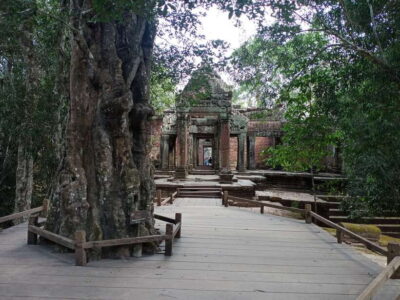
1-Day private Angkor Temple Tour from Siem Reap
Read our review →
1-Day Angkor Wat Sunrise & All Interesting Temples Private Tour
Read our review →
Angkor Wat Sunrise Small-Group 1-Day Tour from Siem Reap
Read our review →