Reviewed · SIEM REAP TOURS
Khmer Gourmet Degustation
Your dinner starts at the market. This small-group cooking class in Siem Reap gives you a practical way to meet Khmer food, because you choose ingredients, prepare two starters, two main courses, and one dessert, then eat what you made. The format feels more personal than a standard restaurant meal, and the maximum group size of six should allow plenty of room for participation.
I especially like the market visit and menu choice, which put you in control of the meal instead of simply watching someone else cook. I also like the dessert angle: Cambodia has its own take on mango sticky rice, and one diner considered it better than the Thai version. The main point to consider is the limited information about the exact dishes and market arrangements, so you should book this for the hands-on experience rather than a fixed, highly detailed culinary itinerary.
In This Review
- Key points at a glance
- Why this cooking class works well in Siem Reap
- Starting at 5:00 pm and meeting in Siem Reap
- Choosing your menu before you cook
- Visiting the market for ingredients
- Preparing two starters and two main courses
- Saving room for the Cambodian dessert
- A small group of six makes a difference
- What the $29 price delivers
- Who should book this experience
- Booking, cancellation, and practical decisions
- Should you book the Khmer Gourmet Degustation?
- FAQ
- Where does the Khmer Gourmet Degustation take place?
- What time does the activity start?
- How long does the cooking class last?
- How many people can join?
- Is hotel pickup available?
- Is the experience near public transportation?
- What will I prepare?
- Do I eat the food I cook?
- Is a mobile ticket available?
- Can I cancel for a full refund?
Key points at a glance
- You choose the menu first: The experience begins with selecting what you will prepare, rather than receiving a fixed meal.
- Five dishes are included: You make two starters, two main courses, and one dessert, then eat your own work.
- The market visit is part of the lesson: Ingredient selection gives the cooking class a direct connection to everyday Khmer food.
- A six-person maximum keeps it personal: The small group should make it easier to take part and ask questions.
- Mango sticky rice gets special attention: Cambodia’s version earned praise for being even better than the familiar Thai preparation.
- The evening runs about two and a half hours: With a 5:00 pm start, it fits neatly into a Siem Reap evening.
Why this cooking class works well in Siem Reap
Siem Reap is best known as the gateway to Angkor, but a cooking class gives you another way to understand Cambodia. Instead of only seeing temples and taking photographs, you spend an evening making food from ingredients selected at a local market.
That matters because food is one of the easiest ways to connect with a place. A recipe can tell you about local produce, seasoning, texture, and the balance between sweet, salty, sour, and savory flavors. Here, you are not simply served a Cambodian meal. You choose part of it and prepare it yourself.
The class is also a good change of pace after a day of sightseeing. Temple visits can involve early starts, long walks, and plenty of visual information. A two-and-a-half-hour evening activity gives you something slower and more social without requiring another major trip outside Siem Reap.
I would not approach this as a formal chef-training course. The description focuses on selecting ingredients, preparing the dishes, and eating the result. That makes it a friendly cultural activity for curious cooks, couples, families, and small groups rather than a technical program for people seeking professional kitchen skills.
A few more options around Siem Reap worth reading up on
- Angkor Wat Sunrise or Sunset Tour with Guide from Siem Reap
★ 5.0 · 12,109 reviews - Siem Reap: Angkor Wat: Small-Group Sunrise or Sunset Tour
★ 5.0 · 9,444 reviews - From Siem Reap: Kampong Phluk Floating Village Tour by Boat
★ 4.9 · 6,979 reviews
Starting at 5:00 pm and meeting in Siem Reap
The listed start time is 5:00 pm, a useful hour for an evening food activity. You can spend the earlier part of the day sightseeing, resting, or visiting another attraction, then shift into the class as dinner approaches.
Pickup is offered, which can remove one common Siem Reap nuisance: figuring out how to reach an unfamiliar meeting point at the end of a busy day. Since the class is also near public transportation, you have another way to get there if pickup does not suit your plans.
The exact pickup terms and meeting location are not provided, so check those details when booking. Do not assume that pickup covers every hotel or that it operates at a particular time. The start time is clear, but the practical transfer details should be confirmed before you commit to your evening schedule.
The mobile ticket is useful for keeping your booking on your phone. Confirmation is provided at the time of booking, so you should have the basic information ready before the class begins.
Choosing your menu before you cook
The first important decision is your menu. You choose what you want to prepare, then visit the market to select ingredients for your starter, main course, and dessert.
The wording indicates a substantial meal: two starters, two main courses, and one dessert. That is more than a quick demonstration followed by a single plate. You should expect the class to involve several stages of preparation, with enough food at the end to function as dinner.
The menu choice is valuable because it gives you some ownership of the experience. If you are excited by a particular Cambodian flavor or curious about a dish you have not tried before, you may be able to steer your meal in that direction. The available choices are not listed, so the exact range depends on what the class offers on the day.
That missing menu detail is also the main limitation. If you need to know the precise recipes before booking, ask the provider, Khmer gourmet cooking class, for the current options. The available information confirms the number of courses, but not their names or ingredients.
Visiting the market for ingredients
The market visit gives the class its most useful local connection. You do not begin with a tray of anonymous ingredients waiting on a cooking-school counter. Instead, you take part in choosing what will become your meal.
I like this part because it can make familiar ingredients easier to understand. A dish on a restaurant menu may seem mysterious, but selecting its components gives you a clearer sense of what goes into it. You also get a better reason to remember the food later: you had a role in bringing it together.
The market stop is not described as a separate sightseeing tour, so keep your expectations in check. Its purpose is connected to the cooking class. You are there to choose and prepare food, not necessarily to receive a long guided tour of every market aisle.
The supplied details do not identify the market, list the ingredients, or explain how much time you spend there. That means I would treat it as an essential part of the meal preparation, not as a stand-alone attraction. The value comes from the connection between shopping and cooking.
Something completely different for another day:
- Sunset tour of Kampong Phluk stilts home village on the Tonle Sap
★ 5.0 · 4,865 reviews - Siem Reap: Angkor Wat 2-Day Tour with Sunrise and Sunset
★ 4.9 · 4,429 reviews - Siem Reap: Kampong Phluk Floating Village Tour with Boat
★ 4.9 · 3,843 reviews - Siem Reap: Full-Day Angkor Wat Guided Tour with Sunset
★ 4.9 · 3,803 reviews
Preparing two starters and two main courses
After choosing the ingredients, you prepare your food. The class includes two starters and two main courses, which should give you a broad taste of the meal rather than a single recipe.
The multiple-course setup is useful if you want to compare different types of Khmer cooking in one sitting. You can pay attention to how the preparation changes from starter to main dish, and how different ingredients work together. Even without knowing the exact recipes, the structure promises variety.
It also means the class may feel active. You are not just watching a demonstration and waiting for dinner. You are involved in several preparations, so allow the full two-and-a-half-hour duration rather than trying to squeeze in another fixed evening appointment immediately afterward.
The information does not say how the cooking is divided among participants, how much instruction each dish receives, or whether recipes are provided afterward. Those are sensible questions to ask if written recipes matter to you. The confirmed point is simple: you choose and prepare the food yourself, then eat it.
For a first introduction to Khmer cuisine, this format has a clear advantage. You can make connections between the raw ingredients, the preparation steps, and the finished plates. That practical sequence tends to stay with you longer than a meal you simply order and consume.
Saving room for the Cambodian dessert
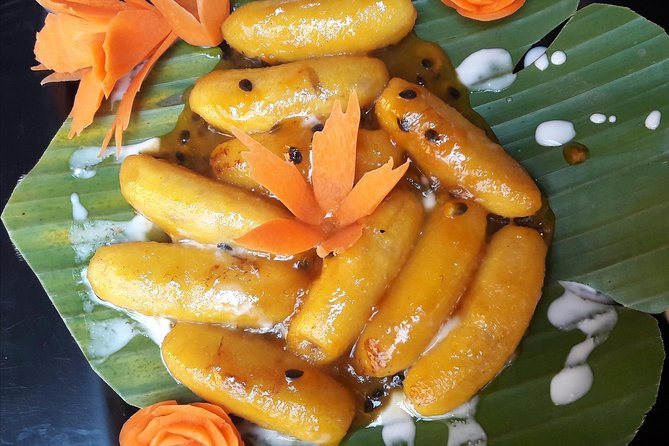
Dessert may be the most memorable part of the evening. A diner specifically praised the Cambodian version of mango sticky rice and judged it better than the Thai preparation.
That comparison is interesting because many visitors already know Thai mango sticky rice. Cambodia’s version gives you a familiar point of reference while showing that the country has its own approach to the dish. You can enjoy the dessert on its own terms, then decide how it compares with the version you may have eaten elsewhere.
The available information does not provide the recipe or explain which ingredients distinguish the Cambodian preparation. So I would not promise a particular flavor profile beyond the fact that mango sticky rice has received strong praise. Still, it is a useful detail for anyone with a sweet tooth or an interest in Southeast Asian food traditions.
Since the dessert is part of the meal you prepare, it is not simply an afterthought served by the kitchen. You take part in creating it, just as you do with the starters and main courses. That makes the final course a fitting end to the class.
A small group of six makes a difference
The maximum group size is six people. That is one of the strongest practical features of the experience.
A small class usually gives you a better chance to participate directly, especially when several dishes are being prepared. You are less likely to feel like you are standing at the back of a demonstration. The group size should also make menu decisions and cooking tasks easier to follow.
There is still no guarantee of a private class. Six is the maximum, not a promise that only one or two people will attend. If you are booking as a couple or solo, you may share the class with other participants.
For families, the small capacity can make the experience feel more manageable. Most people can participate, according to the activity information, though the exact arrangements for children, dietary needs, and cooking assistance are not specified. Ask before booking if any member of your party has special requirements.
What the $29 price delivers
At $29 per person, the price covers an activity lasting about two hours and thirty minutes, plus the food you select and prepare. I consider that a fair value if you want both a meal and a cultural activity in one package.
The comparison is not simply with the cost of eating at a Siem Reap restaurant. A restaurant meal may be cheaper or more elaborate, depending on where you go, but it will not include the market visit, menu selection, cooking practice, or the satisfaction of eating your own work.
The price is especially reasonable for someone who wants a structured evening activity with direct participation. You are buying time, instruction, ingredients, and dinner in one experience. The value is weaker only if you prefer a polished restaurant meal and have little interest in cooking.
Because the exact menu, pickup arrangements, and recipe details are not listed, I would confirm what the fee includes before booking. The core inclusions are clear, but small practical details can affect your sense of value.
Who should book this experience
I would recommend the Khmer Gourmet Degustation to you if you want an active evening in Siem Reap and enjoy trying food through preparation, not just tasting. It suits people who like local markets, small groups, and meals with a personal story behind them.
It is also a good choice for couples and friends. Choosing a menu together gives you something to discuss, and preparing several dishes creates a shared activity before dinner. Families may also enjoy it, since most people can participate, though you should confirm any age or dietary questions directly.
Food-focused visitors will find the format appealing, especially if mango sticky rice is already a favorite. The Cambodian version is a particular reason to consider this class, since it offers a local alternative to the better-known Thai style.
I would be more cautious if you need a detailed published itinerary, a guaranteed list of dishes, or a highly technical cooking lesson. Those features are not confirmed. The class is best understood as a compact, hands-on introduction to Khmer food.
Booking, cancellation, and practical decisions
Free cancellation is available if you cancel at least 24 hours before the 5:00 pm start time. If you cancel less than 24 hours ahead, you will not receive a refund, and changes made inside that same period are not accepted.
The cut-off follows local time in Siem Reap. That detail matters if you are booking from another time zone or changing plans while traveling.
Since confirmation arrives at booking, keep the mobile ticket available on your phone. Pickup is offered, and public transportation is nearby, but confirm the exact meeting instructions and pickup coverage before the day of the class.
Should you book the Khmer Gourmet Degustation?
Book it if you want a small, participatory food experience rather than another sit-down dinner. The market visit, flexible menu choice, five-course structure, and six-person limit give the class real value for $29.
The best reason to choose it is the connection between shopping, cooking, and eating. The most appealing food detail is the Cambodian mango sticky rice, which may give you a new favorite version of a familiar dessert.
Skip it if you want a fixed menu with fully published dishes or a formal culinary course with clearly stated technical instruction. Those details are not supplied. For most curious visitors, though, this is a sensible way to spend an evening in Siem Reap and leave with a better feel for Khmer food.
FAQ
Where does the Khmer Gourmet Degustation take place?
The experience takes place in Siem Reap, Cambodia.
What time does the activity start?
The listed start time is 5:00 pm.
How long does the cooking class last?
The activity lasts approximately two hours and thirty minutes.
How many people can join?
The maximum group size is six participants.
Is hotel pickup available?
Pickup is offered, though the available information does not specify the exact pickup areas or arrangements.
Is the experience near public transportation?
Yes, the activity is described as being near public transportation.
What will I prepare?
You choose and prepare two starters, two main courses, and one dessert.
Do I eat the food I cook?
Yes. After preparing the dishes, you eat what you have cooked.
Is a mobile ticket available?
Yes, the experience offers a mobile ticket, and confirmation is provided at the time of booking.
Can I cancel for a full refund?
Yes, if you cancel at least 24 hours before the experience start time. Cancellations or changes made less than 24 hours in advance are not accepted for a refund.
Newest reviews from Siem Reap
- War Museum, Killing Field, and APOPO Hero RATs Tour★ 5.0 · 7 reviews
- Angkor Wat at Sunrise★ 4.0 · 7 reviews
- Siem Reap Angkor Airport Taxis (from Airport to Hotel)★ 5.0 · 44 reviews
- Cambodian Cooking Class and Oxcart Ride with Local Village Tour★ 5.0 · 4 reviews
- Secret Temples of Angkor – Guided Tour in Siem Reap★ 5.0 · 6 reviews
- Short Cycling at Countryside★ 5.0 · 29 reviews
- SIEM REAP E-BIKE HALF-DAY COUNTRYSIDE (25-30 km)★ 4.0 · 1 review
- Unveiling the Mystical Beauty of Phnom Kulen National Park★ 5.0 · 6 reviews
Siem Reap Tours, compared.

Angkor Wat Sunrise or Sunset Tour with Guide from Siem Reap
Read our review →
Angkor Wat: Small-Group Sunrise or Sunset Tour
Read our review →

Sunset tour of Kampong Phluk stilts home village on the Tonle Sap
Read our review →
Angkor Wat 2-Day Tour with Sunrise and Sunset
Read our review →
Kampong Phluk Floating Village Tour with Boat
Read our review →