
Reviewed · ANGKOR WAT TOURS
Guided Private Tuk Tuk Tour Angkor Wat and Small Circle and Five Extras
Start early, see more, walk farther. This private Angkor tour packs Angkor Wat twice, Ta Prohm, the Small Circle, five quieter sites, and a 3.5 km hike into one long day. I like the private guide and driver, which keeps temple visits flexible, and I like the chance to see East Gate Angkor Wat before returning in late afternoon for reflected towers. The main drawback is simple: this is an intense 11 to 13-hour outing, not a gentle morning of sightseeing.
I also like the mix of famous ruins and lesser-seen corners, including Ta Nei, Mangalartha, and Prasat Chrung. The $59 price is fair for private transport and a licensed English-speaking guide, but you must add the $37 one-day Angkor ticket and lunch, bringing the basic day cost to at least $96 per person before food.
In This Review
- Key points at a glance
- Why this private Angkor route takes all day
- Angkor Wat from the East Gate and West Gate
- Prasat Kravan, Bat Chum, and Srah Srang
- Banteay Kdei and Ta Prohm, two very different jungle temples
- Ta Nei gives the day its quietest temple visit
- Ta Keo, Spean Thma, Chau Say Tevoda, and Thommanon
- Mangalartha and the second Angkor Thom route
- The South Gate and Wat Thmey
- What the $59 price really covers
- Who should book this 11 to 13-hour tour?
- Should you book this Angkor tour?
- FAQ
- What time does the tour start?
- How long does the tour last?
- Is hotel pickup available?
- Is this a private tour?
- Is an English-speaking guide included?
- Is an English-speaking driver included?
- Is the Angkor admission ticket included?
- Is lunch included?
- How much walking is involved?
- Can I cancel for a full refund?
Key points at a glance
- Two visits to Angkor Wat: Enter through the quieter East Gate in the morning, then return for late-afternoon light and reflections.
- A private team: Your group has its own tuk tuk, English-speaking driver, and licensed English-speaking Angkor guide.
- Five quieter stops: Ta Nei, Mangalartha, Prasat Chrung, Spean Thma, and the East Gate area add variety beyond the standard circuit.
- A serious walk: The route includes about 3.5 kilometers along Angkor Thom’s city walls and forest paths.
- A full day in the heat: The 6:30 am start helps with light and crowds, but the long schedule demands stamina.
- Extra costs are clear: The Angkor admission ticket and lunch are not included, while hotel pickup and drop-off are offered.
Why this private Angkor route takes all day
Most people think of the Small Circle as a short loop around Angkor’s best-known temples. This version stretches the idea into a full archaeological day, with 19 stops and several side visits that many people skip.
You begin at 6:30 am. That early start is not just a scheduling quirk. Morning light makes Angkor Wat’s towers more attractive from the East Gate, and the first visit gives you time inside the enormous temple before the day’s heat builds.
The route then moves through smaller temples, the reservoir of Srah Srang, Banteay Kdei, Ta Prohm, and Ta Nei. Later, you continue past Ta Keo and the eastern temples before walking through parts of Angkor Thom. A second Angkor Wat visit closes the temple portion of the day, followed by Wat Thmey and a return to Siem Reap.
I would describe the pace as ambitious rather than relaxed. Several stops last only 15 or 20 minutes, while Ta Prohm gets 1 hour and 15 minutes and Angkor Wat receives longer visits. You will see a lot, but you will need to keep moving.
The private format helps. Your guide accompanies you at the temples while the driver waits at the car park. You are not tied to a large group’s slowest walker or forced to listen to commentary through a crowd. For a solo visitor, couple, or small family group, that privacy is a real benefit.
More Tuk-Tuk Tours in Siem Reap
- Siem Reap: Angkor Wat Private Tuk-Tuk Tour
★ 4.9 · 2,222 reviews - Siem Reap Countryside Bike Tour / E-Bike or Tuk Tuk
★ 5.0 · 935 reviews - Angkor Sunrise Bike Tour / E-Bike or Tuk Tuk
★ 5.0 · 615 reviews
Angkor Wat from the East Gate and West Gate
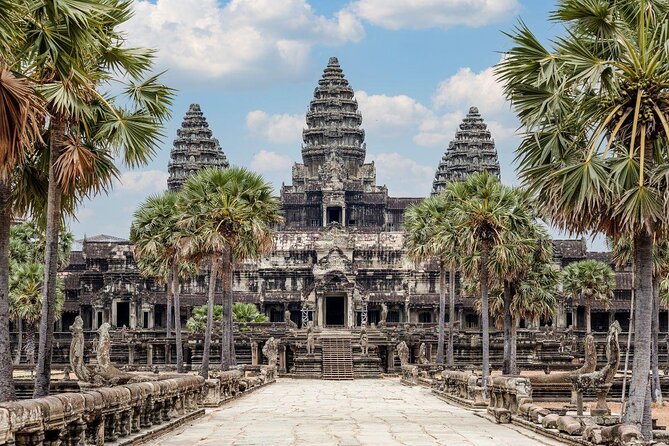
The first two hours are devoted to Angkor Wat. Entering by the East Gate gives you a less usual approach and a different first view of the monument. The morning light is part of the appeal, but the quieter entrance matters too.
Angkor Wat is much larger than a quick photo stop suggests. You can expect broad galleries, towers, courtyards, and long stretches of carved stone. The guide is included here, so you can ask about what you are seeing rather than simply walking from one famous angle to the next.
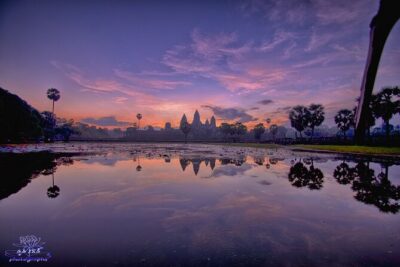
The tour does not treat the first visit as the only Angkor Wat experience. You return late in the afternoon for about an hour. At that point, the towers can be photographed with their reflections in the ponds and moats, and the sunlight has a warmer quality.
That second visit is one of the strongest ideas in the itinerary. Many temple schedules rush away from Angkor Wat after one early stop. Here, you see the monument in two different moods. The tradeoff is time: you spend another hour at a place you have already visited instead of adding another major temple.
Admission is not included. A one-day Angkor ticket is listed at $37 per person and covers the temples on this route. If you want more than one day in the park, a multiple-day ticket is also possible, though the price is not provided here.
Prasat Kravan, Bat Chum, and Srah Srang
Prasat Kravan is a small temple made up of five towers in a line. Its importance comes from the large brick carvings, a style that gives it a different look from the more familiar sandstone monuments.
You have about 20 minutes here. That is enough for a focused visit and photographs, but not a long exploration. I would pay attention to the brickwork rather than expecting a grand complex.
Prasat Bat Chum follows with another 20-minute stop. Three towers share one platform, and large inscriptions give the site value beyond its size. The inscriptions point to the growing role of Buddhism in Angkor, making this a useful stop for anyone interested in religious change.
Srah Srang is scheduled for 10 minutes, but it also serves as the lunch area. The reservoir has an attractive terrace decorated with animal sculptures. The tour information distinguishes Srah Srang from a baray, explaining that Srah Srang was artificially deepened, while a baray is a reservoir.
Several restaurants are available near the water. Lunch is not included, so bring money for your meal. The driver can take you elsewhere, but you must agree to pay for the extra kilometers. Eating here is the most practical choice because it avoids adding more driving to an already long day.
Banteay Kdei and Ta Prohm, two very different jungle temples
Banteay Kdei is often described as the smaller sister of Ta Prohm, though it remains a large and complex site. Its flat layout can feel maze-like, with corridors and chambers arranged in a way that rewards slow attention.
You have about 45 minutes. That gives you more time than at the first small temples, but the site is broad enough that you may still need to choose where to focus.
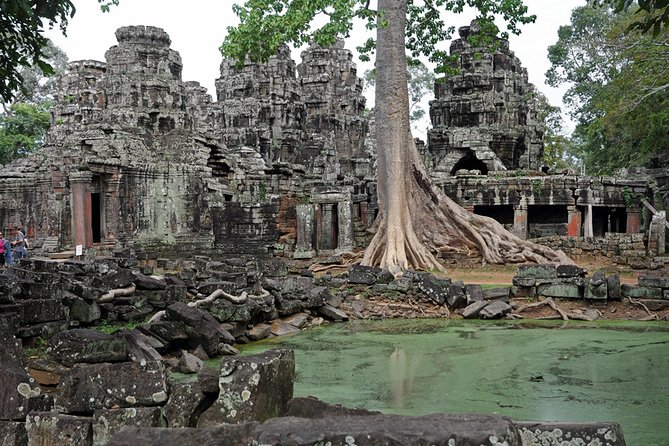
Ta Prohm receives 1 hour and 15 minutes, and it deserves the extra time. This is the famous jungle temple, with huge strangle figs growing over parts of the ruins. The trees are not a minor decoration. They shape the whole experience, showing how stone monuments can be overtaken by the forest.
Ta Prohm can also be a demanding stop. It is a large compound, and you may spend much of your time walking between the best-known sections. The included guide can help you understand the layout and point out architectural features, while the driver remains at the parking area.
If you have only seen Angkor Wat in photographs, Ta Prohm provides a sharp contrast. Angkor Wat feels ordered and monumental. Ta Prohm feels tangled, damaged, and theatrical. Seeing both in the same morning gives you a better sense of how varied Angkor’s temple building was.
More ways to see Angkor Wat:
- Angkor Wat Sunrise or Sunset Tour with Guide from Siem Reap
★ 5.0 · 12,109 reviews - Siem Reap: Angkor Wat: Small-Group Sunrise or Sunset Tour
★ 5.0 · 9,444 reviews - Siem Reap: Angkor Wat 2-Day Tour with Sunrise and Sunset
★ 4.9 · 4,429 reviews - Siem Reap: Full-Day Angkor Wat Guided Tour with Sunset
★ 4.9 · 3,803 reviews
Ta Nei gives the day its quietest temple visit
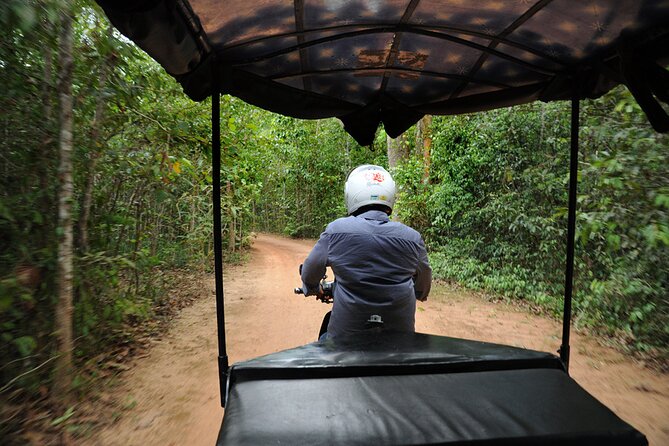
Ta Nei is reached by gravel roads and remains tucked into the forest. The rougher access is part of its appeal, since it helps explain why this temple receives less attention than Ta Prohm.
You have about 30 minutes at the site. The ruins are described as an Indiana Jones-style setting, but the practical point is that Ta Nei offers a quieter pause after the large and famous temple complexes.
Do not expect the same scale or restoration work you see at Angkor Wat. Ta Nei is valuable because of its setting and sense of distance from the main route. I would save a little energy for it rather than treating it as just another quick stop.
This is one of the places where a private tour has an advantage. The driver can handle the rough approach while your guide walks with you through the ruins. You get a focused visit without spending the day waiting for a large group to gather.
Ta Keo, Spean Thma, Chau Say Tevoda, and Thommanon
Ta Keo is a former state temple built as an artificial mountain, a stepped pyramid with five towers on its highest platform. The stairs are described as extraordinarily steep.
The stop lasts about 40 minutes. That is enough time to see the structure and climb if conditions and your comfort allow. The stairs are an important consideration for anyone with mobility concerns or a fear of steep climbs. The tour notes say most people can participate, but they do not promise easy access at every temple.
Spean Thma is a brief five-minute photo stop. This late-Angkor stone bridge was built with carved stones taken from earlier temples. The river has since shifted east, so you are looking at a bridge whose original setting has changed.
Chau Say Tevoda gets about 20 minutes. It is a medium-sized temple with an impressive eastern processional route and pediment carvings showing mythological subjects.
Thommanon, its sister temple, receives 15 minutes. Its towers belong to the Angkor Wat period and share that period’s style. These two temples work well as a pair, especially if you want to compare their layout and decoration without spending another hour at each.
The short timing here means your guide’s explanations matter. You will not have much time to study every carving, so listen for the main architectural differences and use the stops as a visual break between the larger complexes.
Mangalartha and the second Angkor Thom route
Mangalartha is a small temple on a steep, tiered platform. It dates from the 13th century and is considered the last stone temple built in Angkor.
The visit lasts 15 minutes. That may sound brief, but its value is not size. Mangalartha is a rare chance to see a late example of Angkorian stone construction, away from the major monuments.
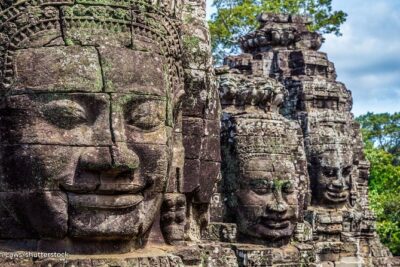
Next comes the Victory Gate, one of the best-preserved gates of Angkor Thom. You can climb the wall for a view toward the southern giant face of the gate. That elevated angle helps you see the gate as part of the old city’s defensive and ceremonial design, rather than as a single roadside monument.
The main Angkor Thom walk then begins. Along the city walls, you reach the lonesome East Gate, an area without a road leading directly to it. The route includes about 3.5 kilometers of walking and takes you to the southeastern Prasat Chrung, one of four corner temples set on Angkor Thom’s walls.
This walk is the tour’s most unusual feature and its biggest physical test. You will see a quieter side of Angkor Thom, but you will also be walking after several hours of temple visits. Wear practical footwear and treat water and rest as necessities, not extras.
Prasat Chrung receives about 20 minutes. Its position on the wall gives it a different relationship to the city than the central temples. The site is described as the best-preserved of the four corner temples, making it a worthwhile reward for the walk.
The South Gate and Wat Thmey
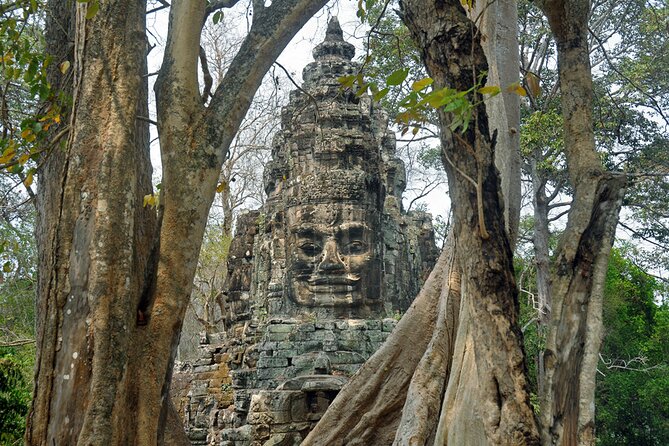
The South Gate of Angkor Thom is a compact but powerful stop. Its face tower and rows of giant statues, showing demons and gods, create one of the most recognizable approaches in the Angkor area.
You have about 15 minutes there. This is a place to slow down for a few photographs and let the guide explain the imagery. The gate is easy to appreciate even late in the day, when your attention may be wearing thin.
Wat Thmey is the final cultural stop before your return to town. Its small memorial stupa honors victims of the Khmer Rouge, and photo boards show some of those who were killed there. An open area and prayer hall complete the site.
The 10-minute visit is short, but the subject is serious. Wat Thmey adds modern Cambodian history to a day otherwise focused on ancient stone. I would not treat it as a casual final photo stop. Give the memorial your attention, even if only briefly.
What the $59 price really covers
At $59 per person, the tour includes private transportation, an English-speaking driver, and a licensed English-speaking Angkor guide. Pickup is offered, and drop-off can be at your hotel or another point in central Siem Reap.
The price is strongest for small groups. Since this is a private activity, the cost may make more sense for two or more people sharing the experience than for a solo visitor comparing it with a basic tuk tuk hire. Group discounts are available, though the exact reduction is not stated.
Add the $37 one-day Angkor ticket, and the known cost becomes $96 per person. Lunch is extra. That is not a budget temple outing, but it covers a very long day, private driving, two Angkor Wat visits, a licensed guide, and several less-visited sites.
The main value comes from organization. You do not have to arrange separate transport between 19 stops or figure out the wall walk on your own. If the guide’s commentary is a priority, the price is easier to justify.
Who should book this 11 to 13-hour tour?
I would choose this for someone who wants to see much more than the standard Angkor Wat and Ta Prohm pairing. It suits a solo visitor who wants personal attention, couples who prefer their own pace, and small groups that can share the private cost.
It also suits people who enjoy ruins in different states: grand Angkor Wat, tree-covered Ta Prohm, rougher Ta Nei, modest Mangalartha, and wall temples reached on foot.
I would not choose it if you want a slow day with long restaurant breaks and plenty of idle time. The schedule is packed, some stops are very short, and the 3.5-kilometer walk comes late in the route.
The tour has received top marks in the supplied feedback, with praise for tailored planning, smooth arrangements, Cambodian hospitality, and fair pricing. One solo itinerary was adjusted around personal interests, which suggests the private format can be useful if you want to ask for more time at certain temples. The available feedback does not provide guide names, so you should not expect to book a particular person.
Free cancellation is available up to 24 hours before the 6:30 am start. Changes or cancellations made inside that window are not accepted for a refund.
Should you book this Angkor tour?
Book it if you want an ambitious, private day that combines the major sights with quieter ruins and a proper walk through Angkor Thom. The repeat visit to Angkor Wat is especially appealing for photographers, while Ta Nei and Prasat Chrung add places that a standard loop often leaves out.
Skip it if you prefer a short temple visit, have limited stamina, or want a schedule with plenty of unplanned time. At $59 plus the Angkor ticket and lunch, it is not the cheapest way to see the park. It is a good-value choice for a small group that wants a guide, private transport, and a carefully connected route without having to organize the details alone.
FAQ
What time does the tour start?
The tour starts at 6:30 am.
How long does the tour last?
The expected duration is approximately 11 to 13 hours.
Is hotel pickup available?
Yes. Pickup is offered, and drop-off can be arranged at your hotel or another point in central Siem Reap.
Is this a private tour?
Yes. Only your group participates in the activity.
Is an English-speaking guide included?
Yes. The tour includes a licensed English-speaking Angkor guide.
Is an English-speaking driver included?
Yes. An English-speaking driver is included with the private transportation.
Is the Angkor admission ticket included?
No. The one-day Angkor ticket is listed at $37 per person. Multiple-day tickets are also possible, but their prices are not provided.
Is lunch included?
No. Lunch is not included. Restaurants are available near Srah Srang.
How much walking is involved?
The itinerary includes a 3.5-kilometer hike along parts of Angkor Thom’s city walls and to Prasat Chrung.
Can I cancel for a full refund?
Yes, if you cancel at least 24 hours before the experience start time. Cancellations made less than 24 hours in advance are not refundable.
Newest reviews from Siem Reap
- War Museum, Killing Field, and APOPO Hero RATs Tour★ 5.0 · 7 reviews
- Siem Reap Angkor Airport Taxis (from Airport to Hotel)★ 5.0 · 44 reviews
- Angkor Wat at Sunrise★ 4.0 · 7 reviews
- Cambodian Cooking Class and Oxcart Ride with Local Village Tour★ 5.0 · 4 reviews
- Secret Temples of Angkor – Guided Tour in Siem Reap★ 5.0 · 6 reviews
- Short Cycling at Countryside★ 5.0 · 29 reviews
- SIEM REAP E-BIKE HALF-DAY COUNTRYSIDE (25-30 km)★ 4.0 · 1 review
- Unveiling the Mystical Beauty of Phnom Kulen National Park★ 5.0 · 6 reviews
Angkor Wat Tours, compared.
Angkor Wat Sunrise or Sunset Tour with Guide from Siem Reap
Read our review →
Angkor Wat: Small-Group Sunrise or Sunset Tour
Read our review →
Angkor Wat 2-Day Tour with Sunrise and Sunset
Read our review →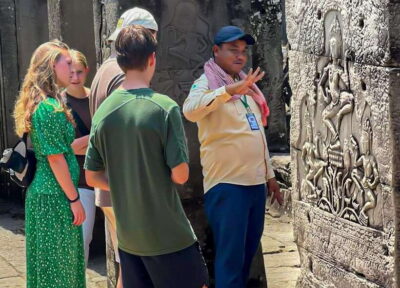
Angkor Wat Sunrise tour with Small – Group and Guide tours
Read our review →
Angkor Wat Highlights and Sunrise Guided Tour from Siem Reap
Read our review →
Angkor Wat Sunset Small Group Tour with Lunch Included
Read our review →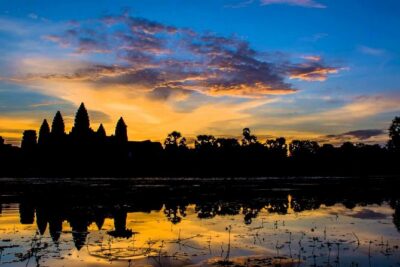
Full-Day Angkor Wat Sunrise Private Tour with Guide from Siem Reap
Read our review →Browse the lists this tour appears in