
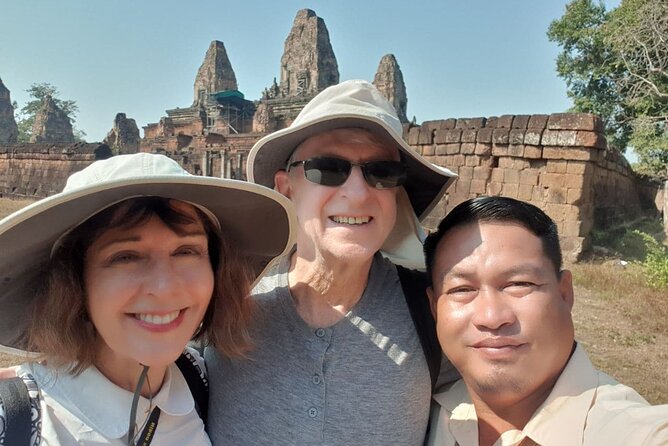
Reviewed · ANGKOR WAT TOURS
Full-Day private Tour in Lost City & Angkor Wat from Siem Reap
Angkor rewards a well-planned day. This private tour pairs Angkor Wat’s quieter eastern entrance with the major temples of Angkor Thom and the tree-covered ruins of Ta Prohm, giving you a useful first look at Cambodia’s most important archaeological area. I like the private vehicle and hotel pickup, and I like having a guide who can adjust the pace when the heat or temple fatigue sets in. The main drawback is that the $30 price excludes the Angkor entrance ticket, and eight hours in hot, exposed temple grounds can feel long.
You get a lot of ground covered here: Angkor Wat, the South Gate, Bayon, Baphuon, the Royal Palace area, the Terraces of the Elephants and Leper King, and Ta Prohm. I especially value the guide service because the carvings can blur together without context. Just plan for humidity, stairs, uneven paths, and modest clothing that covers your knees and shoulders at sacred areas.
In This Review
- Key points to know before you book
- Why a private Angkor day can work well
- Angkor Wat from the eastern approach
- The South Gate and Bayon’s stone faces
- Baphuon and the former royal center
- Phimeanakas and the two ceremonial terraces
- Ta Prohm, where trees take over the ruins
- Lunch, heat, and the practical rhythm of the day
- What the $30 price really covers
- Who will get the most from this tour
- Should you book this Angkor tour?
- FAQ
- Is the Angkor temple admission fee included?
- Is this a private tour?
- Does the tour include hotel pickup and drop-off?
- How long does the tour last?
- What should I wear to the temples?
- Can I cancel for a full refund?
Key points to know before you book
- Enter Angkor Wat from the eastern side: You begin away from the temple’s famous front view, using a quieter route toward an ancient library pool and the inner chambers.
- Private touring keeps the day flexible: Only your own group participates, so the guide can change the order or slow down when you need a break.
- The guide adds meaning to the stonework: Angkor Wat’s bas-reliefs, Bayon’s faces, and the everyday scenes at Angkor Thom make much more sense with explanation.
- You see the main Angkor Thom circuit: The route includes the South Gate, Bayon, Baphuon, Phimeanakas, both terraces, and less-publicized places within the old city.
- Ta Prohm provides the strongest atmosphere: Trees growing through the ruins give this final major stop a very different feeling from the open courtyards of Angkor Wat.
- The price is attractive, but not all-inclusive: At $30 per person, you receive transport, guide service, water, and hotel transfers, but the temple admission fee is extra.
Why a private Angkor day can work well
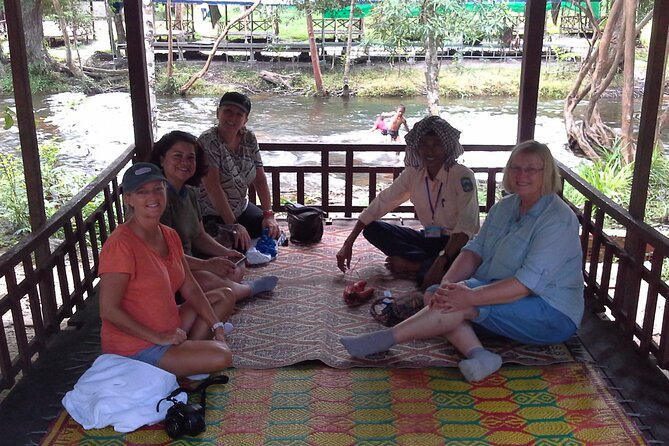
This is an eight-hour private outing from Siem Reap, with pickup and drop-off at your hotel. You travel in a private vehicle with an English-speaking guide, rather than following a fixed group and waiting for strangers at every doorway.
That matters at Angkor. The temples are spread over a broad area, and the day involves repeated stops, short walks, stone steps, and time in the sun. If you are eager to spend longer at a bas-relief, take photographs, or pause for a drink, a private arrangement gives you more room to do so.
The guide can also adjust the order. Sim, one of the guides associated with this tour, received particular praise for extensive explanations and flexibility. One day was rearranged to visit a temple earlier, then included time at a coffee place near Angkor Wat when the group became tired and temple-weary. That is a useful reminder: you do not have to treat the itinerary as a race.
Guide Rith was also praised for letting the group move at its own pace while keeping the history clear. That combination is important. A guide who talks constantly can make a long day tiring, while a guide who says too little leaves you staring at stones without a story. The strongest feedback here points to guides who explain, watch the pace, and remain engaged with the place.
More ways to see Angkor Wat:
- Angkor Wat Sunrise or Sunset Tour with Guide from Siem Reap
★ 5.0 · 12,109 reviews - Siem Reap: Angkor Wat: Small-Group Sunrise or Sunset Tour
★ 5.0 · 9,444 reviews - Siem Reap: Angkor Wat 2-Day Tour with Sunrise and Sunset
★ 4.9 · 4,429 reviews
Angkor Wat from the eastern approach
Your first major stop is Angkor Wat, the largest religious monument in the world. Built in the early 12th century, it began as a Hindu temple and has remained an active religious center since its foundation, later becoming associated with Buddhism.
Most photographs show the western front and its long reflection pool. This tour takes a different approach, entering from the less-used eastern side. You continue on foot along a jungle path toward an ancient library pool before moving into the temple complex.
That route changes the first impression. Instead of immediately joining the classic postcard view, you approach the monument through vegetation and stone, gradually getting a sense of its size. I like this because it makes Angkor Wat feel less like a single photo stop and more like a place with layers and routes.
Inside, your guide explains the bas-reliefs carved along the walls. These carvings include mythological scenes, royal themes, and stories from Khmer religious tradition. The reliefs form the longest continuous stretch of bas-relief carvings in the world, so a guide helps you focus on details rather than trying to inspect every figure.
You then move toward the central chambers and upper terraces. Angkor Wat is at its most impressive here, but this part also demands care. The stone surfaces and stairways can be uneven, and the walk is not a gentle museum visit. Flat, comfortable shoes are essential.
Allow about two hours for Angkor Wat. That is enough to see the principal areas with an explanation, though you may want more time if photography is your priority. Admission is not included, so you need the required temple entrance ticket before entering. The guide sends a link to purchase the temple e-ticket several days in advance.
The South Gate and Bayon’s stone faces
After Angkor Wat, the tour moves to Angkor Thom, the former royal capital of the Khmer Empire. The South Gate is a short stop, but it gives you a strong visual introduction to the old city.
The gate is flanked by rows of 54 stone figures on each side. The figures represent a famous mythic tug-of-war, with gods on one side and demons on the other. Even if you spend only about 20 minutes here, look closely at the expressions and the condition of the figures. The entrance is one of the most photographed places in the Angkor area, so a private guide can help you position the visit within the wider story of Angkor Thom.
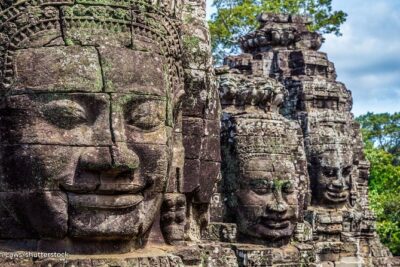
Bayon follows, with about an hour inside the temple. Built in the 13th century as the state temple of King Jayavarman VII, Bayon occupies the center of Angkor Thom. Its famous towers carry more than 200 large stone faces, each with a calm, slightly smiling expression.
The faces are the obvious attraction, but do not rush past the lower galleries. Bayon has two sets of bas-reliefs. One group shows mythological scenes, while the outer galleries also record battles, court life, markets, animals, and ordinary daily activity. These scenes help you picture the Khmer world beyond kings and monuments.
Bayon can feel confusing at first. Towers overlap, passages narrow, and the faces appear from unexpected angles. I find that a guide is especially useful here because the temple’s layout is less immediately clear than Angkor Wat’s long galleries.
Baphuon and the former royal center
Baphuon sits northwest of Bayon inside Angkor Thom. It was built in the mid-11th century as a state temple, before Jayavarman VII’s later building program. The structure rises in three levels and once reached about 50 meters with its tower.
Give this stop about an hour. The temple has a different character from Bayon. Its long approach and pyramid form make you think about Khmer temple design as a climb toward a sacred center, rather than simply a set of enclosed rooms.
Baphuon’s scale impressed a late 13th-century Chinese envoy, who described it as the Tower of Bronze. That old description helps explain why the temple still deserves time, even when the faces of Bayon and the trees of Ta Prohm are competing for attention.
The route then continues through Angkor Thom toward places many people pass quickly. The tour description includes two brief stops described as special or less-seen places, but it does not identify them by name. Treat these as flexible pauses rather than guaranteed major monuments. Your guide may use them to show you a quieter corner, explain the city’s layout, or give you time to take photographs.
A few more options around Siem Reap worth reading up on
- From Siem Reap: Kampong Phluk Floating Village Tour by Boat
★ 4.9 · 6,979 reviews - Sunset tour of Kampong Phluk stilts home village on the Tonle Sap
★ 5.0 · 4,865 reviews - Siem Reap: Kampong Phluk Floating Village Tour with Boat
★ 4.9 · 3,843 reviews - Siem Reap: Full-Day Angkor Wat Guided Tour with Sunset
★ 4.9 · 3,803 reviews
Phimeanakas and the two ceremonial terraces
Phimeanakas, also called Vimeanakas, is located inside the walled Royal Palace enclosure. The temple began in the late 10th century under Rajendravarman and was completed under Suryavarman I. It takes the form of a three-tier pyramid, with a tower once rising from the top.
This stop is scheduled for about an hour. Compared with Angkor Wat and Bayon, Phimeanakas is more restrained. Its importance comes from its place within the royal center and from the way it shows the development of Khmer temple architecture over time.
Next comes the Terrace of the Elephants, a long platform about 350 meters in length. King Jayavarman VII built it in the 13th century as a reviewing stand for public ceremonies and as a base for royal audiences. The elephant carvings along the terrace give it its name.
You have about 40 minutes here. This is a good place to think about Angkor Thom as a working capital, not just a collection of temples. The terrace was tied to public displays of power, ceremonies, and royal gatherings. It may also appeal to you if you enjoy architecture in relation to civic life.
The Terrace of the Leper King follows, with another 40 minutes. This U-shaped structure may have served as a royal cremation site. Its modern name comes from a statue found there, although the figure depicts Yama, the Hindu god of death.
The terrace is enclosed and decorated with carved figures, so it rewards a closer look. Ask your guide to explain the competing interpretations of the site. The evidence does not give every answer, and that uncertainty is part of the interest.
Ta Prohm, where trees take over the ruins
The last major temple is Ta Prohm, built in the 13th century under Jayavarman VII. It was a religious temple in the center of an ancient Khmer university and is now famous for its trees, roots, galleries, and partly ruined walls.
You get about an hour here. Ta Prohm feels very different from Angkor Wat. Angkor Wat is ordered and monumental, while Ta Prohm is tangled, shaded, and visually dramatic. Trees grow through sections of the ruins, creating the famous image that has made this temple one of Cambodia’s most recognizable sights.
The nickname Tomb Raider temple reflects its use as a film location, but the place is more than a movie backdrop. Its condition preserves a sense of the jungle reclaiming a former religious complex. UNESCO added Ta Prohm to the World Heritage List in 1992.
This is likely to be your most atmospheric stop, but it can also be the most tiring. After several hours of walking, the uneven ground and crowded passageways may test your patience. A private schedule helps because you can decide how much time to spend on the best-known tree and gallery views instead of following a group’s fixed pace.
Lunch, heat, and the practical rhythm of the day
Lunch is arranged at a restaurant near the temple, with cold drinks available. The meal is not listed among the included features, so plan to pay for it separately unless your booking details say otherwise.
The break matters. Cambodia’s heat and humidity can wear you down even when each walk seems short. One person described the humidity as the chief challenge, while another appreciated taking a coffee break after becoming tired. I would treat that as sound advice: tell your guide early if you need water, shade, or a slower pace.
The tour also advertises ways to avoid crowds and escape the heat. The eastern entrance at Angkor Wat is one part of that strategy, and private transport helps you move between sites without waiting for a larger group. Still, no tour can guarantee empty temples. Angkor Wat, Bayon, and Ta Prohm are major sights, so expect other people at popular viewpoints.
Wear flat shoes and light clothing that covers your knees and shoulders where required. Bring sun protection and make use of the bottled water provided. The day is suitable for most people, but it is not ideal if you have difficulty walking on uneven surfaces or climbing temple steps.
What the $30 price really covers
At $30 per person, this is an appealing price for a private eight-hour service. You receive an English-speaking guide, a private comfortable vehicle, hotel pickup and drop-off, and bottled water.
The value is strongest for two or more people sharing the same booking. You are paying for a full day of transport and personal guiding rather than only a ride between temples. The private format also gives you something a group tour cannot promise as easily: control over the pace.
The important catch is the Angkor admission fee. It is not included, and the guide sends you a link to purchase the temple entrance e-ticket in advance. Add that cost to your total before deciding if the tour fits your budget.
The tour is mobile-ticket friendly, and confirmation arrives at booking. Pickup is offered, and the area is near public transportation, though the included hotel transfer is the more practical choice for a long temple day.
Cancellation is free with a full refund if you cancel at least 24 hours before the start time. Changes or cancellations inside that 24-hour window are not accepted for a refund, based on local time.
Who will get the most from this tour
I would choose this tour if you want the main Angkor sights in one focused day without joining a large group. It suits first-time visitors who want explanations of the carvings and temple layout, as well as couples, families, colleagues, or friends who prefer setting their own rhythm.
It is also a good match if you want photographs but do not want to spend the whole day at one monument. The eastern approach at Angkor Wat, the faces at Bayon, the terraces, and the roots at Ta Prohm give you very different scenes.
I would think twice if you want a slow, deeply detailed study of every temple. The schedule includes many stops, and some are allotted only 10 to 40 minutes. You will see a lot, but you cannot examine every carving at leisure.
I would also avoid packing the day too tightly if heat affects you strongly. The itinerary can be adjusted, but it remains an eight-hour outing with substantial walking. A private vehicle helps you recover between stops, yet it does not remove the physical demands of the site.
Should you book this Angkor tour?
Book it if you want a well-priced private introduction to Angkor with hotel transport, an English-speaking guide, and flexibility when your energy changes. The strongest part is the guide-led interpretation, especially at Angkor Wat and Bayon, where the carvings and symbols can otherwise become a blur.
The tour is less suitable if your main goal is sunrise photography, a slow archaeological study, or an all-inclusive price. Sunrise is not specified, lunch is separate, and the entrance ticket costs extra.
For most first visits from Siem Reap, I see this as a practical choice. Buy the temple ticket ahead of time, wear proper shoes and modest clothing, carry patience for the heat, and tell the guide when you need a break. Do that, and the day gives you a broad, meaningful look at Angkor without making you surrender control of your own pace.
FAQ
Is the Angkor temple admission fee included?
No. The Angkor entrance fee is not included in the $30 tour price. The guide will send you a link to purchase the temple entrance e-ticket several days before the tour.
Is this a private tour?
Yes. Only your own group participates in the activity. You travel in a private vehicle with an English-speaking guide.
Does the tour include hotel pickup and drop-off?
Yes. Hotel pickup and drop-off are included.
How long does the tour last?
The tour lasts approximately eight hours. The listed visits include about two hours at Angkor Wat, one hour at Bayon, one hour at Baphuon, one hour at Phimeanakas, 40 minutes at each terrace, and one hour at Ta Prohm, along with shorter stops and travel time.
What should I wear to the temples?
You should wear clothing that covers your knees and shoulders when entering sacred areas. Flat shoes that are comfortable for walking are recommended.
Can I cancel for a full refund?
Yes, if you cancel at least 24 hours before the experience start time. Cancellations or changes made less than 24 hours before the start time are not eligible for a refund.
Newest reviews from Siem Reap
- War Museum, Killing Field, and APOPO Hero RATs Tour★ 5.0 · 7 reviews
- Angkor Wat at Sunrise★ 4.0 · 7 reviews
- Siem Reap Angkor Airport Taxis (from Airport to Hotel)★ 5.0 · 44 reviews
- Cambodian Cooking Class and Oxcart Ride with Local Village Tour★ 5.0 · 4 reviews
- Secret Temples of Angkor – Guided Tour in Siem Reap★ 5.0 · 6 reviews
- Short Cycling at Countryside★ 5.0 · 29 reviews
- SIEM REAP E-BIKE HALF-DAY COUNTRYSIDE (25-30 km)★ 4.0 · 1 review
- Unveiling the Mystical Beauty of Phnom Kulen National Park★ 5.0 · 6 reviews
Angkor Wat Tours, compared.
Angkor Wat Sunrise or Sunset Tour with Guide from Siem Reap
Read our review →
Angkor Wat: Small-Group Sunrise or Sunset Tour
Read our review →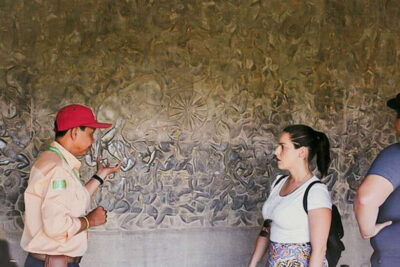
Angkor Wat 2-Day Tour with Sunrise and Sunset
Read our review →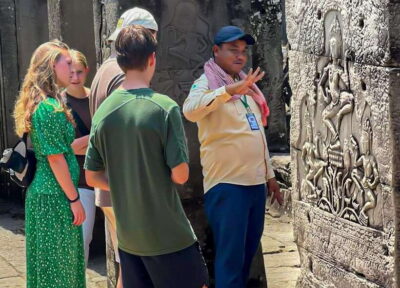
Angkor Wat Sunrise tour with Small – Group and Guide tours
Read our review →
Angkor Wat Highlights and Sunrise Guided Tour from Siem Reap
Read our review →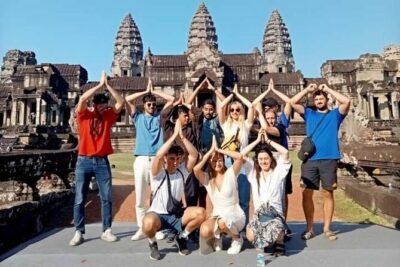
Angkor Wat Sunset Small Group Tour with Lunch Included
Read our review →
Full-Day Angkor Wat Sunrise Private Tour with Guide from Siem Reap
Read our review →Browse the lists this tour appears in