
Reviewed · ANGKOR WAT TOURS
Angkor Wat Highlights 2 Days Tour with Sunrise and Sunset
Angkor Wat rewards an early start. This two-day Siem Reap tour combines the major temples with quieter ruins, a Cambodian circus performance, and sunset from Phnom Bakheng. I especially like the 04:30 pickup for sunrise and the mix of famous sights such as Bayon and Ta Prohm with less visited Ta Nei and Banteay Samre.
I also like that the tour includes hotel pickup, an English-speaking licensed guide, bottled water, and Phare Circus tickets. The main drawback is the pace. Day one begins before dawn and packs in many stops, while the $199 price does not include the Angkor temple pass, meals, accommodation, or drinks.
In This Review
- Key points at a glance
- What the two-day plan gets right
- Sunrise and the long morning at Angkor Wat
- Angkor Thom, Bayon, and the royal center
- Ta Nei and Ta Prohm in the jungle
- Phare Cambodian Circus gives day one a lift
- Day two reaches Banteay Srei and Banteay Samre
- Neak Pean and Preah Khan after lunch
- Sunset from Phnom Bakheng
- What the $199 price really covers
- The guide can shape the whole experience
- Who should book this tour
- Should you book the two-day Angkor plan?
- FAQ
- What is included in the $199 tour price?
- Is the Angkor temple pass included?
- Is this a private tour?
- What time does pickup begin on day one?
- Is breakfast included?
- Are lunch and dinner included?
- What transport is used?
- Which temples are visited?
- Is the Phare Cambodian Circus ticket included?
- Can the tour be canceled for a full refund?
Key points at a glance
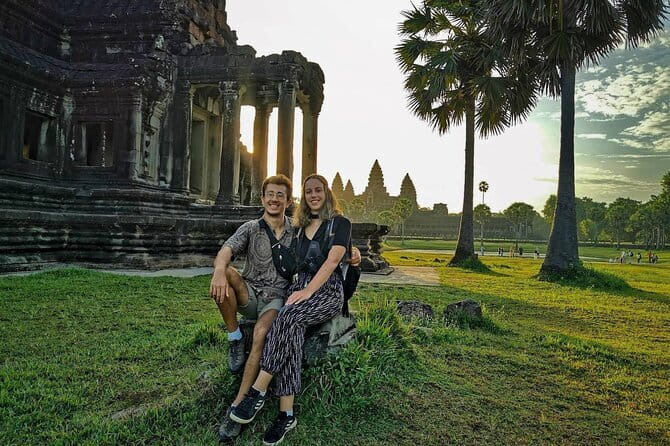
- Sunrise at 04:30: You reach Angkor Wat before the main temple visit, with time to see the morning light and then explore the complex.
- Private experience: Only your group takes part, with a tuk-tuk on day one and an air-conditioned car or minivan on day two.
- A strong temple mix: The route covers Angkor Wat, Angkor Thom, Bayon, Ta Prohm, Banteay Srei, Preah Khan, and several quieter sites.
- Culture beyond stone ruins: Phare Cambodian Circus adds music, dance, theater, acrobatics, and stories drawn from Cambodian life.
- Extra costs matter: Add $62 per adult for the temple pass, then budget separately for meals and drinks.
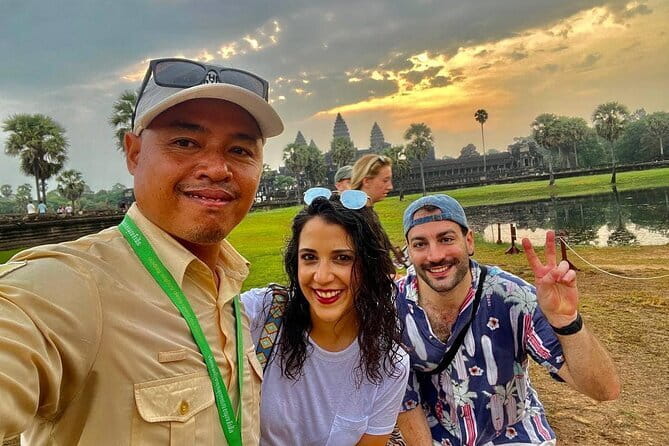
- A guide with a camera eye: Mr P is praised for his energy, kindness, historical explanations, and photography help.
What the two-day plan gets right
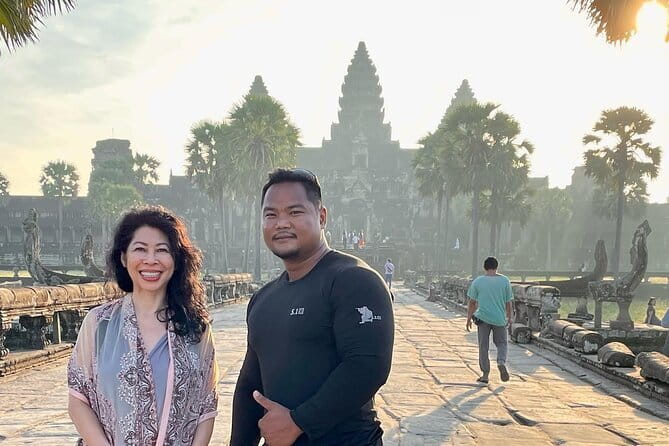
Angkor Archaeological Park is too large for a quick temple visit. The first day focuses on the main route around Angkor Wat and Angkor Thom, while the second reaches farther out to Banteay Srei, Banteay Samre, Neak Pean, and Preah Khan.
That division makes sense. You see the most famous monuments while your energy is fresh, then use the second day for smaller temples and a different rhythm. Still, this is not a slow, contemplative schedule. Day one includes an early wake-up, many short stops, and a circus show at night.
The tour is private, so you are not following a large bus group. That matters at the temples, where a guide can adjust the pace for your group. It also gives you a better chance to ask about carvings, religious symbols, and Cambodian kings instead of simply moving from one photo stop to the next.
More ways to see Angkor Wat:
- Angkor Wat Sunrise or Sunset Tour with Guide from Siem Reap
★ 5.0 · 12,109 reviews - Siem Reap: Angkor Wat: Small-Group Sunrise or Sunset Tour
★ 5.0 · 9,444 reviews - Siem Reap: Angkor Wat 2-Day Tour with Sunrise and Sunset
★ 4.9 · 4,429 reviews
Sunrise and the long morning at Angkor Wat
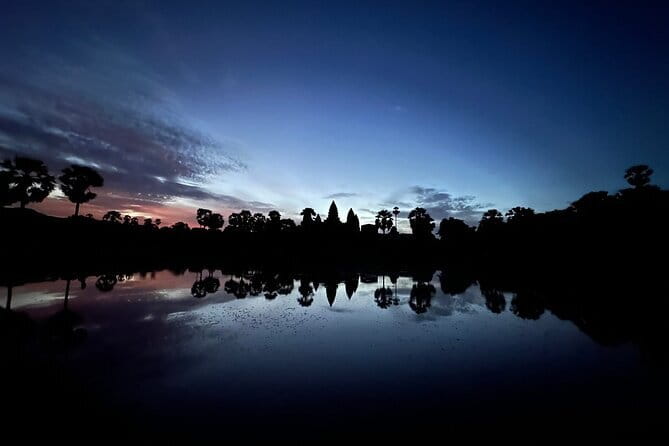
The tuk-tuk pickup is scheduled for 04:30, which is the price of seeing Angkor Wat at sunrise. The early hour may feel severe, especially if you have arrived in Siem Reap recently, but the payoff is access to the temple before the heat becomes intense.
Angkor Wat was built in the 12th century by King Suryavarman II. It began as a Hindu temple dedicated to Vishnu and later became a Buddhist site. Its towers and galleries express the idea of Mount Meru, the sacred center of the universe in Hindu and Buddhist thought.
After the sunrise, you continue into the temple rather than leaving after the familiar reflection photograph. Allowing about three hours here gives you time to notice the bas-reliefs, towers, courtyards, and carefully planned structure.
The practical issue is admission. The $199 tour price does not include the temple pass, which costs $62 per adult. Children under 12 enter free according to the provided details. Add that fee when comparing the tour with other options.
Angkor Thom, Bayon, and the royal center
From Angkor Wat, the route continues to Angkor Thom, the 12th-century capital built under King Jayavarman VII. The city was surrounded by walls measuring about three kilometers on each side, with five large gates.
The South Gate is a classic stopping point. Stone figures line the approach, and the gate itself makes a strong first photograph before you enter the old city. The scheduled stop is about 30 minutes, including time at the gate and the wider Angkor Thom area.
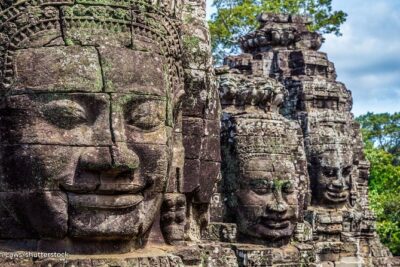
Bayon is the main reason to enter Angkor Thom. More than 200 large faces appear on its towers, creating the famous smiling faces of Angkor. The faces are generally connected with Avalokitesvara, a Buddhist bodhisattva, and their calm expressions give the temple a strange, watchful character.
You have about 40 minutes at Bayon. That is enough for a useful first look, but not enough to study every corridor and carving. If you enjoy architectural detail, tell your guide early that you would like a little time for close inspection.
Baphuon follows. This 11th-century temple sits on a rectangular sandstone base with five levels. Its galleries and elevated walkway show a different design from the more familiar Angkor Wat style. You have roughly 30 minutes here.
Phimeanakas is a simpler sandstone temple near the center of the former Royal Palace enclosure. It was once topped by a golden pinnacle and was known as the Tower of Gold. The decoration is restrained, so this stop is more about the temple’s place in the royal center than about elaborate carvings.
You also pass the Terrace of the Elephants and the Terrace of the Leper King. The Elephant Terrace stretches about 350 meters and carries carvings of elephants and mythological creatures. The Terrace of the Leper King is known for its layered bas-reliefs, including an inner wall that can be viewed through a corridor.
These shorter stops help you understand Angkor Thom as a planned royal city, not just a collection of isolated temples. The limitation is that you pass by some areas rather than spending long periods at each one.
Ta Nei and Ta Prohm in the jungle
Ta Nei is one of the best changes of pace on day one. It sits deep in the Cambodian jungle near the East Baray and is described as a quiet site with few vendors and fewer crowds. Built under Jayavarman VII, it follows Buddhist principles and offers a more solitary look at the temple ruins.
The stop lasts about 20 minutes, so do not expect a long exploration. Its value comes from the contrast with Angkor Wat and Bayon. You get a brief sense of what the Angkor area can feel like away from the main circuit.
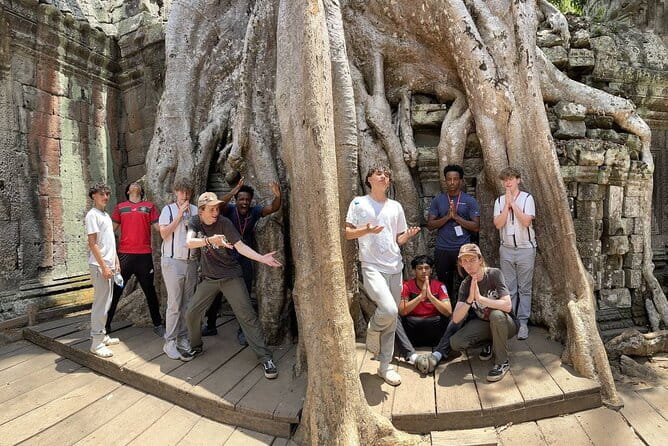
Ta Prohm receives a full hour. Built in the late 12th century and dedicated to Jayavarman VII’s mother, it began as a Buddhist monastery. Its stone galleries and giant tree roots have made it one of the most recognizable temples in Cambodia.
The roots are not simply decoration added for visitors. They are part of the reason Ta Prohm feels different from the more restored temples. The site has been left largely in its overgrown condition, while carvings of Buddhist motifs and celestial dancers remain visible.
The temple also appeared in Tomb Raider, which has made it especially popular. Your guide can help connect the film-famous corners with the wider religious and architectural setting. Expect uneven ground and a fair amount of walking, so comfortable footwear matters.
More Sunrise Tours in Siem Reap:
- Angkor Wat Sunrise tour with Small – Group and Guide tours
★ 5.0 · 3,655 reviews - Angkor Wat Highlights and Sunrise Guided Tour from Siem Reap
★ 5.0 · 3,213 reviews - Full-Day Angkor Wat Sunrise Private Tour with Guide from Siem Reap
★ 5.0 · 2,920 reviews - Angkor Wat Sunrise & 3 Main Temples with Breakfast – Small Group
★ 5.0 · 2,857 reviews
Phare Cambodian Circus gives day one a lift
The evening performance at Phare Cambodian Circus is included, with tickets in Section B. Transport back to your hotel follows the show.
Phare combines traditional Cambodian music, dance, and theater with acrobatics, juggling, and aerial acts. The performances tell stories connected to Cambodian folklore, history, and current social issues, using movement and visual storytelling rather than relying only on spoken explanation.
This is a smart addition to a temple-heavy day. You spend the morning and afternoon looking at Cambodia’s past in stone, then see a living performance shaped by Cambodian artists. It is not a quiet ending, though. After a 04:30 start, you may feel ready for bed before the curtain rises.
Day two reaches Banteay Srei and Banteay Samre
Breakfast is not included, so you arrange it at your hotel before pickup. Day two uses an air-conditioned car or minivan, a welcome change after the open-air tuk-tuk ride on day one.
Pre Rup is the first temple stop. This 10th-century Hindu temple is known for its strong, balanced architectural design and pyramid-like form. It is often associated with funerary practices, although the reason for that connection is not certain.
The visit lasts about 30 minutes. I would treat Pre Rup as a compact architectural stop rather than a major centerpiece. Its scale and shape make it useful for understanding the temple-mountain form.
At Preah Dak village, you have about 20 minutes. This traditional Cambodian village is known for palm sugar, rice paper, handmade products, and local food such as Num Banh Chok, a Khmer noodle dish served with fish-based curry.
The village stop adds useful local context, but it is brief. You may get a glimpse of traditional work and daily life rather than a full cultural program. Since food is not included, this can be a good place to consider buying a snack if you need one, though the tour details do not promise a meal stop.
Banteay Srei is one of the day’s highlights. This 10th-century Hindu temple is dedicated to Shiva and is famous for its pink sandstone and fine carvings. Scenes from the Ramayana and Mahabharata appear in the decoration.
The name means Citadel of Women, though the temple’s appeal comes from its craftsmanship rather than from a simple legend. The smaller scale and detailed carving make Banteay Srei a useful counterpoint to Angkor Wat’s grand proportions. You get about an hour here.
Banteay Srei lies outside the main temple group, so the drive is part of the commitment. If your priority is only the biggest monuments, the extra time may feel long. If you care about carving quality, this is one of the strongest reasons to choose the two-day route.
Banteay Samre is smaller and generally quieter. Built under Suryavarman II and dedicated to Vishnu, it has galleries, a central sanctuary, and carvings linked to Hindu mythology. Its layout recalls Angkor Wat on a smaller scale.
The half-hour stop is enough to see the basic structure and appreciate the lower number of visitors. It is a good place to look at how Khmer builders repeated ideas at different scales.
Neak Pean and Preah Khan after lunch
Neak Pean is reached on an artificial island in the former Jayatataka Baray reservoir. Its name means Entwined Serpents, referring to the naga figures around the central sanctuary.
The design centers on one pond with four surrounding pools. The arrangement symbolizes balance and was associated with healing. You spend about an hour here, including the approach and time around the water.
The setting gives Neak Pean a calmer character than the major temple mountains. It is also a place where your guide’s explanations can make a real difference, since the symbolism is not immediately obvious from the path.
Preah Khan receives another hour. Jayavarman VII built it as a Buddhist monastery and university dedicated to his father. Its name means Sacred Sword, and the complex once served administrative and military purposes as well as religious ones.
Long corridors, ceremonial halls, Buddhist and Hindu carvings, jungle growth, and a moat make Preah Khan one of the most rewarding stops for slow-looking. It is larger and more layered than many visitors expect. The one-hour schedule gives you a useful visit, though you may still want extra time if you enjoy exploring side passages.
Sunset from Phnom Bakheng
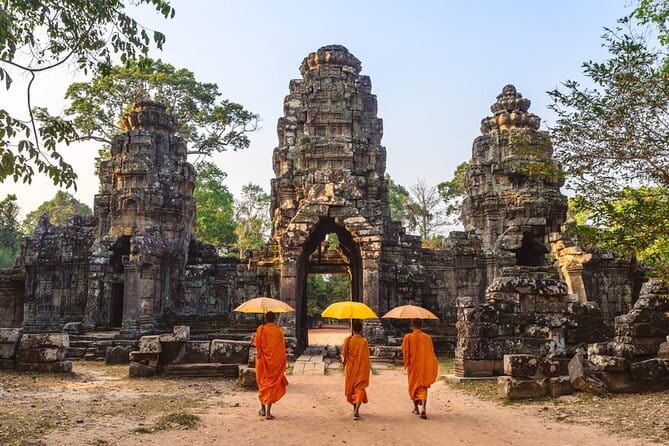
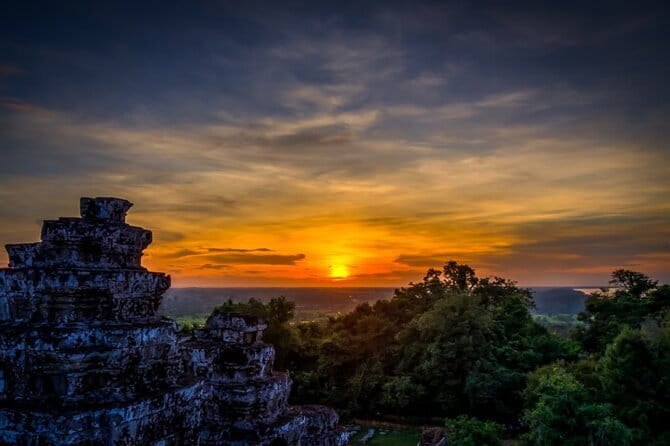
The final stop is Phnom Bakheng, a 9th-century temple mountain dedicated to Shiva. The climb is short but steep, and the summit provides wide views toward Angkor Wat and the surrounding temples.
Sunset is the busiest part of the visit. The tour information notes that the hill can become crowded, so do not expect a private viewpoint. The appeal is the broad view and the sense of seeing the temple zone from above, not a quiet final moment.
After sunset, you return to Siem Reap by car or minivan and receive hotel drop-off. The one-hour allocation includes the sunset visit, so the exact amount of time at the top may depend on the day’s conditions and crowding.
What the $199 price really covers
At $199 per person, the tour is not an all-inclusive two-day package. Once you add the $62 adult temple pass, the base cost becomes $261 per adult before food, drinks, accommodation, or insurance.
The value is strongest if you want a private guide and transport arranged for two full days. You receive hotel pickup and drop-off, an English-speaking licensed guide, a tuk-tuk on day one, an air-conditioned vehicle on day two, bottled water, and a Section B Phare Circus ticket.
Meals are separate. Food prices begin at about $5 per dish, depending on what you order. Accommodation is also excluded, including double, twin, or triple shared rooms.
Group discounts are offered, but the activity itself is private, meaning only your group participates. For a couple or small family, the price may be easier to justify because you avoid sharing the vehicle and can ask the guide to explain details that interest you.
The guide can shape the whole experience
The guide is not just there to point out temple names. The published praise for Mr P focuses on three useful qualities: historical explanation, energy, and kindness. He is also praised for helping with photography.
That last point matters at Angkor. Sunrise, stone faces, narrow galleries, and tree roots all create difficult lighting and crowded photo conditions. A guide who knows where to position you can save time and help you take better pictures without turning the whole day into a photo session.
You should still tell your guide what matters most to you. Ask for more history at Bayon or Preah Khan, more photo help at Angkor Wat, or a quicker pace at minor stops. With a private tour, speaking up is the best way to make the schedule work for you.
Who should book this tour
This tour suits you if you want the major Angkor temples covered in two days, prefer private transport, and like having a guide explain the religious and royal context. It also suits first-time visitors who want both famous sites and less visited places such as Ta Nei and Banteay Samre.
It is less suitable if you want leisurely mornings, long meals, or hours at one temple. The 04:30 start, many stops, and evening circus make day one especially full.
You need a moderate level of physical fitness. The temples involve walking, uneven surfaces, and at Phnom Bakheng a short, steep climb. The tour provides bottled water, but you should plan to carry what you need during the day.
The cancellation terms are forgiving: you can cancel at least 24 hours before the start for a full refund. Changes or cancellations made within 24 hours are not accepted for a refund.
Should you book the two-day Angkor plan?
Book it if you want a strong first look at Angkor with a private guide, a practical vehicle change between days, and a worthwhile cultural show at night. The combination of sunrise, Ta Prohm, Banteay Srei, Preah Khan, and sunset gives you a broad view of the temple zone.
Skip it if you are counting every dollar or prefer to set your own pace. The extra $62 temple pass and separate meals add up, and the itinerary can feel demanding.
For most first visits, I see the value in the structure. Just arrive ready for an early morning, budget for the excluded costs, and tell your guide which temples deserve your best energy.
FAQ
What is included in the $199 tour price?
The price includes hotel pickup and drop-off, an English-speaking licensed guide, day one transport by tuk-tuk, day two transport by air-conditioned car or minivan, bottled water, and a Section B ticket for Phare Cambodian Circus.
Is the Angkor temple pass included?
No. The temple pass costs $62 per adult. Children under 12 can enter free according to the tour details.
Is this a private tour?
Yes. Only your group participates in the activity.
What time does pickup begin on day one?
Pickup begins at 04:30 AM for the sunrise visit to Angkor Wat.
Is breakfast included?
No. You arrange breakfast at your hotel before beginning day two.
Are lunch and dinner included?
No. Lunch, dinner, drinks, and other food are separate. Food prices begin at about $5 per dish, depending on your order.
What transport is used?
Day one uses a tuk-tuk. Day two uses an air-conditioned car or minivan.
Which temples are visited?
The route includes Angkor Wat, Angkor Thom, the South Gate, Bayon, Baphuon, Phimeanakas, the Terrace of the Elephants, the Terrace of the Leper King, Ta Nei, Ta Prohm, Pre Rup, Banteay Srei, Banteay Samre, Neak Pean, Preah Khan, and Phnom Bakheng.
Is the Phare Cambodian Circus ticket included?
Yes. A Section B ticket is included, along with transfer back to your hotel after the performance.
Can the tour be canceled for a full refund?
Yes, if you cancel at least 24 hours before the experience start time. Cancellations or changes made less than 24 hours in advance are not refunded or accepted.
Newest reviews from Siem Reap
- War Museum, Killing Field, and APOPO Hero RATs Tour★ 5.0 · 7 reviews
- Angkor Wat at Sunrise★ 4.0 · 7 reviews
- Siem Reap Angkor Airport Taxis (from Airport to Hotel)★ 5.0 · 44 reviews
- Cambodian Cooking Class and Oxcart Ride with Local Village Tour★ 5.0 · 4 reviews
- Secret Temples of Angkor – Guided Tour in Siem Reap★ 5.0 · 6 reviews
- Short Cycling at Countryside★ 5.0 · 29 reviews
- SIEM REAP E-BIKE HALF-DAY COUNTRYSIDE (25-30 km)★ 4.0 · 1 review
- Unveiling the Mystical Beauty of Phnom Kulen National Park★ 5.0 · 6 reviews
Angkor Wat Tours, compared.
Angkor Wat Sunrise or Sunset Tour with Guide from Siem Reap
Read our review →
Angkor Wat: Small-Group Sunrise or Sunset Tour
Read our review →
Angkor Wat 2-Day Tour with Sunrise and Sunset
Read our review →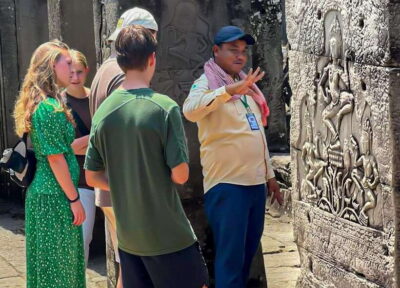
Angkor Wat Sunrise tour with Small – Group and Guide tours
Read our review →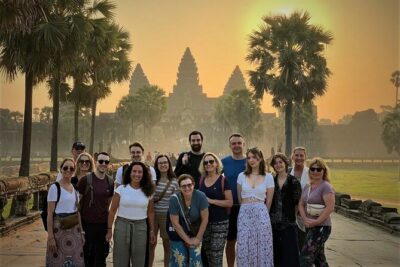
Angkor Wat Highlights and Sunrise Guided Tour from Siem Reap
Read our review →
Angkor Wat Sunset Small Group Tour with Lunch Included
Read our review →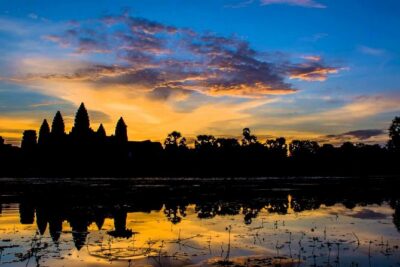
Full-Day Angkor Wat Sunrise Private Tour with Guide from Siem Reap
Read our review →Browse the lists this tour appears in