Reviewed · 1-DAY TOURS
Angkor Temples with Sunset 1-Day Tour
Angkor rewards an organized start. This one-day private tour gives you door-to-door transport, an English-speaking guide, and a clear route through Angkor Thom, Angkor Wat, and a sunset stop. I especially like the personal guide and the steady supply of cold water and towels in Cambodia’s heat. The main catch is the extra cost: the advertised $44.88 does not include the $37 temple pass or meals.
The route packs a lot into roughly eight hours, so you see the major monuments without arranging transport yourself. Guides including Young, Boy, Youk, and Phon Seyha have been praised for their friendly manner, good explanations, family photos, and willingness to adjust the day. Still, you will need to budget for the entrance ticket and accept a fairly full schedule.
In This Review
- Key points at a glance
- Why this Angkor day works well
- South Gate and the great city of Angkor Thom
- Baphuon and Bayon, two very different temples
- Angkor Wat deserves the afternoon
- Choosing between Phnom Bakheng and Pre Rup at sunset
- What the guides add to the experience
- Price, comfort, and what you still pay
- Who should book this Angkor tour?
- FAQ
- What is included in the tour price?
- Is the Angkor temple entrance ticket included?
- What time does the tour start?
- How long does the experience last?
- Are meals included?
- What should I wear to the temples?
- Can I cancel for a full refund?
- Should you book it?
Key points at a glance
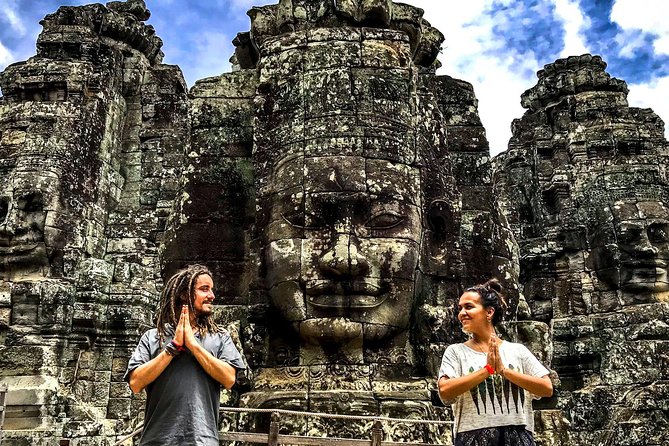
- South Gate begins the day: You enter Angkor Thom through its dramatic bridge and carved stone guardians.
- Bayon is the visual high point: Hundreds of serene stone faces make this temple different from Angkor Wat.
- A private guide adds real value: Young, Boy, Youk, and Phon Seyha have been praised for clear explanations and a warm, helpful approach.
- Angkor Wat gets the afternoon: The famous temple receives a longer visit after the morning at Angkor Thom.
- Sunset depends on the day’s choice: The final stop is Phnom Bakheng or Pre Rup, with photo advice for less crowded views.
- The real price is $81.88 before food: That combines the $44.88 tour charge with the required $37 single-day temple ticket.
Why this Angkor day works well
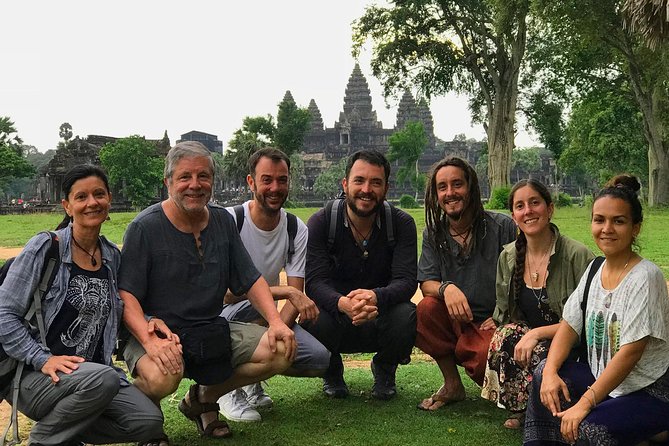
Angkor is not a compact museum complex. Its temples are spread across a large area, and public transport is not available for this sightseeing route. That makes the private car or air-conditioned van more than a convenience. It gives you a fixed vehicle, a driver, and a guide who can move you from one major site to the next without haggling over rides.
You begin at 8:00 am, which is a sensible compromise. You avoid the very earliest start associated with sunrise outings, yet you still have most of the day for the monuments. The tour lasts about eight hours, so you should expect a full morning and afternoon rather than a slow, wandering visit.
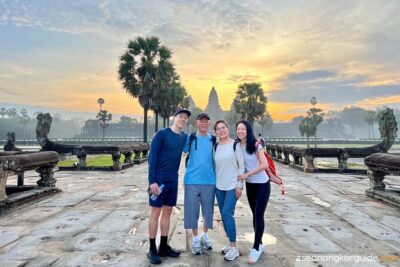
The private format matters. Only your own group participates, so you can ask questions about Cambodia, Khmer rulers, temple design, or daily life without competing with a large crowd. The guides have also helped with family photographs, a small service that can save you from relying on a stranger or trying to fit everyone into one frame.
The supplied vehicle has air conditioning, and the tour provides cool water and cold towels. Those details sound modest before you arrive, but they matter once you have spent hours walking over stone in hot, humid weather. You will still need sun protection and sensible clothing, but the vehicle gives you a place to cool down between sites.
A few more options around Siem Reap worth reading up on
- Angkor Wat Sunrise or Sunset Tour with Guide from Siem Reap
★ 5.0 · 12,109 reviews - Siem Reap: Angkor Wat: Small-Group Sunrise or Sunset Tour
★ 5.0 · 9,444 reviews - From Siem Reap: Kampong Phluk Floating Village Tour by Boat
★ 4.9 · 6,979 reviews
South Gate and the great city of Angkor Thom
The morning opens at the South Gate of Angkor Thom. This entrance gives you an immediate sense of the city’s scale, with a monumental approach and carved figures lining the route. It is a strong first stop because you begin with the setting of the city before moving into its individual temples.
Inside Angkor Thom, the route brings you to the Terrace of the Elephants. Its long platform is known for elephant carvings, and the terrace once formed part of the ceremonial center. Your guide can help you read the carvings as more than decoration and explain how the terrace related to the royal city.
Next comes the Terrace of the Leper King, another carved platform in the central area. The name can be confusing, and this is exactly the kind of place where a guide earns the fee. Without context, you may see a wall of figures and move on. With an explanation, the sculpture and its place within Angkor Thom become easier to understand.
The tour also takes you along the enclosure wall of the Royal Palace and gives you a view of Phimeanakas, a tenth-century temple. Phimeanakas is less immediately famous than Bayon or Angkor Wat, but it helps fill in the picture of the royal center. You see that Angkor Thom was not simply a collection of temples. It was a planned capital with ceremonial spaces, royal compounds, and routes connecting them.
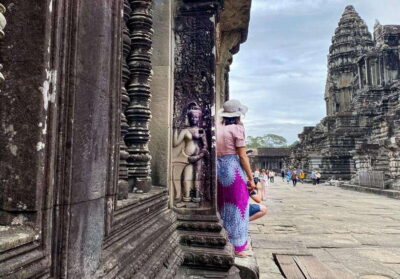
One practical point: this section involves walking and uneven temple surfaces. The program moves at a sightseeing pace, but you should wear footwear that you can manage on stone steps and paths. The dress rule is strict. Shorts and shirts must cover the knees and shoulders, while tank tops, scarves, and shawls are not accepted for temple visits. Light cotton clothing is a good choice in the heat.
Baphuon and Bayon, two very different temples
After the terraces and royal enclosure, you visit Prasat Baphuon. Its large pyramid shape gives it a different character from the long galleries of Angkor Wat. The structure rises in tiers, so you get a clear example of the temple-mountain idea that appears across Khmer architecture.
Baphuon is also a useful stop before Bayon because the two sites create a contrast. Baphuon emphasizes height and geometric form. Bayon is more intimate and visually surprising, with carved faces appearing among the towers.
Bayon is scheduled before the lunch break. The temple is famous for its hundreds of smiling stone faces, and the guide takes you around the first level while explaining Bayon and Angkor Thom’s place in Khmer history. Look up as you walk. The faces can appear from several directions, and the changing angles make this more than a single photo stop.
I would give Bayon time rather than rushing through it. The carvings are easy to photograph, but the explanations are just as useful. This is where a private guide can point out details you might otherwise miss and answer the questions that come naturally once you start looking closely.
Lunch is not included, so plan to pay separately. The published itinerary refers to a lunch stop, but it does not name a restaurant or include a meal in the tour price. Bring some flexibility into the midday schedule, since food, personal spending, and the length of the break can affect how much time you have later.
Angkor Wat deserves the afternoon
The afternoon is reserved for Angkor Wat, Cambodia’s best-known temple. Saving it for later lets you see the smaller Angkor Thom sites first, then approach the main attraction with some context about Khmer religious architecture and royal power.
Angkor Wat rewards patience. The scale can be overwhelming at first, so let your guide establish the basic plan before you start photographing everything. Ask about the galleries, towers, carvings, and the temple’s original purpose. The guide is there to turn a grand view into a story you can follow.
The tour description promises advice on photo spots, including places where you may find fewer people. That is useful at Angkor Wat, where the most obvious viewpoints can become crowded. Your guide may also help with family or group pictures. Phon Seyha was specifically praised for taking many photographs for a family of four, while Young was credited with helping create a large collection of memorable images.
Expect plenty of walking here. The entrance ticket is not included, and you must buy the required one-day temple pass for $37 per person. This is a significant addition to a tour advertised at $44.88, so calculate the full cost before booking rather than treating the headline price as the entire day’s expense.
Something completely different for another day:
- Sunset tour of Kampong Phluk stilts home village on the Tonle Sap
★ 5.0 · 4,865 reviews - Siem Reap: Angkor Wat 2-Day Tour with Sunrise and Sunset
★ 4.9 · 4,429 reviews - Siem Reap: Kampong Phluk Floating Village Tour with Boat
★ 4.9 · 3,843 reviews - Siem Reap: Full-Day Angkor Wat Guided Tour with Sunset
★ 4.9 · 3,803 reviews
Choosing between Phnom Bakheng and Pre Rup at sunset
The final stop is Phnom Bakheng or Pre Rup, depending on the day’s arrangements. Both give the tour a closing viewpoint, but they are not interchangeable in feel.
Phnom Bakheng is associated with sunset visits and elevated views. It can be a popular choice, so the guide’s advice about timing and less crowded photo positions may be particularly helpful. The information provided does not guarantee which site you will visit, the exact sunset time, or a place at a specific viewing point. Ask your guide early in the day so you know what to expect.
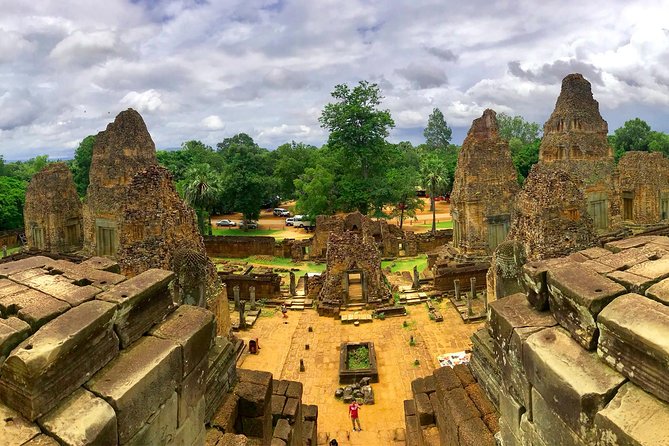
Pre Rup offers a different type of ending, centered on its temple structure and warm late-day light. If the final choice changes because of conditions or crowd levels, that does not necessarily weaken the day. You still finish at a major Angkor monument with time to see the stone change color as daylight fades.
The sunset stop also makes the schedule feel complete. You begin with the city gate and royal center, spend the afternoon at Angkor Wat, then finish above or among the temple ruins. Just remember that a sunset stop can extend the day close to evening, and the itinerary remains fairly packed from start to finish.
What the guides add to the experience
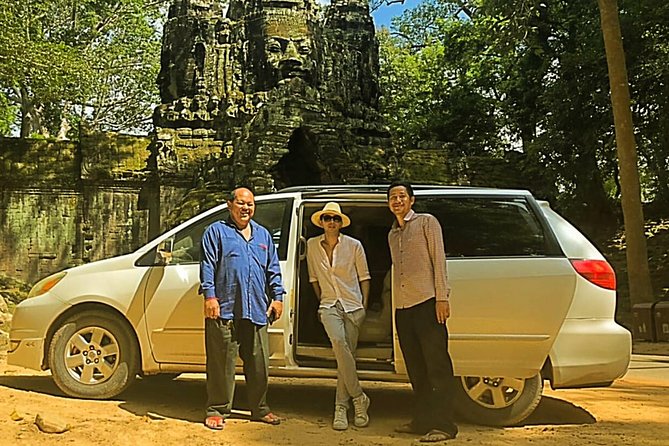
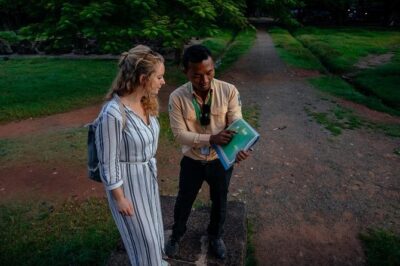
The strongest part of this tour is the human element. Boy has been praised for explaining Cambodia, its people, and the temples with enthusiasm. Youk was described as informative, open to questions, and helpful with photographs. Phon Seyha was cheerful and attentive, while Young was praised for humor, energy, and shaping the day around the group’s wishes.
Those details matter because Angkor can otherwise become a procession of names and stones. A good guide gives you a way to connect the South Gate, royal terraces, Baphuon, Bayon, and Angkor Wat. You also have someone to ask about Cambodia beyond the monuments, including local life and the country’s past.
The private setup gives you the best chance of using that service well. Tell the guide if you want more time for photographs, more historical explanation, or a quicker pace. The tour is planned, but the praised guides appear willing to make the experience feel personal rather than mechanical.
I would not book this expecting a silent, self-guided day. You are paying partly for interpretation and local help. If you prefer to move entirely on your own, the fixed route and guide may feel limiting. If you want the major temples explained and connected, this format makes sense.
Price, comfort, and what you still pay
The tour costs $44.88 per person. Add the required $37 single-day temple ticket, and the known total becomes $81.88 per person before lunch, drinks beyond the supplied water, and personal expenses.
That price is reasonable if you value private transport and a dedicated guide. You are not simply paying for a ride. The fee covers an English-speaking guide, an air-conditioned car or van, round-trip transfers, cold water, and cold towels. Since Angkor has no public transport for this sightseeing plan, arranging those pieces independently may take more effort.
The value is stronger for a small group that can share the private vehicle and guide. Group discounts are offered, though the available information does not state the discount amount. Ask for the exact group price before booking.
The value is weaker if you mainly want a vehicle and quick photo stops. The temple ticket almost matches the tour fee, and meals remain separate. Budget honestly, then decide if the explanations, comfort, and door-to-door service justify the combined cost.
Confirmation is provided when you book, and pickup is offered for the 8:00 am start. Since a specific pickup address is not given here, confirm your hotel or meeting details in advance. Free cancellation is available up to 24 hours before the start time. Cancellations or changes made inside that window are not refunded or accepted.
Who should book this Angkor tour?
I would recommend this experience to first-time visitors who want to see the principal Angkor sites in one day without arranging a driver. It also suits families and small groups, especially if photographs and a private pace matter to you.
History fans should appreciate the progression from Angkor Thom’s civic and royal center to Bayon’s faces, Baphuon’s pyramid form, and Angkor Wat’s grand galleries. The guide can give those monuments a clear connection instead of leaving you with a stack of separate impressions.
You should think twice if you want long, unhurried visits at every temple. Eight hours is enough for a strong first look, but the route includes several major stops. Add the temple ticket, meals, and hot-weather walking, and this is an active day.
FAQ
What is included in the tour price?
The tour includes an English-speaking guide, transport by air-conditioned car or van, cool water, and cold towels during the temple visit.
Is the Angkor temple entrance ticket included?
No. The required single-day temple ticket costs $37 per person and must be paid separately.
What time does the tour start?
The tour starts at 8:00 am.
How long does the experience last?
The day tour lasts approximately eight hours.
Are meals included?
No. Breakfast, lunch, dinner, and personal expenses are not included.
What should I wear to the temples?
Wear clothing that covers your knees and shoulders. Tank tops, scarves, and shawls are not allowed. Light cotton clothing is suggested because the weather is hot and humid.
Can I cancel for a full refund?
Yes. You can cancel at least 24 hours before the local start time for a full refund. Cancellations or changes made less than 24 hours before the start time are not accepted for a refund.
Should you book it?
Book this tour if you want the major Angkor temples in one well-supported day, with private transport and a guide who can explain what you are seeing. The strongest reasons are the personal service, photo help, air conditioning, and the guide team’s friendly approach.
Skip it if you want to avoid extra costs or prefer to explore at your own pace. Once you add the $37 temple ticket and meals, this is not a budget-only outing. For a first visit to Siem Reap, though, the combination of Angkor Thom, Bayon, Angkor Wat, and sunset makes the day a practical and rewarding introduction.
Newest reviews from Siem Reap
- War Museum, Killing Field, and APOPO Hero RATs Tour★ 5.0 · 7 reviews
- Angkor Wat at Sunrise★ 4.0 · 7 reviews
- Siem Reap Angkor Airport Taxis (from Airport to Hotel)★ 5.0 · 44 reviews
- Cambodian Cooking Class and Oxcart Ride with Local Village Tour★ 5.0 · 4 reviews
- Secret Temples of Angkor – Guided Tour in Siem Reap★ 5.0 · 6 reviews
- Short Cycling at Countryside★ 5.0 · 29 reviews
- SIEM REAP E-BIKE HALF-DAY COUNTRYSIDE (25-30 km)★ 4.0 · 1 review
- Unveiling the Mystical Beauty of Phnom Kulen National Park★ 5.0 · 6 reviews
1-Day Tours, compared.
1-Day Amazing Angkor Wat Tour with Sunset & All Interesting Major Temples
Read our review →
Angkor Wat one Day Private Tour for All Highlight Angkor Temples
Read our review →
1-Day private Angkor Temple Tour from Siem Reap
Read our review →
1-Day Angkor Wat Sunrise & All Interesting Temples Private Tour
Read our review →
Angkor Wat Sunrise Small-Group 1-Day Tour from Siem Reap
Read our review →