Reviewed · TOURS
Angkor Grand Circuit Temples Tour
Temples beyond Angkor Wat reward curious visitors. This private 7 to 8 hour outing takes you around the less-famous eastern and northern temples near Angkor Thom, with an English-speaking guide, air-conditioned transport, hotel pickup, and cold water included. I like the private vehicle and guide, which let your group move at a sensible pace, and I like the chance to see quiet places such as Banteay Prei and Ta Som.
The main drawback is the cost of admission. The advertised $52 price does not include the $37 one-day Angkor Pass, food, or drinks, bringing the basic adult total to $89 before lunch. The itinerary is also full, so you should expect a long temple day rather than a relaxed morning with plenty of downtime.
In This Review
- Key Points Before You Book
- What This Grand Circuit Day Is Really About
- Preah Khan: A Strong Two-Hour Opening
- Banteay Prei: A Quiet Break From the Main Route
- Neak Pean: A Water Temple With A Different Shape
- Ta Som: Small Scale, Strong Atmosphere
- Eastern Mebon: A Temple Built For A Wider Setting
- Banteay Samre: A More Complete Temple Experience
- Pre Rup: A High Point Near The End
- Srah Srang: A Calm Final Stop
- Guide Quality And The Value Of A Private Vehicle
- Cost, Admission, And What You Need To Bring
- Who Should Book This Tour?
- Should You Book The Angkor Grand Circuit?
- FAQ
- How much does the Angkor Grand Circuit Temples Tour cost?
- How long does the tour last?
- What time does the tour start?
- Is hotel pickup and drop-off included?
- Is this a private tour?
- Which temples and sites are visited?
- What is included in the tour price?
- What clothing is required?
Key Points Before You Book
- Private touring keeps the day flexible: Only your group takes part, with an English-speaking guide and a private car, minivan, or minibus.
- Eight temple and lake stops fill the day: Preah Khan, Banteay Prei, Neak Pean, Ta Som, Eastern Mebon, Banteay Samre, Pre Rup, and Srah Srang are included.
- The smaller sites can be the highlight: Banteay Prei and Ta Som may offer a quieter experience than the famous central temples.
- Guides are a major strength: Bunpheng is praised for finding good photo spots, while Pal Chen is praised for clear English, strong temple knowledge, and experience.
- You start at 8 a.m.: Hotel pickup follows breakfast, then the group goes to the ticket office before reaching the first temple.
- Dress rules are strict: Your shoulders and knees must be covered for temple access.
What This Grand Circuit Day Is Really About
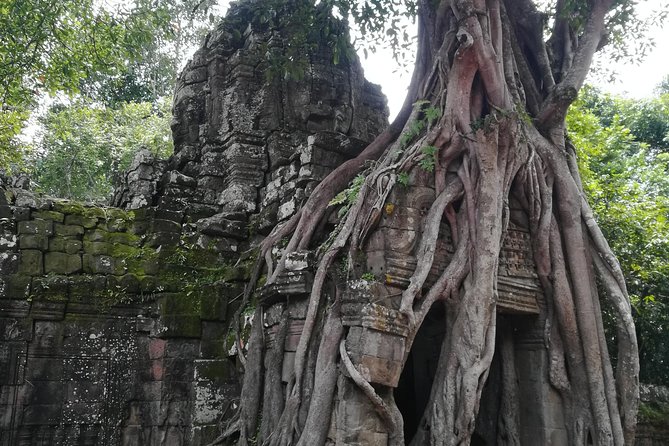
The Grand Circuit gives you a different side of Angkor. Instead of concentrating only on Angkor Wat and the main Angkor Thom sights, the route spreads east and north across a string of temples built for different purposes and rulers.
That variety matters. You move from a large former royal complex to a small, quiet sanctuary, then to a water temple, a jungle-framed ruin, a mountain-like pyramid, and a lakeside terrace. The sites do not all offer the same visual drama, but together they show how broad the Angkor complex is.
I especially like the private format for this route. Eight stops can feel rushed in a large group, particularly when everyone wants time for photographs. With only your party in the vehicle, you can ask questions, hear explanations at your own pace, and spend more time at a place that catches your eye.
The tour begins at 8 a.m. from your Siem Reap hotel. You will first visit the ticket office to obtain your Angkor Pass. Since admission is not included, plan for the extra $37 per person. The tour price covers transport, the guide, and bottled water, but not lunch or other drinks.
A few more options around Siem Reap worth reading up on
- Angkor Wat Sunrise or Sunset Tour with Guide from Siem Reap
★ 5.0 · 12,109 reviews - Siem Reap: Angkor Wat: Small-Group Sunrise or Sunset Tour
★ 5.0 · 9,444 reviews - From Siem Reap: Kampong Phluk Floating Village Tour by Boat
★ 4.9 · 6,979 reviews
Preah Khan: A Strong Two-Hour Opening
Preah Khan receives the longest planned visit, about two hours, and that makes sense. It is a large temple complex with enough courtyards, passageways, carvings, and partially restored sections to reward a careful walk.
The setting gives you a strong introduction to the Grand Circuit. You will see stone architecture mixed with trees and open sections, rather than one perfectly restored monument. That roughness is part of the appeal. The site feels like a place to explore, not simply a building to photograph from one angle.
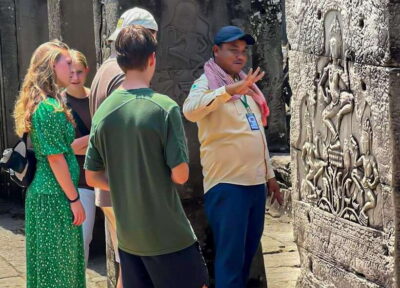
A good guide can make a big difference here. Bunpheng is particularly praised for knowing the routes to useful photo stops and for pointing out details that are easy to miss. That kind of local direction matters at a large temple, where it is easy to spend your energy wandering without understanding what you are seeing.
Allowing two hours also makes Preah Khan less of a quick photo stop. Still, the full itinerary means you should keep moving. If you prefer to study every carving at length, this schedule may feel tight.
Banteay Prei: A Quiet Break From the Main Route
The visit to Banteay Prei lasts about 30 minutes. It is a short stop, but it may become one of the most memorable because it can feel remarkably quiet. The tour description notes that there are often no other tourists there, though conditions can change on any day.
That possibility gives the stop real value. After a large site such as Preah Khan, a smaller temple with fewer people can reset the pace. You get a chance to look around without the constant movement found at the best-known Angkor monuments.
Do not expect a long guided visit here. Thirty minutes is enough for an introduction, photographs, and a quick look at the structure. If you want extensive historical explanation at every stop, you may wish this portion were longer.
Neak Pean: A Water Temple With A Different Shape
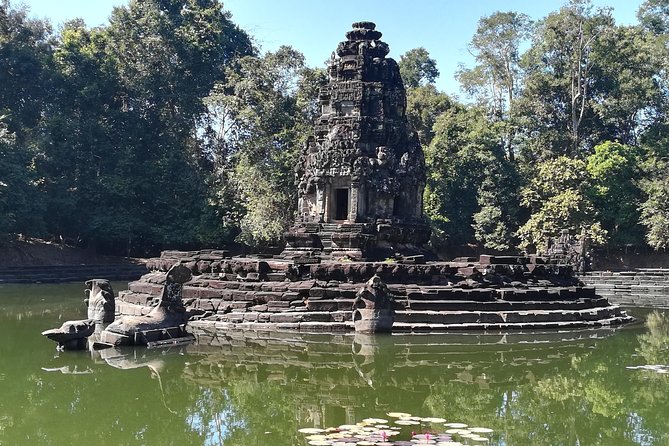
Neak Pean receives about an hour. Its design sets it apart from the other temples on this route, making it an important change of pace.
Rather than feeling like a conventional enclosed temple, Neak Pean is associated with water and a central structure. The approach and surrounding pools give the site a more open feel. That contrast is useful after the corridors and courtyards of Preah Khan.
Your guide can explain how the water features fit into the temple’s purpose and design. The value here is not only the photograph. Neak Pean helps you see that Angkor was planned around more than towers and carved walls.
Conditions around water features can affect how much you see, so keep your expectations practical. This is a one-hour stop, not a half-day visit, and the appeal comes from the unusual layout rather than sheer size.
Something completely different for another day:
- Sunset tour of Kampong Phluk stilts home village on the Tonle Sap
★ 5.0 · 4,865 reviews - Siem Reap: Angkor Wat 2-Day Tour with Sunrise and Sunset
★ 4.9 · 4,429 reviews - Siem Reap: Kampong Phluk Floating Village Tour with Boat
★ 4.9 · 3,843 reviews - Siem Reap: Full-Day Angkor Wat Guided Tour with Sunset
★ 4.9 · 3,803 reviews
Ta Som: Small Scale, Strong Atmosphere
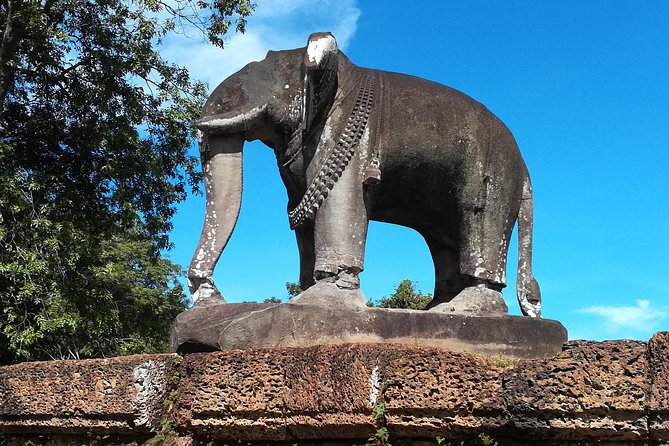
Ta Som is scheduled for another hour. It is a compact temple, but compact does not mean dull. Its smaller scale makes it easier to take in as a complete site, especially after a large complex.
Ta Som is also one of the places where the balance between stone and trees can create striking photographs. Your guide may help you find the best angles, a service singled out in the strongest comments about Bunpheng and Pal Chen.
I like this stop because it gives you room to slow down without losing the day. You can look at the carved details, notice how vegetation has taken hold, and ask questions without the sheer size of the site getting in the way.
The tradeoff is that the one-hour allocation may feel generous for some people and short for others. If you are mainly interested in large monuments, Ta Som could feel modest. If you enjoy texture, atmosphere, and smaller ruins, it may be a favorite.
Eastern Mebon: A Temple Built For A Wider Setting
The route then continues to Eastern Mebon for about an hour. This is another chance to see a temple whose original setting is important to its design.
Eastern Mebon was built with a strong connection to water and the wider Angkor system. Today, the surrounding setting is different from the original one, but the elevated temple form and decorative details still make the visit worthwhile.
The site gives your guide a useful chance to explain how Angkor’s temples related to reservoirs, canals, kingship, and religious life. You will get more from Eastern Mebon if you listen for those connections instead of treating it as another stop for a quick photograph.
By this point, you may also begin to feel the length of the day. The repeated steps, heat, and movement from one site to another can wear you down. The air-conditioned vehicle and bottled water are practical inclusions, but you should still pace yourself.
Banteay Samre: A More Complete Temple Experience
Banteay Samre also receives about an hour. Its design has a more enclosed, fortress-like quality than some of the smaller open ruins, and the site can feel more complete as a temple compound.
This stop adds variety to the route. You are not simply seeing the same style eight times. The changing shapes, layouts, and levels of preservation help show the range of construction across the Angkor period.
A guide with strong English makes this part of the day more useful. Pal Chen is praised for clear English, long experience, and the ability to explain the temples while also helping with photographs. Those are valuable skills on a private tour, since you can ask for more detail when a site interests you.
An hour is enough for a solid visit, but the schedule leaves little room for unexpected delays. If you stop for a long lunch or spend extra time at Preah Khan, later stops may need to be shorter.
Pre Rup: A High Point Near The End
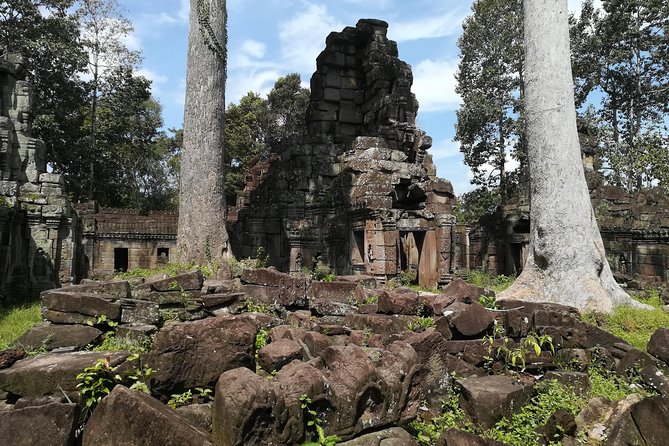
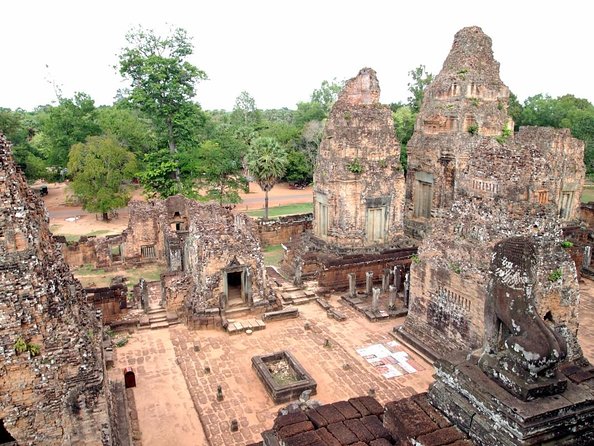
Pre Rup is the next one-hour stop. Its raised, pyramid-like structure gives you a change in scale and viewpoint. You climb through the temple levels and see how the design creates a sense of ascent.
This is a good place to notice the construction itself. The broad stone terraces, upper levels, and strong geometric lines make Pre Rup feel different from the lower, more enclosed temples earlier in the day.
Because it comes late, your energy level will shape the experience. You may appreciate the elevated structure and open views, or you may be ready for a seat and a cold drink. The tour includes water, but not food or additional drinks, so bring or buy what you need before the day gets too far along.
The route does not promise a special sunset visit. Pre Rup is included as a daytime stop, so book this tour for the temple and its views, not for a particular evening light effect.
Srah Srang: A Calm Final Stop
The final stop is Srah Srang, planned for about 20 minutes. This is a short pause at a sandstone terrace decorated with Naga and Shimha statues, with a view across the water.
Ending beside the reservoir is a sensible choice. After a day of climbing and walking, you can slow down, take photographs, and enjoy a quieter setting before returning to Siem Reap.
Twenty minutes is not long, but it is enough for a final look and a breather. I would not treat this as a full lakeside outing. It functions more as a graceful closing stop than as one of the main temple visits.
Guide Quality And The Value Of A Private Vehicle
The best reason to choose this tour over a basic shared transfer is the guide. Bunpheng receives especially strong praise for arriving on time, knowing the temple routes, finding good photo positions, and pointing out site-specific details. Pal Chen is also praised for excellent English, broad experience, and helpful photography.
Those details tell you what to look for from the service. A good guide here should do more than name the temples. You want someone who can explain why the sites differ, direct you through the most useful paths, and adjust the visit to your group’s interests.
The private vehicle adds comfort and control. Transport is provided in an air-conditioned car, minivan, or minibus, depending on the group. Hotel pickup and drop-off remove the need to arrange separate transport, and only your group participates.
The private setup does not turn a busy itinerary into a slow one. You still have eight stops and a start time of 8 a.m. The benefit is better coordination, not unlimited time.
Cost, Admission, And What You Need To Bring
The tour costs $52 per person. The Angkor Pass costs another $37, so the basic combined cost is $89 per person. Food and drinks are extra, while accommodation is not part of the service.
For a private full-day outing with a guide, transport, hotel pickup, and water, that price can be fair, especially if you are traveling with companions who can share the value of the private vehicle. For a solo visitor, the total is harder to justify unless you place a high value on personal attention and a set route.
Bring comfortable clothing that covers your shoulders and knees. This is not just a suggestion: uncovered shoulders or knees can prevent temple access. Carry enough water beyond the complimentary bottles if you know you drink often, and plan for your own meal since food is not included.
The tour is generally suitable for most people, but the information does not promise special accessibility arrangements. The itinerary includes several temple visits, walking, and likely steps, so consider your own comfort before booking.
Who Should Book This Tour?
I would choose this tour if you have already planned a separate visit to Angkor Wat or the central Angkor Thom sights and want to see more of the complex. It works especially well for first-time visitors who want historical context without arranging transport and routes themselves.
It also suits photographers and small private groups. The guides’ reported skill at finding photo spots, combined with visits to quieter sites, gives you more than a simple checklist of famous names.
You may want a different plan if you prefer a slow visit to two or three temples. This route covers eight stops, and the advertised seven to eight hours leave limited space for lingering. It is also less suitable if you want food, drinks, or admission bundled into one price.
The tour is commonly booked well ahead, with an average booking lead time of 72 days. That does not guarantee availability, but it is a useful sign to plan early during a busy Siem Reap visit.
Should You Book The Angkor Grand Circuit?
Book it if you want a private, well-organized day that reaches beyond Angkor Wat, especially if guide quality and quiet temple stops matter to you. The strongest value comes from the combination of a personal guide, air-conditioned transport, and a varied route that includes both major and lesser-known sites.
Skip it if the extra $37 admission fee pushes the cost too high, or if eight stops sound tiring. For many visitors, though, this is a practical way to see the wider Angkor area without spending the day working out roads, temple order, and transport on your own.
FAQ
How much does the Angkor Grand Circuit Temples Tour cost?
The tour costs $52 per person. The one-day Angkor Pass is not included and costs $37 per person, making the basic combined total $89 per person before food and drinks.
How long does the tour last?
The experience lasts approximately 7 to 8 hours.
What time does the tour start?
Hotel pickup starts at 8:00 a.m., after breakfast.
Is hotel pickup and drop-off included?
Yes. Pickup and drop-off from your Siem Reap hotel are included.
Is this a private tour?
Yes. Only your group participates, with a private guide and vehicle.
Which temples and sites are visited?
The route includes Preah Khan, Banteay Prei, Neak Pean, Ta Som, Eastern Mebon, Banteay Samre, Pre Rup, and Srah Srang.
What is included in the tour price?
The price includes an English-speaking guide, air-conditioned transportation by car, minivan, or minibus, and bottles of cold drinking water.
What clothing is required?
You must wear clothing that covers your shoulders and knees. Temple access may be refused if those areas are uncovered.
Newest reviews from Siem Reap
- Village walking & Cooking class in Siem Reap★ 5.0 · 2 reviews
- Ultimate Sunrise to Angkor Wat, Angkor Thom and Bayon Temple★ 5.0 · 3 reviews
- Angkor Wat Sunrise Shared Tours: Bayon, Ta Prohm And Kravan★ 5.0 · 1 review
- Twilight Tastes of Siem Reap Include Dinner★ 5.0 · 13 reviews
- Two Days Tour Angkor Complex; Banteay Srei, and Kulen Hill★ 5.0 · 1 review
- Trekking Tour at Phnom Kulen National Park from Siem Reap★ 5.0 · 3 reviews
- Trip to Big Circle included Banteay Srey and Banteay Samre★ 5.0 · 1 review
- Full-Day Private Tour of Angkor Wat with Pick Up★ 5.0 · 12 reviews
Tours, compared.
Angkor Wat Sunrise or Sunset Tour with Guide from Siem Reap
Read our review →
Angkor Wat: Small-Group Sunrise or Sunset Tour
Read our review →
Sunset tour of Kampong Phluk stilts home village on the Tonle Sap
Read our review →
Angkor Wat 2-Day Tour with Sunrise and Sunset
Read our review →
Kampong Phluk Floating Village Tour with Boat
Read our review →