Reviewed · 1-DAY TOURS
1-Day Angor Wat Small Circuit Tour with Sunset
Angkor in one long, memorable day. This private Siem Reap tour brings you to the park’s major highlights, from Angkor Wat and Ta Prohm to Bayon, Baphuon, and Phnom Bakheng. I like the air-conditioned transport and hotel pickup, and I like the mix of famous temples with a quieter stop at Ta Nei. The licensed English-speaking guide adds useful context, rather than leaving you to stare at stones and guess what happened there.
The main catch is simple: this is a full day, not a gentle temple sampler. The schedule runs about eight to nine hours, and the final climb to Phnom Bakheng can feel tough after a morning and afternoon on your feet. The $63 tour price also excludes the one-day temple pass, which costs $37 per person, plus meals.
In This Review
- Key points to know before you book
- What the $63 tour price really gets you
- Starting at Angkor Wat for the morning light
- Ta Prohm and the famous tree roots
- Ta Nei offers a quieter change of pace
- Angkor Thom begins at the Victory Gate
- Bayon’s stone faces demand your attention
- Baphuon shows another side of Khmer design
- The royal terraces add context to Angkor Thom
- Phnom Bakheng is a sunset reward, not an easy finish
- The guide can make or break this full day
- Transport, meals, and the pace of the day
- Who will enjoy this Angkor route most
- Booking details worth checking
- Should you book the Angkor small circuit tour?
- FAQ
- What is included in the Angkor Wat small circuit tour?
- How long does the tour last?
- What time does the tour start?
- Is the Angkor temple pass included?
- Are meals included?
- Is this a private tour?
- Which temples and sites are visited?
- Does the tour include sunset?
- Can I cancel for a full refund?
Key points to know before you book
- Private transport keeps the day flexible: Only your group takes part, with hotel pickup, hotel drop-off, a driver, and an air-conditioned vehicle.
- The route covers Angkor’s essential sights: You visit Angkor Wat, Ta Prohm, Ta Nei, Angkor Thom, Bayon, Baphuon, the royal terraces, and Phnom Bakheng.
- Ta Nei gives you a quieter temple break: This small, unrestored temple in the forest offers a different mood from the park’s famous monuments.
- Guides Sok and Mr. Lucky earn strong praise: Both are described as fluent in English, well informed, punctual, friendly, and helpful with photography.
- The $63 price is not the full cost: Add $37 for the temple pass and budget separately for breakfast, lunch, and dinner.
- The sunset stop requires effort: Phnom Bakheng involves a hike up the mountain and a climb to the temple area, so sturdy shoes and energy matter.
What the $63 tour price really gets you
At first glance, $63 may seem like a reasonable way to see Angkor, but you need to add the required one-day temple pass. That pass costs $37 per person, bringing the basic admission and tour cost to $100 per person before food.
For that money, you receive a private tour rather than a large shared group. Your guide and driver collect you from your hotel or guest house at the stated 8:00 a.m. start time and return you there at the end. The vehicle is air-conditioned, and cool water and a cool wet towel are included. In hot Cambodia, those small comforts become useful long before the day is over.
The strongest value comes from having a guide for a route this packed. Angkor’s monuments are large, spread out, and filled with details that are easy to miss. A good guide can help you understand the carvings, the temple layouts, and the role of each monument within the old Khmer capital.
The private format also matters. You are not waiting for a bus full of strangers at every stop, and you may have more say in how long you spend taking photographs or looking around. The tour details do not promise unlimited flexibility, so I would still confirm the day’s timing with the operator. But the private arrangement is a real advantage for couples, families, and small groups with different walking speeds.
A few more options around Siem Reap worth reading up on
- Angkor Wat Sunrise or Sunset Tour with Guide from Siem Reap
★ 5.0 · 12,109 reviews - Siem Reap: Angkor Wat: Small-Group Sunrise or Sunset Tour
★ 5.0 · 9,444 reviews - From Siem Reap: Kampong Phluk Floating Village Tour by Boat
★ 4.9 · 6,979 reviews
Starting at Angkor Wat for the morning light
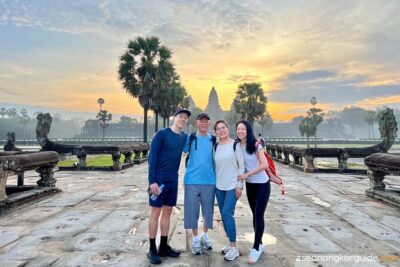
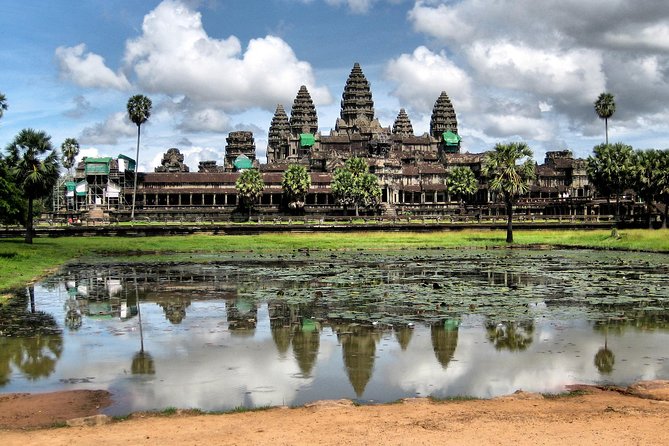
Angkor Wat is the natural first stop. It is the temple most people picture when they think of Cambodia, and the first visit gives you a sense of the scale of the whole park. The tour allows about two and a half hours here, enough time to see the main approach, explore the temple, and pause for photographs.
The schedule says the morning begins with pickup at 8:00 a.m. and also describes watching sunrise at Angkor Wat. Those times may not always match the actual sunrise, which changes through the year. If sunrise is important to you, confirm the exact pickup time before booking. Do not assume that an 8:00 a.m. pickup guarantees the first light.
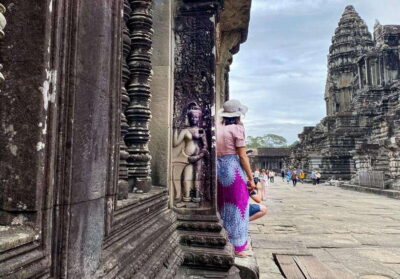
Even without a sunrise start, Angkor Wat deserves unhurried attention. Its long approach, towers, galleries, and stone reliefs reward a slow pace. You will likely spend much of the time walking between major areas, climbing steps, and listening to explanations from the guide.
The two and a half hour allocation is generous compared with a quick photo stop, but it also sets the tone for the day. This is not a tour where you rush through every temple in fifteen minutes. You get a proper opening visit, then move on before the heat and crowds make the site harder to enjoy.
Ta Prohm and the famous tree roots
Ta Prohm is the day’s most theatrical stop. Often called the Tomb Raider temple, it is known for huge tree roots spreading over walls and stone galleries. Nature and architecture meet here in a way that makes the temple instantly recognizable.
You have about an hour and a half at Ta Prohm. That gives you time to look beyond the most photographed roots. The guide can point out the structure of the temple and help explain what you are seeing, while you also get time to take your own photographs.
This is one of the best stops for people who want strong photographs without visiting only open courtyards and towers. The roots create shade, texture, and unusual angles. Still, the popular sections can be busy, and you should expect to share the best-known viewpoints with other people.
Ta Prohm also shows why a guide helps. It is easy to focus on the giant roots and miss the carvings and layout around them. I would ask your guide to balance photo time with the temple’s religious and architectural details.
Ta Nei offers a quieter change of pace
After the better-known temples, Ta Nei gives the day a welcome change in mood. This small temple is located in the forest and has not yet been restored. The tour allows about thirty minutes here.
Ta Nei is not included because it is grander than Angkor Wat or Bayon. It is included because it feels more restrained and quiet. You get a chance to look at an older structure without the same level of attention given to the park’s headline monuments.
The short visit is probably enough for the site, especially after the morning’s longer walks. It also helps break up the day before you enter Angkor Thom. If your main goal is to photograph the most famous monuments, Ta Nei may feel less essential. If you appreciate a quieter stop and a less polished setting, it could be one of the day’s more rewarding moments.
Something completely different for another day:
- Sunset tour of Kampong Phluk stilts home village on the Tonle Sap
★ 5.0 · 4,865 reviews - Siem Reap: Angkor Wat 2-Day Tour with Sunrise and Sunset
★ 4.9 · 4,429 reviews - Siem Reap: Kampong Phluk Floating Village Tour with Boat
★ 4.9 · 3,843 reviews - Siem Reap: Full-Day Angkor Wat Guided Tour with Sunset
★ 4.9 · 3,803 reviews
Angkor Thom begins at the Victory Gate
The next stop is the Victory Gate of Angkor Thom, with about fifteen minutes set aside for photographs. The tour description also refers to the South Gate in this section, so the exact gate used should be confirmed when you meet your guide. Either way, this is a brief introduction to the walled city of Angkor Thom.
Do not expect a full exploration here. Fifteen minutes is enough to stop, take photographs, and hear a short explanation before moving onward. The gate is useful as a transition point because it introduces the scale of Angkor Thom and prepares you for the central temples inside.
This short pause works well in a tightly planned day. The downside is that you will not have time to linger or study every carved figure. Think of it as a photo and orientation stop, not a major temple visit.
Bayon’s stone faces demand your attention
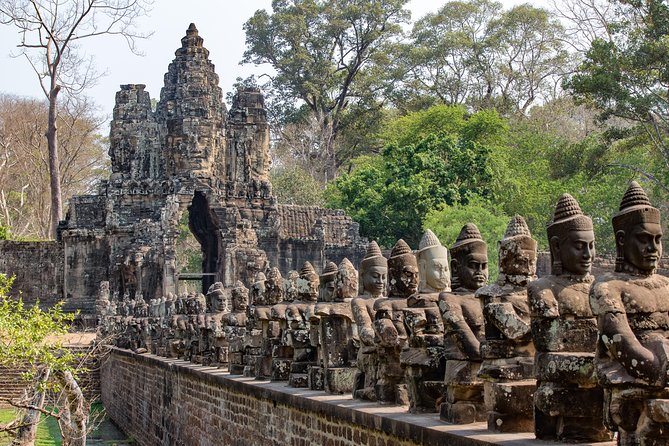
Bayon is one of the park’s most distinctive temples. Its towers carry the famous carved faces, described in the tour material as 216 faces looking out from the temple. From different corners, the faces seem to watch you as you move through the narrow passages.
The tour allows one hour here. That is enough for a meaningful visit, though you will need to keep moving if you want to see the major levels and take photographs. Bayon can feel confusing at first because the towers, galleries, and corridors overlap. This is where an English-speaking guide can make the visit much clearer.
The guides praised most highly are Sok and Mr. Lucky. Sok is described as experienced, fluent in English, and able to answer questions about the sites and Cambodian history. Mr. Lucky is praised for being punctual, friendly, considerate, and good at finding photo spots. He also takes photographs for guests and allows time according to their preferences.
Those details matter at Bayon. You may want a quick explanation and more time for pictures, while someone else in your group may want to hear about the carvings and temple design. A private guide who pays attention to your pace can make this stop feel less rushed.
Baphuon shows another side of Khmer design
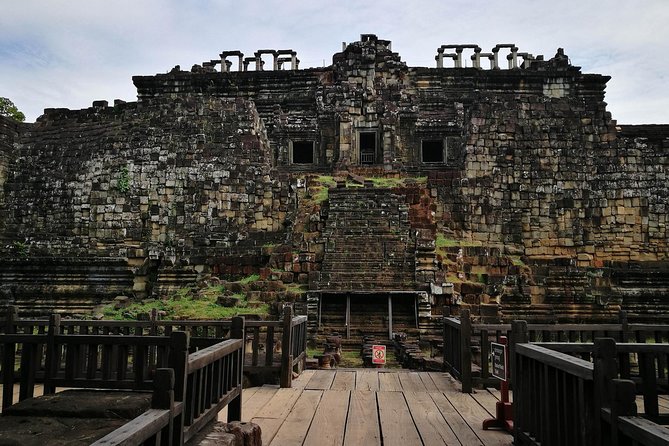
Baphuon sits near Bayon and gives you a different architectural experience. It is a pyramid-shaped Hindu temple built in the 11th century, before Angkor Wat. The tour provides about an hour here.
Compared with Bayon’s crowded face towers, Baphuon is about height, symmetry, and the climb through its layered form. The temple has been restored and is open for you to explore. Its position near the center of Angkor Thom makes it easy to combine with Bayon without adding a long transfer.
You should be ready for steps and uneven surfaces. The available information does not give specific accessibility details, but the overall itinerary involves temple walking, climbing, and a final mountain hike. If you have limited mobility, ask the operator what parts of Baphuon and the other sites you can comfortably reach.
An hour is a useful amount of time here. You can see the main structure without letting one temple consume the afternoon. Still, by this point, heat and tired legs may affect your pace.
The royal terraces add context to Angkor Thom
The Terrace of the Elephants and the Terrace of the Leper King receive about thirty minutes. These terraces formed part of the royal palace area and served as an elevated platform associated with King Jayavarman VII and the display of a victorious army.
This stop is less about entering a complete temple and more about understanding how Angkor Thom functioned as a royal center. The carved walls and long platforms help you picture ceremonies, public displays, and the power of the Khmer court.
Thirty minutes is enough for a walk along the terraces and an explanation from your guide. You will not get an extended palace visit, and the former royal palace itself is not presented as a fully preserved building that you can tour room by room. The value comes from the setting and the carved surfaces.
I like this part of the route because it prevents the day from becoming a parade of unrelated temples. The terraces connect the religious monuments to the old city’s political life.
Phnom Bakheng is a sunset reward, not an easy finish
The final major stop is Phnom Bakheng, where you hike up the mountain and continue to Bakheng Temple for sunset views. The schedule allows up to two hours, including the climb, time at the temple, and the descent.
This is the most physically demanding part of the day. One review gives a clear warning: the tour is long, and the climb at the end can be tiring. That is valuable advice. You may begin the day feeling fresh at Angkor Wat, but several hours of temple paths, steps, heat, and photographs can make the final ascent feel much harder.
The sunset setting is the reason to make the effort. From the high point, you get a broad view over the surrounding area as the light changes. The tour calls it the highest sunset view, but you should treat the climb itself as part of the attraction, not simply a quick walk to a lookout.
Wear shoes that you can walk in comfortably, bring water, and pace yourself. The tour includes cool water, but you should still arrive prepared for a long day outdoors. If you know that steep walking will be a problem, ask about the practical demands before you commit.
Sunset timing can also be affected by access and conditions at the temple. The information provided does not promise a particular sunset platform or guaranteed viewing position. Your guide can help you manage the timing, but no tour can control clouds or the exact crowd level.
The guide can make or break this full day
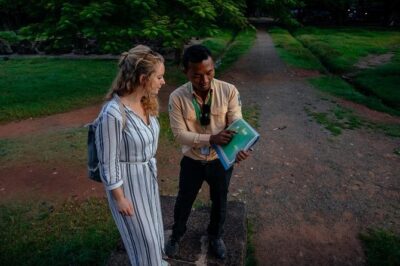
The strongest praise goes to the guides, especially Sok and Mr. Lucky. Sok is described as experienced, fluent in English, and able to answer questions. Mr. Lucky receives similar praise for his English, friendly manner, punctuality, photo help, and useful recommendations.
That combination is important at Angkor. You need someone who can explain what you are seeing, but also someone who watches the clock and understands that people want photographs, water breaks, and moments to look around quietly.
Mr. Lucky’s attention to photography is a practical benefit if you are traveling as a couple or small group. You may not need to rely on strangers to take pictures of everyone together. His willingness to give people the time they want at each stop is also well suited to a private tour.
Guide quality can vary by assignment, so I would request Sok or Mr. Lucky if one of them is available, without assuming a specific guide is guaranteed. The operator is Angkor Guide Services, and confirmation is provided at booking.
Transport, meals, and the pace of the day
Hotel pickup and drop-off simplify the day in Siem Reap. You do not need to arrange separate transport between the city and the archaeological park, and the air-conditioned vehicle gives you a place to cool down between stops.
The route is planned for eight to nine hours, though the listed stop times add up to roughly eight hours and forty-five minutes. That leaves little room for long meals or major delays. The schedule includes no meals, so breakfast, lunch, and dinner are your responsibility.
Lunch is especially important because the route continues into the afternoon and ends with a climb. The supplied information does not name a restaurant or state how much time is reserved for lunch. Ask your guide at the start of the day when and where you will eat, then plan your pace around it.
The vehicle includes cool water and a cool wet towel. Those items will not replace a meal or adequate personal water, but they are welcome after walking around exposed temple grounds.
Who will enjoy this Angkor route most
I would choose this tour if you have one full day in Siem Reap and want to cover the classic small circuit without arranging several separate rides. It suits first-time visitors who want Angkor Wat, Ta Prohm, Bayon, and Baphuon in one organized outing.
It is also a good match for small private groups that value their own vehicle and guide. Families may appreciate hotel pickup and a private schedule, though the long day and final climb may be tiring for young children. People who want a slow, quiet temple study should consider a longer itinerary with fewer stops.
Photography-minded visitors should pay attention to the guide assignment. Mr. Lucky’s help with finding photo locations and taking pictures could be a real plus. The route also gives you a mix of grand monuments, carved faces, forest ruins, royal terraces, and a sunset viewpoint.
I would hesitate if your priority is a relaxed pace. Eight to nine hours is a lot, and the itinerary includes several walking-heavy stops before the final climb. The tour is efficient, but efficiency is not the same as rest.
Booking details worth checking
The start time is listed as 8:00 a.m., with pickup from your hotel or guest house. Because the description also refers to sunrise at Angkor Wat, confirm the actual pickup hour if sunrise is a priority.
The temple pass is not included and costs $37 per person for one day. Accommodation and meals are also excluded. The experience is private, and group discounts are offered, though the exact discount is not specified.
Confirmation is provided when you book. Service animals are allowed, and the tour is described as suitable for most people. Free cancellation is available if you cancel at least 24 hours before the local start time. Cancellations or changes made within 24 hours are not refunded or accepted.
Should you book the Angkor small circuit tour?
Book it if you want Angkor’s major sights in one private day, with hotel transport, an English-speaking guide, and a sunset finish. The price becomes more reasonable when you value the private vehicle, guide support, and time saved arranging transport yourself.
Before booking, budget for the $37 temple pass and meals, confirm the sunrise and pickup timing, and be honest about your fitness for the Phnom Bakheng climb. I would especially try to request Sok or Mr. Lucky, whose clear English, site knowledge, punctuality, photo help, and friendly approach received the highest praise.
Skip it if you want a slow schedule or dislike structured sightseeing. Choose it if your time in Siem Reap is short and you want a well-packed introduction to Angkor, with the important warning that the sunset comes after a very full day.
FAQ
What is included in the Angkor Wat small circuit tour?
The tour includes a licensed English-speaking guide, hotel pickup and drop-off, an air-conditioned vehicle with driver, cool water, and a cool wet towel.
How long does the tour last?
The tour lasts approximately eight to nine hours.
What time does the tour start?
The listed start time is 8:00 a.m., with pickup from your hotel or guest house.
Is the Angkor temple pass included?
No. The one-day temple pass costs $37 per person and is not included in the tour price.
Are meals included?
No. Breakfast, lunch, and dinner are not included.
Is this a private tour?
Yes. Only your group takes part in the activity.
Which temples and sites are visited?
The route includes Angkor Wat, Ta Prohm, Ta Nei, the Victory Gate or Angkor Thom gate area, Bayon, Baphuon, the Terrace of the Elephants, the Terrace of the Leper King, and Phnom Bakheng.
Does the tour include sunset?
Yes. The final stop is Phnom Bakheng mountain, where you hike to Bakheng Temple to watch the sunset.
Can I cancel for a full refund?
Yes, if you cancel at least 24 hours before the experience start time. Cancellations or changes made less than 24 hours before the start are not accepted, and the amount paid is not refunded.
Newest reviews from Siem Reap
- War Museum, Killing Field, and APOPO Hero RATs Tour★ 5.0 · 7 reviews
- Angkor Wat at Sunrise★ 4.0 · 7 reviews
- Siem Reap Angkor Airport Taxis (from Airport to Hotel)★ 5.0 · 44 reviews
- Secret Temples of Angkor – Guided Tour in Siem Reap★ 5.0 · 6 reviews
- Short Cycling at Countryside★ 5.0 · 29 reviews
- Cambodian Cooking Class and Oxcart Ride with Local Village Tour★ 5.0 · 4 reviews
- SIEM REAP E-BIKE HALF-DAY COUNTRYSIDE (25-30 km)★ 4.0 · 1 review
- Unveiling the Mystical Beauty of Phnom Kulen National Park★ 5.0 · 6 reviews
1-Day Tours, compared.
1-Day Amazing Angkor Wat Tour with Sunset & All Interesting Major Temples
Read our review →
Angkor Wat one Day Private Tour for All Highlight Angkor Temples
Read our review →
1-Day private Angkor Temple Tour from Siem Reap
Read our review →
1-Day Angkor Wat Sunrise & All Interesting Temples Private Tour
Read our review →
Angkor Wat Sunrise Small-Group 1-Day Tour from Siem Reap
Read our review →